
Article Description: Considering Six Sigma training in Kenya? Discover the data-driven methodology that helped Motorola save $17 billion and GE exceed $1 billion in cost savings — and how the same approach applies to operations teams in Nairobi today.
Most Kenyan business leaders spend the majority of their energy watching competitors. A rival drops prices. A new entrant enters the market. A client switches suppliers. The assumption is that the threat is always external. In most cases, the more expensive problem is internal — a process that wastes materials nobody is tracking, a workflow step that adds three days to a delivery nobody has questioned, a customer complaint pattern that gets resolved individually every time instead of fixed permanently once. Six Sigma exists to find those problems with data rather than instinct, and to eliminate them in a way that holds.
What Six Sigma Actually Is
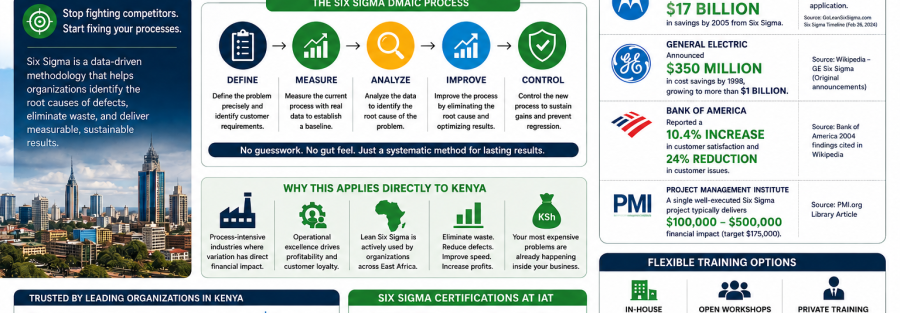
The methodology was developed by engineer Bill Smith at Motorola in 1986 as a response to a specific operational problem — product defect rates that were costing the company money it couldn’t fully account for. The solution was a structured, five-step process called DMAIC: Define the problem precisely, Measure the current process with real data, analyze that data to find the root cause, improve the process by eliminating the root cause and Control the new process to prevent regression. No guesswork. No gut feel. Just a systematic method for tracing a business problem back to its exact source and fixing it there, not downstream.
What the Evidence Actually Shows
By 2005, Motorola had documented more than $17 billion in savings from Six Sigma across the organization, according to Motorola’s own university materials cited in GoLeanSixSigma.com’s Six Sigma Timeline, published February 26, 2024. That figure accumulated over nineteen years of consistent application — not a single dramatic intervention, but hundreds of individual projects each targeting a specific measurable problem. General Electric adopted Six Sigma in 1995 under CEO Jack Welch and announced $350 million in cost savings by 1998, a figure that grew to more than $1 billion as the programme matured, according to Wikipedia’s documented record of GE’s original announcements. Bank of America applied Six Sigma to its customer service operations and reported a 10.4% increase in customer satisfaction alongside a 24% reduction in customer issues, according to Bank of America’s 2004 findings cited in Wikipedia.
The Project Management Institute, in a library article published on PMI.org, quantifies what a single well-executed Six Sigma project typically delivers — financial impact of between $100,000 and $500,000 per project, with a target of $175,000. For a Nairobi-based operations manager, that means a single Green Belt project, completed in three to six months by someone trained to run it, is expected to return multiples of the cost of the training itself.
Why This Applies Directly to Kenya
The industries driving Kenya’s economy — manufacturing, logistics, financial services, telecoms, and healthcare — are all process-intensive businesses where variation in quality or delivery has direct financial consequences. Seven Levers, a Nairobi-based management consulting firm, specifically supports East African organizations using operational excellence and Lean Six Sigma frameworks, which is itself evidence that the methodology has found a genuine home in the region’s business environment.
IAT’s own corporate training clients include WHO Kenya, Living Goods, and CMC Motors Group. Kennedy Mugo, Human Resource Business Partner at CMC Motors Group, stated in an undated testimonial published on IAT’s corporate training page that IAT’s delivery of Advanced Microsoft Excel and PowerPoint training to cross-functional teams exceeded expectations — a signal that structured, methodology-driven training produces measurable outcomes rather than just attendance certificates at this level of client.
The Two Certifications and What Each One Does
Six Sigma training operates across belt levels. The Green Belt, completed in three days through IAT’s corporate programme, trains professionals to support and contribute to improvement projects while maintaining their existing roles. The Black Belt, completed over five days, trains professionals to lead projects independently, manage cross-functional teams, and deliver the financial results the methodology is designed to produce. Both are available through IAT as in-house training delivered at your premises, through open workshops at IAT’s facilities, or privately for senior individuals with schedule constraints. Pricing is customized per organization — contact IAT directly for a tailored quote based on group size, format, and delivery location.
Your Business’s Most Expensive Problems Are Already Happening
The counterintuitive conclusion Six Sigma consistently produces is that the most expensive problems in any organization are not the visible crises — the failed project, the lost client, the system outage. They are the stable, accepted inefficiencies that nobody challenges because they have always been there. A defect rate that sits at 3% because that is what it has always been. A supplier lead time that adds two weeks to every cycle because nobody has mapped what actually happens in those two weeks. Six Sigma doesn’t find new problems. It finds the cost of the old ones — and that number is almost always larger than the leadership team expected.
Call +254 725 040 588 or email registrar@iat.ac.ke to discuss how IAT’s Six Sigma corporate training can be structured around your organization’s schedule and delivered at your premises anywhere in Kenya. Green Belt training runs three days. Black Belt runs five. Both can be tailored to your organization’s specific processes and objectives.
Blog Writer: James Gitonga