
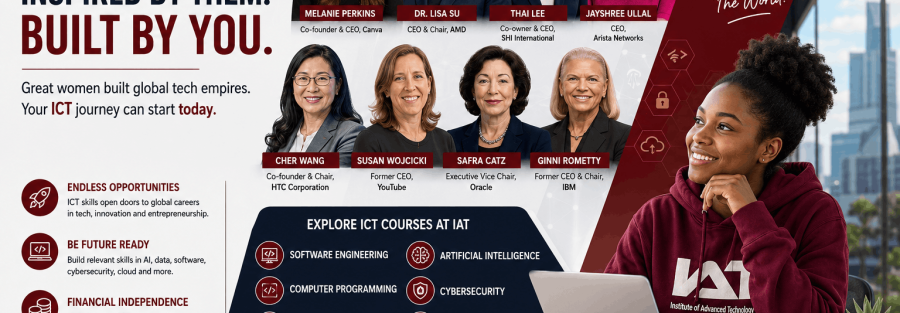
Article Description: Discover the inspiring journeys of women who founded, transformed and led some of the world’s most influential technology companies, including Canva, AMD, SHI International, Arista Networks, HTC, Oracle, IBM and YouTube, and learn how studying ICT at the Institute of Advanced Technology can prepare young women for careers in software engineering, programming, artificial intelligence, data science, networking, cybersecurity and database management.
What If the Next Global Technology Empire Is Built by You?
Imagine being a young girl in Kenya and looking at a smartphone, computer or artificial intelligence application and thinking, “One day, I could build something like this.” Imagine learning your first programming language, developing your first website and eventually creating an application used by thousands or even millions of people. Imagine starting with an idea in a classroom and eventually building a technology company that solves a problem affecting people across Kenya, Africa and the rest of the world.
That future isn’t as impossible as it may sound because the global technology industry has already been shaped by women who began with education, curiosity, persistence and a willingness to solve problems. Women such as Melanie Perkins of Canva, Dr. Lisa Su of AMD, Thai Lee of SHI International and Jayshree Ullal of Arista Networks have demonstrated that women can create, lead and transform some of the world’s most important technology organizations. Their stories are particularly powerful because their careers developed through different routes, proving that there isn’t only one way to succeed in technology.
For a young woman choosing what to study after secondary school, college or another qualification, ICT can provide an enormous range of possibilities. You can learn to develop software, analyze data, build websites, manage databases, configure networks, protect digital systems, work with artificial intelligence or eventually establish your own technology company. At the Institute of Advanced Technology (IAT), you can explore technology pathways including Software Engineering, Data Science & Machine Learning, CCNA, Computer Programming, Python Programming, Web Design & Development, databases and other professional ICT programmes.
The question isn’t whether women belong in technology because they already do. The bigger question is whether today’s young girls will acquire the skills necessary to become tomorrow’s programmers, engineers, cybersecurity professionals, data scientists, network architects, technology entrepreneurs and CEOs. Your ICT journey could be the beginning of a much bigger story than simply getting a job.
Melanie Perkins: From a Small Yearbook Business to Canva
When you look at Canva today, it is easy to imagine that its success must have started with a huge technology laboratory, hundreds of programmers and millions of dollars in investment. Melanie Perkins’ early journey tells a very different story because her first technology venture was connected to a problem she encountered while helping students create school yearbooks. She and Cliff Obrecht developed Fusion Books as a way of making yearbook creation easier, and they worked on the business while still studying and holding other jobs.
The early days were far from glamorous because Perkins and Obrecht had limited resources and had to work extremely hard to keep the business operating. Their early operation even involved using her mother’s garage, driveway and hallway for the printing business, while they continually redeveloped their software as technology improved. Perkins has described those years as challenging and explained that they were essentially learning how to build a business while building the product.
That experience eventually helped inspire the larger vision that became Canva. In 2013, Perkins, Obrecht and Cameron Adams launched Canva, with the ambition of making design easier for ordinary people rather than limiting sophisticated visual communication to professional designers. Forbes currently identifies Perkins as Canva’s co-founder and CEO and reports that Canva was valued at $42 billion by private investors in 2025, illustrating how dramatically the original idea grew.
Canva is an excellent example of how software can remove barriers for ordinary users. Instead of requiring everyone to understand complicated professional design software, Canva created a much more accessible visual communication experience that could be used through a browser and later across other digital platforms. The company’s development shows that technology doesn’t always have to solve an enormous scientific problem because sometimes the biggest opportunity is making an existing task significantly easier.
For a young woman interested in technology, Perkins’ story should encourage you to combine creativity with technical skills. If you enjoy art, design, communication, social media or business, you don’t have to choose between those interests and ICT because modern software development can bring them together. At IAT, Software Engineering training can help you understand software design, coding, testing, debugging, version control and development methodologies, while Computer Programming and Web Design & Development programmes can provide additional technical pathways.
The lesson from Perkins is simple but powerful. You don’t need to start with a billion-dollar idea, and you don’t need to have everything figured out before you begin. You need to identify a problem, learn the skills required to address it and remain willing to improve your solution as you gain experience. Your first school project, website or application could become the beginning of something much bigger.
Dr. Lisa Su: The Engineer Who Transformed AMD
If Melanie Perkins demonstrates how software can transform everyday activities, Dr. Lisa Su demonstrates how deep engineering knowledge can transform an entire technology industry. Su is the Chair and CEO of Advanced Micro Devices, commonly known as AMD, one of the world’s major semiconductor and high-performance computing companies. AMD states that Su has led the company’s transformation into a high-performance and adaptive computing leader focused on next-generation computing and artificial intelligence solutions.
Su’s career was built on technical education rather than simply business leadership. She earned advanced qualifications in electrical engineering and spent years working in semiconductor engineering and technology before joining AMD in 2012. Before AMD, she held senior engineering and business responsibilities at Freescale Semiconductor, where she worked on networking and multimedia technologies.
When Su became AMD’s CEO in 2014, the company faced significant competitive and technological challenges. Her response involved focusing strongly on high-performance computing, product development and technological execution rather than attempting to compete everywhere at once. Her leadership helped AMD strengthen its position in processors, graphics and high-performance computing, while the growth of artificial intelligence has created additional opportunities for advanced computing technologies.
Her story is particularly important for girls because it challenges the stereotype that women in technology must work mainly in communication, design or marketing. Su demonstrates that a woman can become one of the world’s most influential leaders in highly technical areas involving processors, semiconductor engineering, computing architecture and AI infrastructure. Her career also shows why mathematics, science, engineering and computer-related subjects can provide powerful foundations for future technology careers.
If you enjoy understanding how computers work at a deeper level, you can explore technical areas such as programming, computer hardware, networking and infrastructure. IAT’s broader technology portfolio includes Computer Programming, CCNA networking training and other technology programmes that can help you build a technical foundation. You can then continue developing your expertise through additional certifications, projects and specialized training.
The biggest lesson from Lisa Su is that technical excellence can become a pathway to leadership. You don’t have to decide between becoming an engineer and becoming a leader because strong technical knowledge can eventually strengthen your leadership capabilities. If you are a girl who enjoys mathematics, science, computers or engineering, don’t allow stereotypes to determine what you believe you can become.
Thai Lee: Turning a Small Software Reseller into a Global IT Enterprise
Thai Lee provides another fascinating example because her story demonstrates that you don’t have to invent a new smartphone, operating system or social media platform to build a major technology company. Lee is the co-founder, president and CEO of SHI International, a global IT solutions provider that serves organizations with technology products and services. Forbes describes her as one of the major figures behind SHI’s growth from a small software reseller into a large global technology business: Forbes’ profile of Thai Lee
Lee’s professional background also demonstrates the value of combining business education with technology. Before becoming a technology entrepreneur, she worked at companies including Procter & Gamble and American Express and earned an MBA from Harvard Business School. In 1989, she and a business partner acquired a small software reseller, and the company they developed eventually became SHI International.
The important lesson is that the technology industry contains many opportunities beyond programming. Organizations need people who understand technology procurement, software licensing, cloud services, infrastructure, cybersecurity, data management and technology strategy. A person who understands both technology and business can therefore create significant value even without personally inventing every piece of technology the organization sells.
For an IAT student, this provides an important reminder that ICT can be combined with entrepreneurship and management. You could begin by learning programming, networking, databases or cybersecurity and later add project management, business analysis or entrepreneurship skills. IAT’s authorized training portfolio includes Software Engineering, Computer Programming, Web Design & Development, Data Science & Machine Learning, Python Programming, CCNA, CCNP, Oracle Database, PostgreSQL and MongoDB.
Thai Lee’s journey therefore challenges another misconception about ICT. You don’t necessarily have to become a programmer to build a technology empire. You can become a technology entrepreneur, consultant, systems specialist, business leader or executive who understands how technology creates value.
Jayshree Ullal: Building the Networks Behind the Cloud
Every time you stream a video, attend an online class, send a message or use an AI application, enormous quantities of information travel through networks. Those networks depend on hardware, software, data centres, security systems and professionals who understand how digital infrastructure works. Jayshree Ullal is one of the technology leaders whose career demonstrates the enormous importance of networking and cloud infrastructure.
Ullal became CEO of Arista Networks in 2008 after spending more than 15 years at Cisco. Arista describes itself as a leader in data-driven client-to-cloud networking for data centres, AI, campus and routing environments, and the company identifies Ullal as its CEO.
Her decision to join Arista was significant because she moved from an established technology company to a much smaller networking venture. Arista’s subsequent growth demonstrates how networking technology became increasingly important as cloud computing and large-scale data centres expanded. Today, Arista says its platforms serve more than 10,000 cloud customers worldwide and have deployed more than 100 million ports.
For girls who enjoy understanding how computers communicate, networking can be an exciting ICT career. Networking isn’t simply about connecting computers with cables because modern networks support cloud computing, banking systems, telecommunications, artificial intelligence, online learning, streaming services and enterprise applications. At IAT, the CCNA programme covers networking fundamentals, IP addressing, subnetting, routing, switching, network security, wireless technologies, automation and troubleshooting.
Ullal’s story also demonstrates the importance of taking calculated career risks. She left a senior position in an established company and joined a much younger organization because she believed in the opportunity. For a young woman, the lesson isn’t that you should make reckless decisions but that you shouldn’t allow fear of uncertainty to prevent you from pursuing opportunities for which you’ve prepared.
Cher Wang: From HTC to Smartphones, VR and Connected Technology
Cher Wang is another influential woman whose career demonstrates how technology companies must constantly adapt to changing markets. Wang co-founded HTC Corporation in 1997 and has remained one of the company’s most important leaders. HTC identifies Wang as its chairwoman and co-founder and describes the company as operating across mobile, VR, 5G and other technology areas.
HTC’s early development was closely connected to mobile computing, and the company eventually became internationally recognized for smartphones. The company later expanded strongly into virtual reality, including its HTC Vive platform, demonstrating how hardware and software can combine to create new technology experiences. When Wang became CEO in 2015, she spoke about the transition from smartphones toward a broader world of connected products and services.
The early challenges faced by a technology company like HTC highlight how quickly the ICT industry can change. A product that is considered revolutionary today can face intense competition tomorrow, meaning that technology companies must continually innovate. HTC’s own corporate history emphasizes its commitment to hardware, platforms, tools, services and immersive technologies.
For a young woman studying ICT, Wang’s story teaches the importance of lifelong learning. The programming language, platform or device that dominates today may eventually be replaced by something new, but your ability to learn and adapt can remain valuable. That is why studying ICT should not simply be about memorizing technologies but about developing problem-solving skills that allow you to continue learning throughout your career.
Susan Wojcicki: From a Garage to Google and YouTube
Susan Wojcicki’s journey is one of the most fascinating stories in the history of modern technology. Before becoming CEO of YouTube, she was involved in the early development of Google and became one of the company’s important early employees. In 1998, Google’s founders Larry Page and Sergey Brin used her garage in Menlo Park as an early workspace, and she later joined Google as its first marketing manager.
What makes Wojcicki’s story especially inspiring for young women is that she did not follow the stereotype of a technology leader. She studied history and literature at Harvard before taking a computer science course and later earning degrees in economics and business administration. Her career demonstrates that you can discover your interest in technology at different stages of your education and still build an extraordinary technology career.
At Google, Wojcicki worked on advertising products and other important initiatives before becoming involved in the company’s acquisition of YouTube. She later became YouTube’s CEO in 2014 and led the company for nearly nine years before stepping down in 2023.
Her journey is an important lesson for girls who believe that they need to have been programming since childhood to succeed in technology. You don’t need to have your entire career mapped out when you’re sixteen, eighteen or twenty years old. You can discover a new interest, acquire new skills and change direction as your understanding of technology develops.
Safra Catz: Leading Through Enterprise Software and Cloud Technology
Safra Catz represents another pathway into technology leadership. She has held several senior positions at Oracle, including president and chief financial officer, and currently serves as executive vice chair of Oracle’s board. Oracle’s official biography also notes her previous career in investment banking, demonstrating how business and finance experience can eventually become valuable in technology leadership.
Oracle is deeply involved in enterprise software, databases and cloud infrastructure, meaning its technologies support organizations that depend on large-scale information systems. This makes Catz’s career particularly relevant to students interested in understanding the business side of ICT. Technology companies need professionals who understand not only how systems work but also how organizations invest in, manage and derive value from technology.
At IAT, students interested in enterprise technology can explore areas such as Oracle Database, PostgreSQL and MongoDB. Database skills can be particularly useful because almost every modern organization needs systems for storing, organizing, retrieving and analyzing information. When combined with programming, cloud computing or data analytics, database knowledge can become part of a powerful ICT career pathway.
Catz’s story therefore teaches you that technical and business skills can complement each other. A girl who enjoys technology but also has an interest in business, finance or management doesn’t have to choose only one direction. She can build technical competence first and then develop the leadership and commercial skills needed to manage technology organisations.
Ginni Rometty: Reinventing IBM for a Changing Technology Industry
Ginni Rometty’s career demonstrates how long-term professional development can lead to technology leadership. She joined IBM in 1981 and held a series of technical and leadership positions before becoming IBM’s first woman CEO in 2012. IBM states that during her tenure, the company expanded its capabilities in hybrid cloud, security, quantum computing, data and AI while acquiring 65 companies.
Her career also demonstrates why technology professionals must continually reinvent themselves. The technology industry changes rapidly, and professionals who remain relevant are often those who continue learning rather than relying only on what they learned at the beginning of their careers. Rometty’s career included technical work, consulting, business transformation and executive leadership, illustrating how an ICT career can evolve considerably over time.
IBM also highlights Rometty’s work supporting diversity and opportunities for women in technology. The company notes that during her leadership, IBM developed initiatives designed to help women return to the workforce and participate in emerging technology fields.
For a young woman considering ICT, this is an important message. Your first ICT course isn’t necessarily the final destination because it can become the foundation for a much longer career. You might begin with programming, progress into software development, move into project management and eventually become a technology executive.
Anne Wojcicki: Where Technology Meets Data and Healthcare
Anne Wojcicki demonstrates how ICT can transform industries outside traditional technology companies. She co-founded 23andMe, a company that connects biotechnology, genetic information, data and digital technology. Her journey demonstrates how data can become extremely valuable when combined with expertise from another field.
This is particularly relevant to students considering data science because data is increasingly important across healthcare, agriculture, finance, education, manufacturing and government. Organisations need professionals who can collect, organize, analyze and interpret information to support better decisions. The growth of artificial intelligence is making these skills even more relevant because AI systems depend heavily on data and computing.
IAT’s Data Science & Machine Learning programme introduces learners to Python for data science, data analysis and visualization, statistics and machine learning fundamentals. These skills can provide a foundation for students interested in data-driven careers. The programme also provides an example of how ICT education can connect you with opportunities beyond traditional IT departments.
Wojcicki’s journey therefore gives young women an important message. You can use ICT to enter an industry you already care about. If you love healthcare, agriculture, finance, education or science, technology can become the tool through which you create solutions in that sector.
Ruchi Sanghvi: Becoming a Pioneer at Facebook
Ruchi Sanghvi represents another important story in the development of social technology. She became Facebook’s first female engineer and worked on important products including the News Feed and Facebook Platform. Her career demonstrates how software engineering can provide opportunities to participate directly in the development of platforms used by millions of people.
Her story is especially significant because women have historically been underrepresented in software engineering and computer science. Entering an environment where you may not see many people who look like you can sometimes create uncertainty about whether you belong. Sanghvi’s career demonstrates that being different from the majority doesn’t mean you don’t have the ability to succeed.
Her experience also highlights why programming remains such an important foundation. Social networks, financial applications, e-commerce platforms, educational systems and artificial intelligence tools all depend on software. At IAT, Software Engineering provides structured training in software development principles, requirements analysis, software design, coding, testing, debugging, version control and maintenance.
For girls who are interested in becoming developers, this is an encouraging example. You don’t have to wait for technology companies to become more diverse before entering the industry. You can become part of the generation that changes the industry from within.
Reshma Saujani: Building a Movement for Girls in Technology
Reshma Saujani offers a different kind of technology story because her contribution has focused heavily on increasing access to technology education for girls. She founded Girls Who Code after recognizing the gender gap in computing and developed an organization dedicated to encouraging girls to learn computer science. Her work demonstrates that technology leadership can involve education, advocacy, community building and entrepreneurship as well as engineering.
Her story is particularly interesting because she did not begin as a traditional computer scientist. Instead, she recognized a problem and used leadership and entrepreneurship to address it. This demonstrates that you don’t need to be an expert programmer before you can become involved in the technology ecosystem.
For a young girl reading this article, that message is incredibly important. You don’t have to know Python, Java, networking or artificial intelligence before deciding that you want to study ICT. You can begin as a beginner, learn systematically and gradually discover the area of technology that excites you most.
The bigger lesson is that women in technology can also create opportunities for other women. If you become a programmer, network engineer, data scientist or cybersecurity professional, you can eventually mentor another girl who is just beginning her journey. Your success can therefore become part of a larger cycle that helps more women enter ICT.
What Do These Women Have in Common?
These women did not all build the same type of technology. Melanie Perkins represents software and visual communication, Lisa Su represents semiconductor engineering and high-performance computing, Thai Lee represents enterprise IT, Jayshree Ullal represents networking, Cher Wang represents mobile and immersive technology, Susan Wojcicki represents digital platforms, Safra Catz represents enterprise technology and Ginni Rometty represents large-scale technology transformation.
Their educational and professional backgrounds are also different. Some developed deep engineering expertise, while others combined business, economics, communications or other disciplines with technology leadership. Their different routes demonstrate that there isn’t one definition of a successful woman in ICT.
What connects their stories is curiosity, persistence, problem-solving and continuous learning. They encountered uncertainty, competition, limited resources, changing technologies and difficult decisions, yet they continued developing their capabilities. Their journeys demonstrate that success in technology is rarely the result of one lucky moment.
That should be encouraging if you’re a young woman considering ICT. You don’t need to know exactly where your career will end before you begin. You need to take the first step, develop useful skills and remain open to discovering new opportunities along the way.
Why Should a Young Woman Study ICT?
Studying ICT can provide you with skills that are useful across almost every modern industry. Technology is no longer confined to computer companies because hospitals, banks, schools, farms, governments, manufacturers, retailers and professional services all depend on digital systems. This means that ICT skills can give you flexibility when deciding where you want to build your career.
Technology can also give you the ability to create rather than simply consume. Instead of only using mobile applications, you can learn how applications are developed, while instead of simply using websites, you can learn how websites are designed and programmed. Instead of only interacting with AI tools, you can begin learning how data, algorithms and computing systems contribute to artificial intelligence.
ICT can also provide an entrepreneurship pathway. You can develop software for businesses, build digital products, provide cybersecurity services, create data solutions, offer IT consulting or establish a technology-enabled business. Your first business doesn’t need to be enormous because the important thing is developing the ability to identify problems and create useful solutions.
ICT can also expose you to careers that can operate across borders. Digital skills can potentially allow professionals to work with international teams, develop software for global customers or provide technology services to organisations outside their immediate geographical location. This doesn’t guarantee employment or business success, but it demonstrates the international reach that technology can provide.
Choosing an ICT Pathway at IAT
If you enjoy creating applications, websites and software, you can explore Software Engineering at IAT. The programme covers software development methodologies, requirements analysis, software design, version control, testing, debugging and maintenance, giving learners a structured introduction to software engineering.
If you are fascinated by artificial intelligence, data and intelligent systems, you can explore AI,Data Science & Machine Learning at IAT. The programme includes Python for data science, data analysis and visualization, statistics and machine learning fundamentals, providing a foundation for students interested in data-driven careers.
If you enjoy understanding how computers communicate, CCNA at IAT provides training in networking fundamentals, IP addressing, routing, switching, network security, wireless technologies, network automation and troubleshooting. This pathway connects particularly well with the type of cloud and data-centre networking environment associated with technology companies such as Arista Networks.
If you’re interested in protecting digital systems, IAT’s broader authorized technology training portfolio includes cybersecurity-related certifications alongside networking, programming, databases and other ICT disciplines. Cybersecurity can provide pathways into areas such as security operations, risk management, network security and other defensive technology roles. The important thing is to develop strong fundamentals and then specialise as your interests become clearer.
If you enjoy working with information, IAT also provides training in database technologies including Oracle Database, PostgreSQL and MongoDB. Database skills are important because modern organisations depend on reliable systems for storing and retrieving information. When database knowledge is combined with programming, cloud computing, data analysis or cybersecurity, it can become part of a powerful ICT skill set.
The Benefits of ICT Education for a Young Woman
One of the greatest benefits of studying ICT is that it can give you the confidence to understand technology rather than feeling intimidated by it. The first time you write a working programme, configure a network, build a website, analyze a dataset or query a database, you experience the satisfaction of making something work. Those experiences can gradually transform your perception of what you are capable of achieving.
ICT can also develop problem-solving skills that extend beyond technology. Programming teaches you to break complex problems into smaller components, while troubleshooting teaches you to investigate causes rather than simply assume that something cannot be fixed. These habits can become useful in business, education, entrepreneurship and everyday decision-making.
Technology education can also help you become an informed creator. You can understand how applications are designed, how information is stored, how networks communicate and how digital systems can be protected. This knowledge gives you a stronger foundation for participating in discussions about technology and its impact on society.
Most importantly, ICT can give you the opportunity to create solutions for problems that matter to you. If you see a challenge affecting girls in education, healthcare, financial access, agriculture or business, technology may provide one of the tools for addressing that challenge. Your perspective can become part of the solution.
Your First ICT Project Could Be the Beginning
Don’t wait until you become an expert before you start building. If you’re studying programming, create a simple application, while if you’re studying web development, build a website for a school, community project or small business. If data interests you, take an appropriate dataset and learn how to analyze and visualize it, while if networking interests you, practice building and troubleshooting networks in authorized learning environments.
The purpose of your first project isn’t to compete with Canva, AMD or Arista Networks. The purpose is to discover what you enjoy and develop the confidence that comes from creating something yourself. Every project gives you another opportunity to practice, make mistakes, troubleshoot problems and improve your technical abilities.
Over time, these projects can become evidence of your skills. A portfolio can demonstrate what you can build rather than simply listing what you have studied. For a young woman entering ICT, this practical mindset can be extremely valuable because technology is ultimately about applying knowledge to real problems.
You might start with Python and discover that you love AI. You might begin with CCNA and discover that networking fascinates you, or you might study databases and discover that you enjoy working with information systems. Learning doesn’t only give you qualifications; it helps you discover who you can become.
The Next Global Technology Founder Could Be a Kenyan Girl
The next global technology company doesn’t have to begin in Silicon Valley. It could begin in Nairobi, Mombasa, Kisumu, Nakuru, Eldoret or another Kenyan community where a young woman notices a problem and decides to solve it using technology. The technology ecosystem is increasingly global, meaning ideas developed in Africa can potentially serve customers far beyond Africa.
Consider the journeys of the women discussed in this article. Perkins started with yearbooks before developing Canva, while Su developed deep semiconductor expertise before leading AMD through major technological transformation. Thai Lee built an enormous IT enterprise from a small software reseller, and Ullal helped transform a young networking company into a major cloud networking organization.
Their stories demonstrate that you cannot always predict the final destination from the first step. A small project can lead to a business, a programming course can lead to software engineering and a networking certification can lead to cloud infrastructure or cybersecurity. Your responsibility is to develop your skills and remain open to the opportunities that those skills create.
That is why choosing an ICT course today can be much more significant than simply selecting a programme of study. You are choosing whether you want to be a consumer of technology or someone capable of understanding, creating and shaping it.
Don’t Just Use Technology-Learn to Build It
Every day, millions of girls use smartphones, social media, online learning platforms, digital banking services and artificial intelligence tools. But the future will need more women who don’t simply use these technologies but understand how they work and have the skills to create the next generation of digital solutions. The women discussed in this article demonstrate that women can participate at every level of the technology ecosystem, from engineering and programming to entrepreneurship, networking, data science and executive leadership.
The Institute of Advanced Technology provides a range of pathways for students interested in developing ICT skills. Its technology portfolio includes Software Engineering, Data Science & Machine Learning, CCNA, programming, Python, web development, CCNP, ITIL, databases and other professional programmes.
You don’t have to copy Melanie Perkins, Lisa Su, Thai Lee, Jayshree Ullal, Cher Wang, Susan Wojcicki, Safra Catz or Ginni Rometty. Their purpose in this story is not to give you a career to imitate but to demonstrate the enormous range of possibilities available when women develop technology skills and combine them with ambition, creativity, leadership and persistence.
Your story can be completely different.
You could build an African AI company, develop software for schools, create cybersecurity solutions for businesses, design agricultural technology, develop financial technology, build healthcare applications, become a cloud engineer or establish a company that nobody has imagined yet. The technology industry doesn’t need another copy of someone who already exists. It needs your ideas.
Your ICT Journey Starts Here
The next great woman in technology doesn’t have to come from Silicon Valley, London or another global technology centre. She could come from Kenya, learn her first programming concepts in a classroom, develop her first application as a student and eventually create technology that serves people across Africa and the world. She could be sitting in a classroom today wondering whether ICT is really for her.
If you’re that girl, don’t allow stereotypes to make the decision for you. Explore the technology areas that interest you, speak to professionals, develop your technical skills and give yourself permission to discover what you’re capable of achieving. You can start by exploring the ICT and technology courses offered by IAT and visiting the official Institute of Advanced Technology website for current programme information.
Your journey could start with one course. It could start with one programming exercise. It could start with one network configuration. It could start with one dataset. It could start with one idea.It could start with you.
Don’t Just Dream About the Future of Technology-Learn the Skills to Build It.
About the Blog Writer
Dennis Njeru is a business and technology professional, educator and digital content writer with more than 10 years of experience spanning management, finance, human resources, information technology, digital marketing and business operations. His multidisciplinary background enables him to explore technology not only from a technical perspective but also through the lens of education, business, career development and entrepreneurship.
In his writing, Dennis focuses on making complex business and technology topics practical, relatable and inspiring, particularly for students and young professionals making important career decisions. His articles connect emerging technologies and real-world success stories with the skills learners can develop to prepare for the changing workplace.
For this article on women who have built and transformed global technology companies, Dennis highlights the journeys of influential women including Melanie Perkins, Dr. Lisa Su, Thai Lee, Jayshree Ullal, Cher Wang, Susan Wojcicki, Safra Catz and Ginni Rometty. Their stories are used to demonstrate the diverse career pathways available to women in ICT, from software engineering and programming to artificial intelligence, data science, networking, databases, entrepreneurship and technology leadership.