
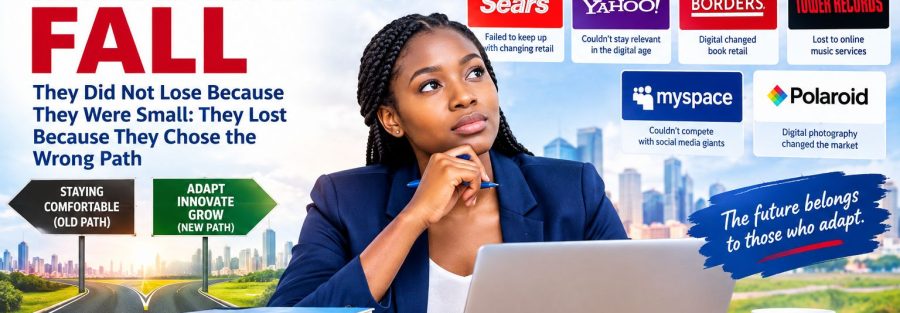
They Did Not Lose Because They Were Small, They Lost Because They Chose the Wrong Path
The Business Lesson Every Entrepreneur, Manager and Professional Needs to Understand
Article Description
Why Great Businesses Fail: A Learning Point for Future Entrepreneurs explores the strategic mistakes and missed opportunities that contributed to the decline or loss of relevance of once-famous companies such as Kodak, Blockbuster, Nokia, BlackBerry, Sears, Yahoo!, Borders, Tower Records, Myspace and Polaroid. The article goes beyond simply describing business failures to examine how success can become a trap when organizations become too comfortable with the strategies, products and business models that made them successful. It highlights the importance of adaptability, customer understanding, innovation, technology, continuous learning, strategic leadership and the willingness to challenge established assumptions.
The article is particularly relevant to entrepreneurs, managers, business owners, professionals and students who want to understand why organizations must continuously evolve as technology, customer expectations and markets change. Through practical lessons drawn from the experiences of major companies, readers are encouraged to think critically about their own businesses and careers, identify potential risks early and develop the capabilities needed to respond to change. The article also demonstrates that technology should not be adopted simply because it is fashionable, but should be used strategically to solve customer and organizational problems.
For aspiring entrepreneurs and students, the article delivers an important message: today’s success does not automatically guarantee tomorrow’s relevance. Building a sustainable career or business requires continuous skills development, curiosity, innovation and the ability to recognize emerging opportunities before they become unavoidable challenges. The article ultimately challenges readers to ask one important question: What are we doing today that could become outdated tomorrow?
Estimated Read Time
Fast reader: 8-10 minutes
Average reader: 10-12 minutes
Careful reader: 14-17 minutes
When Yesterday’s Success Becomes Tomorrow’s Weakness
The collection of once-famous organizations including Kodak, Blockbuster, Nokia, BlackBerry, Sears, Yahoo!, Borders, Tower Records, Myspace and Polaroid points to once great entrepreneurship stories that went bad, alongside the strategic choices that contributed to their decline or loss of relevance. The message is not simply about companies that failed, because many of these organizations were once among the most recognizable names in their industries. The deeper lesson is about what happens when an organization becomes comfortable with the model that made it successful and becomes slow to respond when customers, technology and markets begin moving in another direction. For entrepreneurs, managers and professionals, this lesson is particularly important because success today does not automatically guarantee relevance tomorrow.
Business history is full of organizations that appeared almost impossible to challenge at the height of their success. They had established brands, experienced employees, large customer bases, strong distribution networks and significant financial resources. Some had technologies that were considered revolutionary in their time, while others had physical networks that competitors could only dream of building. Yet market leadership can create a dangerous psychological comfort because organizations may begin to assume that customers will continue behaving as they have always behaved. When that assumption becomes embedded in strategy, an organization can spend years protecting yesterday’s business instead of preparing for tomorrow’s opportunities. The result is that a company does not necessarily disappear because it lacks resources, but because those resources are directed toward protecting an increasingly outdated path.
The above examples therefore provide an important starting point for understanding business adaptability. Kodak is commonly associated with the transition from film photography to digital photography, while Blockbuster is associated with the shift from physical video rentals toward new forms of home entertainment. Nokia and BlackBerry illustrate the dramatic transformation of the mobile-phone industry, while Borders and Tower Records demonstrate what can happen when digital distribution changes how people consume books and music. Myspace and Yahoo! provide additional examples of how rapidly digital platforms can lose relevance when user expectations, technology and competitive dynamics change. The details of each story are different, but the broader lesson is remarkably similar: organizations must continuously question whether the path that created yesterday’s success will create tomorrow’s success.
Success Can Become a Trap
One of the most difficult challenges for any successful organization is recognizing that the very practices that created its success can eventually become limitations. When a particular product generates revenue year after year, management naturally wants to protect it. When customers continue purchasing through an established channel, changing that channel can appear unnecessary or even dangerous. When employees have spent years mastering a particular system, introducing a completely different approach can create resistance and uncertainty. However, the external environment does not have to remain stable simply because an organization is comfortable with its internal environment. This creates what can be described as the success trap. The success trap occurs when an organization interprets its current achievements as evidence that its existing strategy will remain effective indefinitely. Management may continue investing heavily in the products, systems, skills and distribution channels that currently generate revenue. At the same time, emerging technologies or alternative business models may receive insufficient attention because their immediate returns appear small. The organization can therefore become increasingly efficient at doing something that customers are gradually becoming less interested in.
The problem becomes more serious when employees begin measuring innovation against the organization’s existing business model. A new idea may be rejected because it could reduce current revenue, inconvenience existing customers or require investment in unfamiliar capabilities. Leaders may ask whether the new opportunity is profitable enough today instead of asking whether it could become strategically important tomorrow. This approach can cause organizations to underestimate technologies that initially appear immature or commercially insignificant. By the time the new market becomes obviously valuable, competitors may already have developed the capabilities, customer relationships and infrastructure required to dominate it.
Kodak and the Danger of Protecting the Existing Business
Kodak provides one of the most frequently discussed examples of disruption in business education. The company became strongly associated with photographic film and developed an enormous presence in the photography industry. Yet photography itself eventually changed dramatically as digital technologies became more accessible and consumers moved away from traditional film-based processes. The important lesson is not simply that Kodak failed to understand digital photography, because the historical story is more complicated than that. The more useful lesson is that organizations can struggle when a disruptive technology threatens the economics of the business model that made them successful.
Digital photography fundamentally changed the economics and behaviour associated with taking pictures. Traditional photography involved film, processing and physical prints, while digital photography allowed consumers to capture, store, edit and share images without depending on traditional film processing in the same way. Once digital imaging became sufficiently affordable and convenient, consumers gained a completely different set of expectations. They could take many pictures without worrying about wasting film, review images immediately and increasingly share them electronically. This meant that the definition of value in photography was changing from simply producing physical photographs to providing convenient digital experiences around images.
The lesson for modern organizations is therefore broader than “embrace technology.” Organizations need to examine how technology changes customer behaviour. A company can remain technologically competent while still missing the larger transformation occurring around its industry. The critical question is not always whether an organization possesses the new technology, but whether it is willing to redesign its products, revenue streams, processes and customer experience around the implications of that technology. When leaders recognize that a technology is changing what customers value, they can begin adapting before the old business model becomes structurally difficult to defend.
Blockbuster and the Changing Meaning of Convenience
Blockbuster became synonymous with physical video rental, building a substantial network of stores that allowed customers to choose movies and take them home. The physical-store model was effective for a particular period because customers valued access to a large catalogue of entertainment close to where they lived. But the concept of convenience changed as new technologies and business models emerged. Customers increasingly wanted entertainment without travelling to a store, worrying about availability or dealing with the limitations associated with physical media.
The transformation of entertainment demonstrates why businesses should never confuse their existing delivery mechanism with the underlying customer need. Blockbuster’s deeper customer need was not necessarily “visit a video store,” because customers ultimately wanted convenient access to entertainment. Once technology enabled entertainment to be delivered differently, the traditional store network became less central to the customer experience. The same principle applies across industries because customers usually care about the problem being solved rather than the internal processes used by the organization to solve it. A business that understands the deeper customer need has more opportunities to reinvent its delivery model.
This lesson is particularly relevant to modern service businesses. A bank should not think that customers primarily need branches if what they really need is convenient access to financial services. A college should not assume that students only value physical classrooms if learners increasingly want flexible online, hybrid and blended options. A professional-services firm should not assume that clients care about traditional office meetings if clients increasingly value speed, digital collaboration and measurable outcomes. Organizations that identify the underlying customer need can change the method of delivery without losing sight of their purpose.
Nokia and the Speed of Technological Change
The story of Nokia demonstrates how quickly leadership in one technological era can be challenged by a fundamentally different competitive environment. Nokia had enormous recognition in the mobile-phone market and was associated with reliable devices used by millions of people. The smartphone era, however, changed the basis of competition by combining communication with software, applications, internet services, touch interfaces and broader digital ecosystems. Competition was no longer simply about producing a durable handset with useful communication features.
The transformation of the mobile industry demonstrates the difference between product competition and ecosystem competition. In a product-centred market, an organization may focus on hardware quality, manufacturing efficiency, distribution and physical features. In an ecosystem-centred market, customers may care about operating systems, applications, developer communities, cloud services, user interfaces, connectivity and integration with other devices. An organization that continues optimizing the old competitive dimensions may find that the market has moved to an entirely different set of dimensions. Strategic adaptability therefore requires leaders to ask not only, “How can we make our product better?” but also, “What is the market going to consider valuable next?”
This principle applies to virtually every technology-driven industry today. Artificial intelligence, cloud computing, cybersecurity, automation and mobile technologies are changing how organizations operate and compete. A business that simply adds one new technology to an old process may gain limited benefits. A business that redesigns its workflow around the capabilities of the technology can achieve a much more significant transformation. The difference is between technology adoption and technology-enabled transformation.
BlackBerry and the Importance of Listening to Customers
BlackBerry became famous for mobile devices that were strongly associated with physical keyboards, secure communication and professional users. Its devices developed a loyal customer base, particularly among people who valued messaging, email and productivity. As touchscreen smartphones and application-based ecosystems became increasingly important, however, customer expectations shifted. The competitive question was no longer simply how efficiently a phone could support email and messaging, but how effectively it could serve as a broader digital platform.
This illustrates an important principle about innovation: customers may not always tell organizations exactly what the next market will look like. Customers often evaluate products based on what they already know, while innovators attempt to anticipate what customers will value as possibilities expand. Organizations therefore need systems for monitoring behaviour, technology and emerging competitors rather than relying exclusively on traditional customer feedback. Listening to customers remains important, but leaders must also interpret signals that customers themselves may not yet recognize as significant.
Another lesson is that differentiation can become dangerous when it becomes rigidity. A company may build a powerful identity around one feature, design philosophy or customer segment. That identity can become part of the organization’s culture and make alternative approaches feel like a betrayal of what the company represents. Sustainable differentiation, however, should evolve as the market evolves. The objective is not to abandon everything that made the organization successful, but to preserve the underlying strengths while changing the elements that no longer create sufficient value.
Sears and the Challenge of Reinventing Established Retail
Sears represents another useful example because retail is one of the industries that has experienced profound changes in consumer behaviour. Traditional retail depended heavily on physical stores, catalogues, established supplier relationships and geographic distribution. The growth of e-commerce introduced new expectations around convenience, product discovery, price comparison, home delivery and digital customer experiences. Consumers gained the ability to compare products and purchase them from almost anywhere, changing the competitive environment for established retailers.
Established organizations often face a difficult problem when a new business model threatens the existing one. Investing in a new model can reduce attention and resources available for the current business. Yet failing to invest can allow competitors to build capabilities that become increasingly difficult to replicate later. This is why organizations need to distinguish between protecting today’s revenue and creating tomorrow’s revenue. Both are important, but treating them as identical strategic priorities can prevent meaningful experimentation.
A practical solution is to create room for new business models without immediately requiring them to replace the existing model. organizations can establish innovation teams, pilot new services, test digital channels and experiment with new customer segments. They can then use evidence from these experiments to determine which ideas deserve greater investment. This approach allows the organization to learn without placing the entire business at risk. More importantly, it creates a culture in which adaptation becomes a normal business activity rather than an emergency response.
Yahoo! and the Problem of Strategic Focus
Yahoo! became one of the best-known names of the early internet era, providing users with a broad collection of online services. Its experience illustrates how difficult it can be for large digital companies to determine which opportunities deserve strategic priority. Internet businesses can expand into many directions because new technologies create seemingly unlimited possibilities. The challenge is that spreading resources across too many opportunities can weaken an organization’s ability to build a clear and sustainable competitive position.
Strategic adaptability does not mean pursuing every new idea. In fact, constantly chasing trends can be just as dangerous as refusing to change. An adaptable organization needs a clear process for identifying which developments are strategically significant and which are temporary distractions. Leaders should examine market growth, customer behaviour, competitive movements, technological maturity, internal capabilities and potential business impact before committing substantial resources. Adaptability therefore requires both openness to change and discipline in deciding which changes deserve attention.
This distinction is important for small businesses as well. Entrepreneurs sometimes hear that they must “follow every trend” to remain competitive. That approach can create confusion, inconsistent branding and wasted resources. A better approach is to identify changes that are directly connected to the customer’s needs and the organization’s strategic direction. The goal is not to become everything to everyone, but to remain relevant to the people the organization is designed to serve.
Borders and the Digital Transformation of Books
Borders became a major name in physical bookselling, benefiting from the experience of customers who enjoyed visiting large bookstores and browsing extensive collections. The rise of online shopping and digital books changed how consumers discovered, purchased and consumed reading material. Physical bookstores did not suddenly become useless, but the customer journey became more diverse. Customers could search online, compare prices, read reviews, order books for delivery and eventually access digital editions instantly.
This example demonstrates that disruption does not always destroy an industry overnight. Instead, it can gradually change the economics of an industry while creating new expectations. Customers may continue using the old service while simultaneously adopting the new alternative. Over time, however, the proportion of customers using each channel can change significantly. Organisations that monitor these shifts can gradually reposition themselves, while those that ignore them may eventually discover that the market has moved much further than they expected.
The broader lesson is that small changes in customer behaviour can become large strategic changes when they accumulate. One customer buying online may not appear important to a traditional retailer. Thousands or millions of customers changing their purchasing habits can fundamentally reshape the market. Businesses should therefore pay attention to early signals rather than waiting until the change becomes impossible to ignore. Strategic foresight is often about recognising the significance of small trends before they become obvious to everyone.
Tower Records and the Transformation of Music
Tower Records provides another example of how technology can change an entire value chain. Traditional music retail depended heavily on the sale of physical recordings through specialized stores. Digital music changed how people discovered, purchased and eventually consumed music. The transition was not merely about replacing one physical product with a digital file, because it also changed distribution, pricing, discovery, ownership and consumer expectations.
The modern lesson is that organizations must understand where value is being created throughout their industry. A company may be highly successful in one part of a value chain while another part is rapidly becoming more important. When this happens, management must determine whether it should remain focused on its traditional position, move into the emerging opportunity or develop partnerships with organizations already possessing the necessary capabilities. Remaining in the same position simply because the company has historically been successful there can become increasingly risky.
This principle also applies to professional careers. A person who has built a successful career using one skill set may eventually discover that technology has changed the value associated with that skill. The answer is not necessarily to abandon the existing profession. Instead, the professional can combine existing expertise with emerging capabilities such as data analysis, artificial intelligence, digital communication, automation or cybersecurity. This creates a more adaptable professional profile without discarding years of accumulated experience.
Myspace and the Importance of User Experience
Myspace became a major social networking platform during the early growth of social media. Its story illustrates how quickly users can migrate between platforms when another service offers a more attractive or convenient experience. Digital users have relatively low switching costs compared with customers who must physically change banks, relocate offices or replace industrial equipment. If a digital platform becomes slower, more complicated or less appealing, users may move to an alternative with remarkable speed.
This makes user experience a strategic issue rather than simply a design issue. organizations need to understand how customers experience every stage of interaction with their products and services. A technically functional product can still lose customers if it is difficult to use, confusing, slow or disconnected from changing expectations. Businesses therefore need to combine technology, design, customer research and continuous testing to understand what users actually experience.
User experience is equally important outside technology companies. A college website, for example, may contain all the information prospective students need but still generate few enquiries if the information is difficult to find. A bank may offer numerous digital services but frustrate customers if the application process is complicated. A consulting firm may possess exceptional expertise but lose opportunities if clients struggle to understand its services. In every case, the organization must look at its business from the customer’s perspective rather than only from the internal perspective.
Polaroid and the Emotional Attachment to a Business Model
Polaroid built a powerful brand around instant photography and developed products that gave consumers a distinctive photographic experience. As digital photography developed, the fundamental way people captured and stored images changed. The challenge for an organization in such circumstances is that its identity may become strongly connected to the traditional product. Employees, customers and investors may all associate the brand with a particular experience, making strategic transformation emotionally and commercially difficult.
This demonstrates that organizational identity can become both an asset and a constraint. A strong identity creates recognition, loyalty and differentiation. However, if the identity becomes narrowly defined around a product rather than a customer need, it can restrict innovation. organization’s should therefore periodically ask what their brand truly represents. If a company believes its purpose is to “sell a particular product,” its strategic options may be limited, whereas an organization that understands itself as “helping customers preserve and share memories,” for example, can potentially explore many more solutions.
The lesson for entrepreneurs is especially valuable. When building a business, founders should avoid defining the company too narrowly around its first product. The initial product may be the vehicle through which the business enters the market, but it does not necessarily have to determine the organization’s entire future. Customer needs evolve, technologies change and new opportunities appear. A flexible purpose can help an organization remain relevant while allowing its products and services to evolve.
The Real Meaning of Adaptability
Adaptability is sometimes misunderstood as simply changing whenever something new appears. That definition is too simplistic because constant change without strategic direction can damage an organization. Genuine adaptability means having the ability to recognize meaningful changes, evaluate their implications, make informed decisions and adjust resources accordingly. It combines awareness, learning, experimentation, leadership and execution. An adaptable organization therefore does not change randomly; it changes deliberately in response to evidence and emerging opportunities.
One of the most important components of adaptability is organizational learning. Businesses should continuously collect information from customers, employees, competitors, technology providers and market developments. They should analyze both successes and failures rather than treating failure as something that must be hidden. Teams should be encouraged to ask what they learned from an unsuccessful project and how that knowledge can improve the next experiment. An organization that learns faster than its environment changes has a much stronger foundation for long-term relevance.
Adaptability also requires leaders to create psychological and organizational space for experimentation. Employees will rarely propose bold ideas if every mistake is punished and every project must guarantee immediate returns. Leaders need to establish appropriate boundaries within which teams can test ideas safely. Small experiments can provide valuable evidence without requiring massive investment. The objective is to discover what works before committing the organization’s full resources.
Technology Is an Enabler, Not the Strategy
One of the biggest mistakes organizations make is believing that buying new technology automatically makes them innovative. A company can purchase advanced software, artificial intelligence tools, cloud platforms or modern hardware while continuing to operate outdated processes. In such cases, technology may increase the speed of an inefficient system without solving the underlying problem. Digital transformation therefore begins with business objectives and customer needs, not with a shopping list of technologies.
organization’s should first identify where value is being lost or where opportunities are emerging. They can then determine whether technology can help address those challenges. For example, automation may reduce repetitive administrative work, data analytics may improve decision-making, artificial intelligence may support customer service and cloud systems may improve collaboration. The technology becomes valuable because it contributes to a specific business outcome rather than because it is technologically impressive.
This is particularly relevant in the age of artificial intelligence. organization’s are increasingly exploring generative AI, automation and intelligent digital assistants. The organizations that benefit most will not necessarily be those that use the most AI tools. They will be those that identify meaningful workflows where AI can improve productivity, customer experience, decision-making and innovation while maintaining appropriate governance. The strategic question is therefore not simply, “Where can we use AI?” but, “Which organizational problems can AI help us solve responsibly and effectively?”
Adaptability Begins with Leadership
Leadership plays a central role in determining whether an organization responds effectively to change. Leaders establish what the organization pays attention to, what employees are rewarded for and which investments receive resources. If leaders consistently reward short-term results while ignoring emerging opportunities, employees will naturally focus on protecting current performance. If leaders encourage learning, experimentation and evidence-based innovation, the organization is more likely to develop adaptive capabilities.
Effective leaders also need to recognize when their own assumptions are becoming outdated. Experience is valuable because it provides knowledge of what has worked in the past. However, past experience can become a problem when leaders assume that future conditions will resemble historical conditions. The world changes through technology, regulation, demographics, consumer behaviour, global competition and economic conditions. Leaders therefore need humility as well as confidence because today’s expertise does not automatically answer tomorrow’s questions.
A useful leadership practice is to regularly ask difficult strategic questions. What would happen if our biggest revenue source disappeared within five years? Which emerging technology could change our industry? What are customers doing differently today compared with three years ago? Which competitors are gaining attention and why? What would a new competitor design if it started the business today without our existing systems, assumptions and limitations?
Building an Adaptable Organization
An adaptable organization needs more than inspirational leadership because adaptability must be embedded into everyday operations. Recruitment should consider learning ability alongside existing technical competence. Training should help employees develop both current skills and future-oriented capabilities. Performance management should recognize innovation, collaboration, problem-solving and continuous improvement where these behaviours support organizational goals. These systems collectively determine whether adaptability becomes part of the organizational culture.
Training is particularly important because technology and business models are changing faster than many traditional education cycles. Employees may need to develop skills in data literacy, artificial intelligence, cybersecurity, digital communication, project management, leadership and process automation. Organisations that invest in continuous professional development can increase their ability to respond when new opportunities appear. Training should therefore not be viewed only as a response to current skill gaps, but also as an investment in future organizational capability.
This is where corporate training can become a strategic tool rather than simply an employee benefit. A well-designed corporate training programme can align employee capabilities with organizational priorities. Leadership programmes can strengthen decision-making and people management, while technology programmes can improve digital productivity and innovation. Communication, customer service, project management and business skills can strengthen the organization’s ability to execute its strategy. When training is connected directly to organizational goals, learning becomes part of business transformation.
The Importance of Scenario Planning
One way organizations can prepare for uncertainty is through scenario planning. Instead of predicting one specific future, leaders can imagine several plausible futures and examine how the organization would respond to each. One scenario might involve rapid technological change, another might involve economic pressure and another might involve major shifts in customer behaviour. The objective is not to predict the future perfectly, because that is rarely possible. The objective is to make the organization more prepared for different possibilities.
Scenario planning can reveal weaknesses that ordinary strategic planning may overlook. A business might discover that its revenue depends heavily on one customer segment, one distribution channel or one technology platform. It may also discover that certain skills are critical but concentrated in only a few employees. Once these vulnerabilities are identified, management can develop contingency plans. Preparation creates options, and options give organizations more freedom to respond when uncertainty becomes reality.
The same approach can be applied at an individual career level. Professionals can consider what their work might look like if automation increases significantly, if their industry becomes more digital or if employers demand new skills. They can then identify capabilities that would remain valuable across multiple scenarios. Communication, leadership, analytical thinking, digital literacy, adaptability and continuous learning are examples of capabilities that can support resilience across changing environments.
The Cost of Waiting
One of the most dangerous features of disruption is that the cost of waiting is often invisible at first. An organization can postpone an innovation project for another year without immediately experiencing disaster. It can delay digital transformation because the existing system still works. It can postpone employee training because current employees can still perform their present responsibilities. The problem is that every delay can increase the distance between the organization and the capabilities it will eventually need.
When change becomes urgent, organizations often attempt to move too quickly. They may spend heavily on technology, recruit large numbers of new employees or launch major transformation projects without sufficient preparation. This can create confusion, resistance and financial pressure. Early experimentation is usually less expensive because the organization has time to learn gradually. Waiting until the market forces change can transform an optional investment into an urgent expense.
The examples represented in the infographic therefore encourage organizations to think about timing. The question is not simply whether change is necessary. The question is whether the organization is beginning to prepare early enough to make the transition deliberately. A company does not need to abandon a successful business model the moment a new technology appears. It does, however, need to understand the technology, monitor its development and determine what strategic options it could create or threaten.
Adaptability and Small Businesses
It would be easy to look at large companies such as Kodak, Nokia or Sears and conclude that adaptability is mainly a concern for multinational corporations. The opposite is often true because small businesses can be particularly vulnerable to rapid changes in customer behaviour. A small company may depend heavily on a few customers, one product, one supplier or one sales channel. If that dependency changes suddenly, the business can face significant pressure.
At the same time, small businesses have an important advantage: they can often make decisions faster. They may not have layers of bureaucracy, complex approval processes or legacy systems that make transformation difficult. A small business can test a new product, introduce digital marketing, change its sales process or adopt new software relatively quickly. The challenge is therefore to combine speed with disciplined decision-making.
Entrepreneurs should build adaptability into their business plans from the beginning. They can develop multiple customer acquisition channels, monitor customer feedback, maintain relationships with suppliers and continuously review their cost structure. They can also allocate a small portion of resources to experimentation. A business that develops the habit of testing new ideas while its core operation is healthy is better positioned to respond when circumstances change.
Adaptability and Education
Educational institutions also operate in an environment where adaptability is increasingly important. Students are preparing for careers that may involve technologies, roles and business models that are still evolving. Traditional academic knowledge remains important, but graduates also need practical skills that allow them to apply knowledge in changing environments. Digital literacy, communication, problem-solving, entrepreneurship and technology skills can complement academic qualifications.
Institutions therefore have an opportunity to connect learning with the evolving needs of employers and industries. Programmes can incorporate practical projects, emerging technologies and workplace scenarios. Students can be encouraged to think beyond examinations and consider how their skills solve real organizational problems. This approach helps learners understand that education is not simply about obtaining a qualification, but about building capabilities that remain useful as circumstances change.
For professionals already in employment, the same principle means continuing to learn after graduation. A qualification can open a door, but continuous development helps professionals remain effective after they enter the workplace. Short courses, professional certifications, workshops, digital learning and workplace projects can all contribute to career adaptability. The professional who keeps learning is better positioned to recognize opportunities when industries evolve.
What Organisations Can Do Today
The first practical step toward adaptability is to conduct an honest assessment of the organization’s current position. Leaders should identify which products, services, processes and revenue streams are growing, stable or declining. They should examine customer feedback and behavioural trends rather than relying exclusively on internal assumptions. They should also identify technologies and competitors that could change the basis of competition. This assessment creates a factual foundation for deciding where adaptation may be necessary.
The second step is to identify the organization’s strategic strengths. Adaptability does not mean starting from zero every time the market changes. Organisations possess valuable assets such as trusted brands, experienced employees, customer relationships, intellectual property, distribution networks and institutional knowledge. The goal is to determine how these strengths can be transferred into emerging opportunities. A company with strong customer relationships, for example, may have an advantage when introducing a new digital service because customers already trust the brand.
The third step is to experiment. Organisations should select a few promising opportunities and test them on a manageable scale. They can launch pilot programmes, develop prototypes, test new customer journeys or introduce new digital tools to selected teams. Each experiment should have clear objectives and measurable indicators. The results can then inform decisions about whether to expand, modify or discontinue the initiative.
The fourth step is to build the necessary skills. Even the best strategy will fail if employees do not have the capabilities required to execute it. Organisations should identify current and future skills and develop structured learning programmes around them. Training should combine theoretical understanding with practical application wherever possible. Employees should leave training with the confidence and tools to apply what they have learned in their actual work.
The fifth step is to create a culture of continuous improvement. Adaptability should not be treated as a once-in-five-years transformation project. Markets change continuously, so organizations need mechanisms for continuously reviewing performance and identifying opportunities. Regular strategy reviews, customer feedback, employee suggestions, innovation sessions and technology assessments can become part of normal organizational practice. When continuous improvement becomes routine, major changes become less frightening because employees are already accustomed to learning and adjusting.
The Question Every Organization Should Ask
The most important question emerging from the infographic is not, “Could our organization become the next Kodak or Blockbuster?” A more useful question is, “What are we doing today that could become outdated tomorrow?.” Every organization has processes, products, assumptions and habits that were developed under particular market conditions. Those conditions may change even when the organization itself remains successful. Leaders therefore need the courage to examine their own success critically.
Another important question is, “What customer need are we actually serving?” This question can reveal opportunities that are hidden behind traditional products and services. A training institution may think it provides courses, but students may actually be seeking employability, professional advancement and practical skills. A bank may think it provides accounts, but customers may actually seek convenient financial management. A media company may think it sells advertising space, but clients may actually be purchasing attention, visibility and measurable engagement.
The final question is, “What capabilities do we need to build now?” Organisations should not wait until a new technology or competitor becomes dominant before developing relevant skills. Capability building takes time because people need opportunities to learn, practice and integrate new knowledge into existing workflows. Early investment can therefore create strategic flexibility. When the market changes, the organization already has people who understand how to respond.
From Survival to Opportunity
Adaptability should not be viewed only as a defensive strategy. Organisations that adapt effectively can discover opportunities that did not exist under the previous market structure. Digital transformation has created entirely new industries, business models and professional roles. Artificial intelligence is creating new ways of automating work, analyzing information and supporting decision-making. E-commerce has allowed businesses to reach customers beyond their traditional geographic markets.
This means that change can be a source of growth rather than simply a threat. The organizations that look beyond protecting existing revenue can identify new customer segments and services. They can use technology to reduce costs, improve quality and create new experiences. They can develop partnerships that would have been impossible under older business models. The ability to see opportunity within disruption can therefore become a competitive capability.
However, opportunity still requires disciplined execution. Not every new technology will create value for every organization, and not every emerging trend deserves investment. Businesses should evaluate opportunities based on customer needs, strategic fit, financial viability, organizational capability and potential long-term impact. Adaptability is strongest when curiosity is combined with critical thinking. The goal is not to chase change, but to understand it well enough to make informed choices.
Key Learning Point: Choose the Path Before the Market Chooses It for You
The companies featured in the infographic represent different industries, different eras and different business models, but they provide a common lesson about organizational change. Their histories demonstrate that size, reputation and previous success do not permanently protect an organization from disruption. Markets evolve, customer expectations change and technologies introduce new possibilities. An organization that refuses to examine its assumptions can gradually become disconnected from the environment in which it operates.
The central message is therefore worth repeating: organizations do not necessarily lose because they are small; they can lose because they continue following a path that no longer matches where the market is going. Adaptability means recognizing when the environment is changing, understanding what those changes mean and preparing the organization to respond. It requires leadership, continuous learning, technology awareness, customer understanding, experimentation and a willingness to challenge established assumptions. Most importantly, adaptability must begin before change becomes an emergency.
For entrepreneurs, the lesson is to build businesses that can evolve beyond their first products and services. For managers, the lesson is to create teams that learn continuously and are prepared to experiment responsibly. For professionals, the lesson is to keep developing skills rather than assuming that today’s expertise will remain sufficient throughout an entire career. For organizations, the lesson is to invest in people, technology, innovation and strategic thinking before circumstances force them to do so. The future will continue to reward organizations that can learn, adapt and execute.
The question is no longer whether change will come, because change is already happening across virtually every industry. The real question is whether an organization will recognize the change early enough to respond deliberately. Companies can study their history, monitor their markets, listen to customers and develop the skills required for new opportunities. They can experiment while their existing business remains strong instead of waiting until the old model is under severe pressure. They can choose to treat adaptability as an ongoing organizational capability rather than a crisis response.
Ultimately, the most valuable lesson from Kodak, Blockbuster, Nokia, BlackBerry, Sears, Yahoo!, Borders, Tower Records, Myspace and Polaroid is not that successful companies are destined to fail. Their stories instead demonstrate that success requires renewal. The organization that succeeds today must continue asking what success will require tomorrow. The professional who is valuable today must continue learning what employers and customers will value tomorrow. The entrepreneur who solves today’s problem must remain alert to the next problem customers will need solved. In a world where technology, markets and customer expectations can change rapidly, the ability to adapt may become one of the most important forms of competitive advantage.
The future does not belong only to the biggest organization, the oldest brand or the organization with the most resources. It increasingly belongs to organizations that can learn, adapt and move when the environment around them changes. The path that created your success deserves respect, but it should never become a reason to stop looking for the path that will sustain your future.
About the Blog Writer
Dennis Njeru is a business, technology and education professional with more than 10 years of experience spanning management, finance, human resources, information technology, digital marketing and business operations. His multidisciplinary background allows him to examine technology not only from a technical perspective but also through the lens of education, career development, entrepreneurship and business transformation.
Dennis is passionate about ICT education, digital skills development and inspiring young people to pursue careers in technology, be God-fearing, morally upright, be wholesome and quality global citizen. His writing focuses on making complex technology topics relatable while connecting them to practical opportunities for students and aspiring professionals.
He encourages young aspiring technology professionals to explore areas such as software engineering, programming, artificial intelligence, data science, networking, databases and cybersecurity.
Dennis believes that the next great technology solution could come from Kenya, Africa and from a young person who chooses to learn today. His goal is to use practical and inspirational storytelling to help students move from simply consuming technology to understanding, creating and using it to solve real-world problems.