
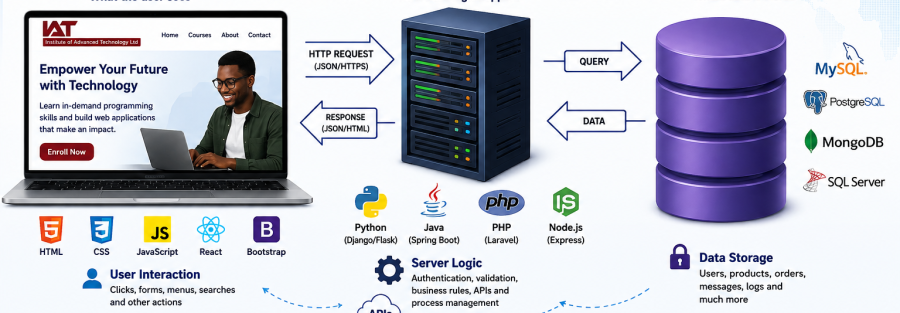
Article Description: Discover how web-based applications work by understanding the front end, back end, databases, and APIs. Learn how these technologies connect and why studying programming courses at the Institute of Advanced Technology (IAT) can prepare you for a rewarding career in software development.
Have you ever wondered what really happens after you click the Login, Register, or Buy Now button on a website? Within just a few seconds, your request travels through several layers of technology before the information you need appears on your screen. Whether you are checking your bank account, ordering food online, watching a movie on a streaming platform, or enrolling for an online course, you are interacting with a sophisticated web-based application. Understanding how these applications work is one of the most valuable skills you can develop if you are considering a career in information technology or software engineering.
Today’s digital economy is powered by web applications that connect businesses with customers across the globe. Organizations in banking, healthcare, education, manufacturing, government, retail, logistics, and entertainment rely on web applications to deliver services efficiently and securely. As businesses continue their digital transformation journeys, the demand for skilled web developers has increased significantly. This growing demand creates exciting career opportunities for individuals who understand how the front end, back end, databases, and application programming interfaces work together.
If you are planning to learn programming, choosing the right training institution is just as important as selecting the right programming language. The Institute of Advanced Technology (IAT) has established itself as one of Kenya’s leading ICT training institutions by offering industry-relevant programmes that prepare learners for real-world software development careers. Whether you are interested in web development, software engineering, database management, or programming languages such as Python and Java, IAT provides practical training designed to help you acquire job-ready skills.
This article explains how the major components of a web-based application work together, why each one is important, and how learning these technologies through IAT’s programming courses can position you for success in the modern technology industry.
What Is a Web-Based Application?
A web-based application is software that runs inside a web browser rather than being installed directly on your computer or mobile device. Unlike traditional desktop software, web applications can be accessed from almost anywhere with an internet connection, making them highly convenient for businesses and individuals alike. Popular examples include Gmail, Microsoft 365, Google Docs, Netflix, Facebook, LinkedIn, online banking systems, e-commerce stores, and cloud-based accounting platforms. Although these applications differ in appearance and functionality, they all share the same fundamental architecture built around the front end, the back end, and a database.
One of the reasons web-based applications have become so popular is their accessibility. Users no longer need to install software on every device they own because applications are available through standard web browsers such as Google Chrome, Microsoft Edge, Mozilla Firefox, and Safari. Businesses also benefit because updates are deployed centrally, allowing every user to access the latest version immediately without downloading new software. This flexibility has made web applications the preferred choice for organizations seeking scalable and cost-effective digital solutions.
Developing such applications requires professionals with knowledge in several programming disciplines. At IAT, learners can begin this journey through the Computer Programming Course, which introduces essential programming concepts before progressing to more advanced software development topics. Students interested in building complete applications can further enhance their knowledge through the Software Engineering Programme, where they learn industry-standard development methodologies and best practices.
Understanding the Front End
The front end, often referred to as the client side, is everything you see and interact with when visiting a website. Every menu, image, button, navigation bar, registration form, search box, and animation is part of the front end. Its primary objective is to provide an attractive, responsive, and intuitive user experience that enables visitors to complete tasks efficiently. A well-designed front end not only improves usability but also encourages visitors to remain on a website longer and engage more with its content.
Three core technologies form the foundation of front-end development: HTML, CSS, and JavaScript. HTML provides the structure by defining headings, paragraphs, forms, tables, images, and hyperlinks. CSS enhances presentation by controlling colours, layouts, typography, spacing, and responsive behaviour across different devices. JavaScript introduces interactivity by enabling dynamic content updates, form validation, animations, interactive dashboards, and communication with servers without reloading entire web pages.
Modern front-end development has evolved significantly through the introduction of frameworks and libraries such as React, Angular, Vue.js, Bootstrap, Tailwind CSS, and Next.js. These technologies enable developers to build highly interactive user interfaces more efficiently while maintaining consistency across large applications. Businesses increasingly seek developers who understand these frameworks because they reduce development time and improve application performance.
Learners interested in creating professional websites can strengthen their skills through IAT’s Web Design and Development Course. This programme introduces students to responsive web design, modern development practices, and the technologies required to create visually appealing and functional websites for businesses and organizations.
Understanding the Back End
While users spend most of their time interacting with the front end, the real processing occurs in the back end. The back end consists of servers, application logic, authentication systems, APIs, security controls, and business rules that determine how information flows through an application. Without the back end, websites would merely display static information and would not be capable of processing registrations, online payments, bookings, inventory management, or customer accounts.
Consider what happens when you sign into an online banking platform. After entering your username and password, the front end sends those credentials securely to the back end. The server validates your identity, checks your permissions, retrieves your account information from the database, and sends the appropriate response back to your browser within seconds. This seamless interaction occurs millions of times every day across countless web applications worldwide.
Back-end developers use programming languages such as Python, Java, PHP, C#, JavaScript through Node.js, Go, and Ruby to build secure and scalable applications. These languages are often supported by frameworks including Django, Flask, Laravel, Spring Boot, ASP.NET Core, Express.js, and Ruby on Rails, all of which simplify development while enforcing security and coding standards. Selecting the right language depends on the nature of the application, expected user traffic, integration requirements, and organizational preferences.
Students who wish to specialise in server-side programming can begin with IAT’s Python Programming Course or the Java Programming Course. Both courses provide practical programming experience while preparing learners to develop enterprise-level applications that power modern businesses.
Understanding Databases: The Heart of Every Web Application
Every successful web-based application depends on a database to store, organize, retrieve, and manage information efficiently. Whenever you create an account on a website, place an online order, upload a photograph, send an email, or make a payment, the information generated is stored inside a database. Without databases, web applications would lose all user information each time a browser was refreshed, making them impractical for real-world use. Databases therefore serve as the permanent memory of every web application, ensuring that information remains available whenever users need it.
Think about your favourite online shopping platform. Every product you browse has a name, description, price, quantity available, category, supplier details, customer reviews, and product images. Instead of storing this information inside the website itself, it is organized within a database that can retrieve thousands of records within milliseconds. When you search for a product, the application sends your request to the database, which quickly locates matching records before displaying them on your screen.
Most modern web applications use either relational databases or NoSQL databases. Relational databases organize information into tables connected through relationships, making them ideal for applications where data consistency and accuracy are critical. Examples include MySQL, PostgreSQL, Oracle Database, Microsoft SQL Server, and MariaDB. These databases are widely used in banking systems, universities, hospitals, government institutions, and enterprise resource planning systems because they maintain high levels of data integrity.
NoSQL databases, on the other hand, are designed to manage large volumes of rapidly changing and unstructured data. Popular examples include MongoDB, Cassandra, Redis, CouchDB, and Amazon DynamoDB. These databases are commonly used in social media platforms, streaming services, mobile applications, Internet of Things (IoT) systems, and artificial intelligence applications because they can scale easily to accommodate millions of users. Understanding the strengths of both database models enables developers to choose the most appropriate technology for specific business requirements.
At IAT, learners interested in database technologies can build a solid programming foundation through the Computer Programming and Software Engineering programmes before progressing to advanced database design and application development. These programmes emphasize practical implementation rather than theoretical concepts, enabling students to design, build, and manage databases that support real business applications. Students also gain experience writing Structured Query Language (SQL), the standard language used to communicate with relational databases. These practical skills are highly valued by employers seeking professionals who can develop reliable and secure information systems.
The Interconnection Between the Front End, Back End, and Database
Although the front end, back end, and database each perform different responsibilities, their true value lies in their ability to work together as one integrated system. Every action performed by a user typically passes through all three layers before the requested information is returned. This communication happens so quickly that most users never realize the complexity involved behind a simple button click. Understanding this interconnected workflow is essential for anyone pursuing a career in software development.
Imagine that you decide to register for one of IAT’s programming courses online. You begin by entering your name, email address, phone number, and preferred course into an online registration form displayed by the front end. Once you click the Submit button, the information is securely transmitted to the back end, where the application verifies that all required fields have been completed correctly and checks whether the email address already exists. If everything is valid, the application stores the information inside the database before sending a confirmation message back to the browser, which then displays a successful registration notification.
The same sequence occurs whenever you log into your online banking account, upload documents to a university portal, reserve an airline ticket, schedule a hospital appointment, or watch a movie on a streaming platform. The front end collects your request, the back end processes the business logic, and the database stores or retrieves the required information. Each layer depends on the others to complete the transaction successfully. If one layer fails, the entire application becomes unavailable or unable to perform its intended function.
Understanding this interaction helps developers troubleshoot problems more efficiently. If users cannot log in, the issue may lie within the authentication logic of the back end, the database connection, or even the user interface. By understanding the responsibilities of each component, developers can identify problems faster and implement effective solutions. This systems-thinking approach is one of the key competencies emphasized during professional software development training.
APIs: The Communication Bridge
As web applications have become more sophisticated, developers increasingly rely on Application Programming Interfaces (APIs) to facilitate communication between different software components. An API acts as a messenger that enables applications to exchange information securely without exposing their internal workings. Instead of allowing the front end to communicate directly with the database, requests are routed through APIs that validate, process, and return only the information required. This approach improves security, scalability, and maintainability.
For example, when you check today’s weather using a mobile application, the app usually does not store weather information itself. Instead, it sends an API request to a weather service that retrieves the latest forecast and sends it back to your device. Similarly, online payment gateways, mapping services, social media platforms, and e-commerce systems all rely heavily on APIs to integrate with external services. APIs have therefore become one of the most important technologies in modern software development.
Most developers today work with REST APIs because they are simple, lightweight, and compatible with virtually every programming language. More recently, GraphQL has gained popularity by allowing applications to request only the specific data they need, reducing unnecessary network traffic and improving performance. SOAP APIs continue to be used in many enterprise environments where strict security and standardized messaging are required. Learning API development enables programmers to build applications that communicate seamlessly with third-party systems and cloud services.
Students pursuing software development at IAT are encouraged to understand APIs because virtually every modern web application depends on them. Whether developing an online learning platform, an inventory management system, a healthcare application, or a mobile banking solution, APIs play a central role in enabling secure communication between software components. As businesses continue adopting cloud computing and microservices architectures, API development skills have become increasingly valuable in the global employment market.
Security Across Every Layer
Security is not the responsibility of a single component within a web application. Instead, it is a shared responsibility that spans the front end, the back end, and the database. Modern cyber threats continue to evolve, making it essential for developers to build security into every stage of application development. Organizations that neglect security expose themselves to financial losses, reputational damage, and legal consequences arising from data breaches.
The front end contributes to security by validating user input before transmitting information to the server. Although client-side validation improves user experience by identifying errors quickly, it cannot be relied upon entirely because attackers can bypass browser-based controls. The back end therefore performs additional validation, authenticates users, authorizes permissions, encrypts sensitive information, and protects applications against attacks such as SQL injection, Cross-Site Scripting (XSS), and Cross-Site Request Forgery (CSRF). These measures ensure that only legitimate requests are processed.
Databases also implement several layers of protection by controlling user access, encrypting stored information, maintaining transaction logs, and performing regular backups. Many organizations further strengthen database security by implementing disaster recovery plans, redundancy mechanisms, and continuous monitoring systems. Together, these security practices create multiple defensive layers that safeguard organizational information and maintain customer trust. Understanding secure software development is therefore an essential competency for every aspiring programmer and software engineer.
Modern Frameworks and Development Tools
As web applications become more sophisticated, developers rarely build everything from scratch. Instead, they use modern frameworks and development tools that simplify coding, improve application performance, and reduce development time. These frameworks provide reusable components, built-in security features, and standardized coding practices that enable teams to build reliable applications more efficiently. By mastering these technologies, developers become more productive and are better equipped to meet the demands of today’s fast-paced software development industry.
On the front end, frameworks such as React, Angular, Vue.js, Next.js, Bootstrap, and Tailwind CSS enable developers to create responsive and highly interactive user interfaces. These technologies make it easier to manage complex applications by organizing code into reusable components that are easier to maintain and scale. As businesses increasingly demand modern digital experiences, employers continue to seek professionals who are proficient in these frameworks. Learners who already understand HTML, CSS, and JavaScript can transition into these advanced tools with greater confidence.
The back end also benefits from powerful frameworks that simplify server-side development. Popular frameworks such as Django and Flask for Python, Laravel for PHP, Spring Boot for Java, Express.js for Node.js, and ASP.NET Core for C# provide ready-made features for authentication, security, routing, database connectivity, and application management. Instead of writing every function from the ground up, developers can focus on solving business problems while relying on proven software architecture. This approach improves productivity, enhances application security, and accelerates project delivery.
Students pursuing software development at IAT are encouraged to begin with strong programming fundamentals before progressing to advanced frameworks. Building a solid understanding of programming logic, object-oriented programming, databases, and algorithms makes learning modern frameworks much easier. Through practical assignments and project-based learning, students develop the confidence needed to create enterprise-quality web applications. This practical approach ensures graduates are prepared for real workplace challenges rather than simply understanding theoretical concepts.
Cloud Computing and Web-Based Applications
The rapid growth of cloud computing has transformed the way web applications are developed, deployed, and managed. Instead of hosting applications on a single physical server, organizations increasingly deploy them to cloud platforms where computing resources can expand automatically as user demand grows. This flexibility enables businesses to provide reliable services to customers around the world without investing heavily in physical infrastructure. As a result, cloud computing has become an essential component of modern software development.
Cloud platforms such as Amazon Web Services (AWS), Microsoft Azure, and Google Cloud Platform provide services for hosting applications, managing databases, storing files, securing networks, and monitoring system performance. Developers can deploy applications quickly while benefiting from built-in security, automatic backups, and global availability. Cloud technologies also make it easier for organizations to support remote work, online learning, digital banking, and e-commerce services.
Learning cloud technologies complements traditional programming skills because modern employers increasingly expect software developers to understand both application development and deployment. Students who understand how to move applications from development environments to cloud platforms gain a competitive advantage in the job market. This combination of programming and cloud computing skills prepares graduates for careers in software engineering, DevOps, systems administration, and cloud architecture.
DevOps and Continuous Improvement
Building a web application is only the beginning of its lifecycle. Applications must be tested, deployed, monitored, updated, and maintained throughout their operational life. DevOps is a modern approach that brings software developers and IT operations teams together to automate these activities and deliver new features more rapidly. By adopting DevOps practices, organizations improve software quality while reducing deployment risks and system downtime.
Continuous Integration (CI) and Continuous Deployment (CD) enable development teams to test new code automatically before it is released to users. Version control systems such as Git allow developers to collaborate effectively while maintaining a history of code changes and simplifying project management. Automated testing ensures that new features do not accidentally introduce bugs into existing applications. Together, these practices improve software reliability and support continuous innovation.
Students who learn programming today should appreciate that software development extends beyond writing code. Understanding version control, collaborative development, testing methodologies, and deployment strategies enables graduates to contribute effectively within professional software development teams. These complementary skills are increasingly valued by employers seeking developers who can participate throughout the entire software development lifecycle.
Career Opportunities After Learning Web Development
Learning how the front end, back end, databases, APIs, and cloud technologies work together opens the door to numerous rewarding career opportunities. Organizations across virtually every sector require professionals who can design, develop, secure, maintain, and improve web-based applications. Whether your interest lies in coding user interfaces, managing databases, designing software architecture, or developing enterprise applications, there is a career path that matches your passion and strengths.
Graduates with web development skills can pursue careers as Front-End Developers, Back-End Developers, Full-Stack Developers, Software Engineers, Database Administrators, Cloud Engineers, DevOps Engineers, Systems Analysts, API Developers, Application Support Specialists, and Solutions Architects. Many professionals also choose freelance software development or establish technology startups that provide customized digital solutions to businesses. The continued expansion of digital transformation initiatives across Africa and the world means that demand for skilled software developers is expected to remain strong for years to come.
IAT prepares students for these opportunities by combining practical instruction with industry-relevant technologies and hands-on project work. Rather than focusing solely on theory, students gain experience solving real-world programming challenges that reflect workplace expectations. This practical orientation helps graduates transition smoothly into employment, entrepreneurship, or further specialization in emerging technologies such as artificial intelligence, cybersecurity, cloud computing, and data science.
Your Learning Roadmap at IAT
If you are completely new to programming, your journey should begin by understanding the fundamentals of how computers solve problems. Learning HTML introduces you to the structure of web pages, while CSS teaches you how to create visually appealing and responsive websites. JavaScript then enables you to transform static pages into interactive web applications that respond to user actions and communicate with servers. These technologies provide the foundation upon which every successful web developer builds a career.
Once you have mastered front-end development, you should progress to server-side programming by learning Python, Java, PHP, or JavaScript with Node.js. These languages teach you how to process user requests, implement business logic, create secure authentication systems, and integrate applications with databases. Studying SQL and database design further strengthens your ability to build complete applications capable of storing and managing business information efficiently. As your confidence grows, you can begin working with APIs, cloud platforms, version control systems, and modern development frameworks.
The Institute of Advanced Technology provides an ideal environment for this learning journey because its programmes emphasize practical competence alongside theoretical understanding. Students benefit from experienced trainers, industry-aligned curricula, and opportunities to apply their knowledge through projects that simulate real business scenarios. This balanced approach equips graduates with the technical and problem-solving skills needed to succeed in today’s competitive technology industry.
For prospective learners who would like to explore available ICT programmes, visit the IAT Courses Page and the IAT ICT Department to discover programmes that align with your career aspirations.
Build Your Future with Web-Based Application Development
The modern digital economy depends on web-based applications that seamlessly integrate the front end, back end, databases, APIs, cloud platforms, and security technologies into a single ecosystem. Understanding how these components work together provides you with the knowledge required to design applications that are secure, scalable, efficient, and user-friendly. Whether you aspire to become a software engineer, web developer, cloud specialist, database administrator, or technology entrepreneur, mastering these concepts establishes a strong foundation for long-term career success.
There has never been a better time to invest in programming skills because organizations across every industry continue to embrace digital transformation. Businesses require professionals who understand the complete software development lifecycle and can build applications that solve real business challenges. By enrolling in industry-focused programming courses at IAT, you gain practical experience with the technologies used by employers while preparing yourself for exciting opportunities in Kenya and the global technology marketplace.
Don’t Just Talk About It,Take Action Now
Are you ready to become a professional software developer? Start your journey today by exploring IAT’s industry-oriented programming programmes and learn from experienced trainers who understand the demands of today’s technology sector. Visit the Institute of Advanced Technology (IAT) to learn more about courses in Computer Programming, Web Design and Development, Python Programming, Java Programming, and Software Engineering. The skills you develop today could become the foundation of an exciting and rewarding career building the next generation of web-based applications.
About the Blog Article Writer
Dennis Njeru is a technology writer and educator with a focus on demystifying complex software development concepts for a broad audience. Through this work, he demonstrates a deep understanding of modern web application architecture-from front-end interfaces to back-end logic, databases, and APIs. He is passionate about bridging the gap between theoretical knowledge and practical, industry-relevant skills, consistently connecting technical principles to real-world business applications. His writing, as seen in this article, positions him as an advocate for practical ICT education, particularly promoting the value of comprehensive programming and software engineering.