Article Description
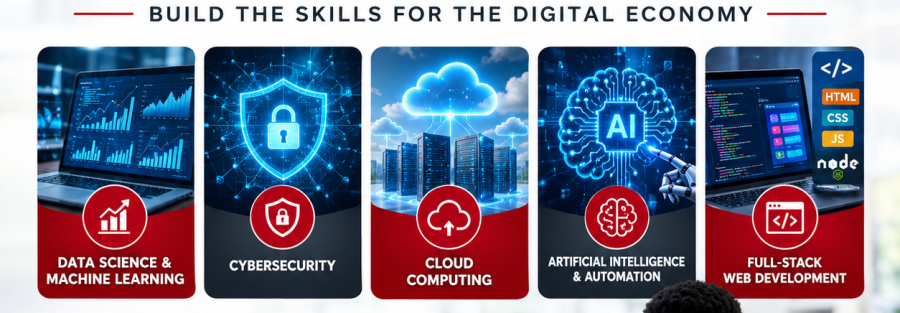
The digital economy is transforming the way businesses operate, people work, and organizations deliver products and services. As technology continues to influence almost every industry, professionals with relevant digital and technical skills are becoming increasingly valuable. This article explores five in-demand technology skills that can help learners prepare for opportunities in the modern digital economy: Data Science and Machine Learning, Cybersecurity, Cloud Computing, Artificial Intelligence and Automation and Full-Stack Web Development. It also highlights how the Institute of Advanced Technology (IAT) can help students and professionals develop practical knowledge and career-ready capabilities in these areas. Whether you are starting your technology journey, changing careers, or looking to upgrade your existing skills, understanding these areas can help you make informed decisions about your professional development.
Estimated Read Time by Reader Type
- Fast Reader: 4-6 minutes
- Average Reader: 7-9 minutes
- Careful/Reflective Reader: 10-12 minutes
- Student/Learner taking notes: 12-15 minutes
- Professional researching career opportunities: 10-14 minutes
Recommended website display: Read Time: 7-9 minutes
The Digital Economy Is Creating New Opportunities
Technology is no longer limited to traditional information technology departments because it has become an important part of almost every modern organization. Banks use technology to deliver financial services, hospitals depend on digital systems to manage information, manufacturers use automation to improve production, and retailers increasingly rely on e-commerce platforms to reach customers. Government institutions, educational organizations, media companies, agricultural enterprises, and professional service firms are also adopting digital solutions to improve how they operate. This transformation means that technology skills are becoming valuable not only for IT specialists but also for professionals working in business, finance, marketing, administration, education, healthcare, agriculture, and many other sectors. For students preparing to enter the workforce, developing relevant technology skills can therefore provide an important foundation for navigating an increasingly digital employment environment.
The rapid development of technology also means that the skills required in the workplace continue to change. Knowledge that was highly specialized a few years ago can now become part of everyday business operations, while new technologies are creating entirely new areas of specialization. Employers increasingly need people who can understand technology, solve problems, work with digital tools, protect information, interpret data, and contribute to technology-driven projects. This does not necessarily mean that every professional needs to become a software engineer or data scientist, but it does mean that digital literacy and technology awareness are becoming increasingly important. For individuals who want to remain competitive, continuous learning and professional development can therefore become an important part of their career journey. The ability to learn new technologies and apply them to real-world problems can be just as valuable as knowledge of a specific technology.
At the Institute of Advanced Technology (IAT), we recognize that successful technology education should go beyond simply learning definitions and theoretical concepts. Students need opportunities to understand how technology is used in actual workplaces and how different skills can be applied to solve practical problems. This is why technology-focused learning should combine concepts, practical exercises, projects, problem-solving, and exposure to current tools and technologies. Whether a learner is interested in programming, cybersecurity, data, artificial intelligence, cloud technologies, or web development, practical competence can make the learning experience more meaningful. IAT is committed to supporting learners as they develop skills that can help them participate confidently in the digital economy.
Data Science and Machine Learning
Data has become one of the most important resources for modern organizations because businesses generate enormous amounts of information through transactions, websites, applications, social media, customer interactions, sensors, and internal operations. However, having large quantities of data does not automatically create value for an organization because the information must be collected, organized, analyzed, interpreted, and used effectively. Data Science brings together techniques from statistics, mathematics, programming, analytics, and domain knowledge to help organizations understand information and make informed decisions. Machine Learning takes this capability further by allowing computer systems to identify patterns in data and use those patterns to support predictions or automated decisions. Together, these fields are creating opportunities across industries ranging from finance and healthcare to marketing, agriculture, logistics, manufacturing, and technology.
The importance of data skills can be seen in the way organizations increasingly use information to understand their customers and improve their operations. A retailer, for example, can analyze purchasing patterns to understand which products customers prefer and when demand is likely to increase. A financial institution can use data analysis to identify unusual transactions and support risk-management processes. Agricultural organizations can analyze information about weather, soil conditions, crop performance, and market trends to support planning and decision-making. These examples demonstrate that data skills are not simply about working with numbers because they are also about asking meaningful questions, identifying patterns, communicating findings, and turning information into useful insights. Professionals who can combine technical data skills with business or industry knowledge can therefore contribute to a wide range of organizational activities.
Learning Data Science can involve several interconnected areas of knowledge. Students may need to develop an understanding of programming languages such as Python, data preparation, data visualization, statistics, databases, machine learning concepts, and model evaluation. They also need to understand how to interpret results rather than simply allowing software to produce outputs. Good data professionals must consider whether the data is reliable, whether the analysis is appropriate, and whether the findings make sense in the real-world context. Communication is equally important because technical findings often need to be presented to managers, clients, or colleagues who may not have a technical background. Developing both technical and analytical capabilities can therefore help learners approach data-related problems more effectively.
At IAT, learners interested in Data Science and Machine Learning can build knowledge in areas that support practical technology applications. Training can introduce learners to programming, data analysis, machine learning concepts, and other techniques used to work with data. The goal is not simply to expose students to technology terminology but to help them understand how different tools and concepts can be applied to real problems. Through structured learning and practical activities, learners can gradually build confidence in working with data and technology. For anyone considering a career involving analytics, artificial intelligence, business intelligence, or data-driven decision-making, developing a strong foundation in data skills can be an important step.
Cybersecurity
As organizations become more dependent on digital systems, protecting information and technology infrastructure has become increasingly important. Businesses store customer information, financial records, employee details, intellectual property, operational data, and other sensitive information within digital systems. Cybercriminals can target these systems through techniques such as phishing, malware, social engineering, credential theft, and other forms of cyberattack. A successful attack can disrupt operations, expose confidential information, create financial losses, and damage customer confidence. Cybersecurity therefore plays an important role in helping organizations identify risks, protect systems, respond to incidents, and strengthen their overall digital resilience.
Cybersecurity is not only an issue for large technology companies because organizations of all sizes can face digital security risks. A small business that relies on email, online payments, cloud applications, and customer databases also needs to protect its systems. Educational institutions, healthcare organizations, government agencies, banks, non-governmental organizations, and professional firms similarly need appropriate security practices. This means cybersecurity knowledge can be useful across many different career paths and organizational environments. Employees who understand basic security principles can also contribute to an organization’s security culture by recognizing suspicious activities and following appropriate procedures.
A career in cybersecurity can involve several different areas of specialization. Some professionals focus on ethical hacking and penetration testing, while others work in security monitoring, risk management, incident response, digital forensics, governance, or security architecture. Cybersecurity professionals need to understand how systems work so that they can identify weaknesses and help organizations protect their infrastructure. They also need to develop problem-solving skills because security incidents can require careful investigation and timely decision-making. Certifications and structured professional training can provide learners with frameworks and knowledge that support their development in this field. As technology continues to evolve, cybersecurity professionals also need a mindset of continuous learning because security threats and defensive techniques continue to change.
IAT provides pathways for learners interested in developing skills in IT security and cybersecurity. Programs such as Certified Ethical Hacking and CompTIA Security+ can expose learners to concepts relating to security, threats, vulnerabilities, risk management, and defensive practices. Practical learning can help students understand how cybersecurity concepts connect to real technology environments rather than treating security as an entirely theoretical subject. Learners can also develop an appreciation for responsible and ethical technology use, which is essential when studying security-related techniques. For students and professionals who want to explore cybersecurity as a career direction, structured training can provide a foundation upon which further specialization and professional development can be built.
Cloud Computing
Cloud computing has significantly changed how organizations access and manage technology resources. Instead of relying exclusively on physical servers and infrastructure located within their own premises, organizations can use cloud services to access computing power, storage, databases, applications, networking, and other resources. Cloud technologies can support flexible working environments, digital collaboration, application development, data storage, and business continuity. Organizations can also scale their technology resources according to changing needs, although effective cloud adoption requires appropriate planning, security, governance, and cost management. As more businesses move workloads and services into cloud environments, knowledge of cloud technologies is becoming increasingly relevant for IT professionals.
The growth of cloud computing has also changed the role of the modern IT professional. Technology teams increasingly need people who understand cloud infrastructure, networking, security, databases, applications, automation, and system administration. Professionals may work with platforms such as Amazon Web Services, Microsoft Azure, Google Cloud, or other cloud technologies depending on their organization and specialization. Understanding the principles behind cloud computing can help learners appreciate how applications and infrastructure operate in modern environments. Cloud knowledge can also complement other technology skills, including cybersecurity, software development, data science, and artificial intelligence. This makes cloud computing particularly relevant for learners who want to develop a broader technology skill set.
Cloud computing also supports many of the technologies that people increasingly encounter in their everyday lives. Websites, mobile applications, online learning platforms, streaming services, business applications, collaboration tools, and data analytics platforms may rely on cloud infrastructure. Organizations can use cloud technologies to support remote work, improve collaboration, deploy applications, store information, and provide digital services to customers. However, moving to the cloud does not remove the need for skilled professionals because cloud environments still require configuration, monitoring, security, optimization, and ongoing management. The technology may be delivered differently, but the need for knowledgeable professionals remains important.
IAT’s professional technical courses can help learners build an understanding of modern technology environments, including concepts related to cloud computing. Students can develop knowledge that complements other IT disciplines and prepares them to understand how contemporary digital infrastructure operates. Learning about cloud technologies can be particularly valuable when combined with areas such as networking, cybersecurity, programming, databases, and systems administration. The combination of these skills can help learners develop a more complete understanding of the technology environments used by modern organizations. For professionals already working in IT, cloud training can also form part of a broader upskilling strategy as organizations continue to adopt cloud-based solutions.
Artificial Intelligence and Automation
Artificial Intelligence has moved from being a specialized area of computer science to becoming an increasingly visible part of everyday technology. AI can support activities such as language processing, image recognition, recommendations, forecasting, content generation, customer service, and data analysis. Automation can similarly help organizations reduce repetitive manual processes by allowing software or machines to perform defined tasks according to specific rules or models. Together, AI and automation can change how organizations approach productivity, customer service, decision-making, and business operations. As these technologies continue to develop, professionals who understand their opportunities, limitations, risks, and practical applications can contribute to technology-driven transformation.
AI should not be understood simply as a replacement for human work because many applications are designed to support people rather than eliminate their involvement. A professional can use AI tools to organize information, generate initial ideas, summarize documents, analyze patterns, or support routine tasks while still applying human judgment. Organizations can use automation to streamline repetitive workflows while employees focus on activities requiring creativity, communication, problem-solving, and decision-making. This creates an important need for professionals who can identify suitable processes for automation and understand how technology can be integrated responsibly. The value of AI therefore extends beyond technical development because it also involves understanding people, processes, data, and organizational objectives.
Learning about AI can involve several different areas depending on a person’s career goals. Students may explore machine learning, deep learning, natural language processing, data analysis, automation, AI tools, or the development of intelligent applications. Professionals in non-technical roles may instead focus on using AI responsibly to improve productivity, research, communication, customer service, administration, or business processes. Understanding concepts such as prompts, data quality, model limitations, privacy, security, and responsible use can help individuals make more informed decisions when working with AI systems. The most useful AI education is therefore not simply about knowing how to use a particular tool but about understanding how to apply AI appropriately to real-world challenges.
At IAT, AI-related learning can complement existing technology programs such as Data Science and Machine Learning. Learners can explore concepts that provide a foundation for understanding intelligent systems and how AI can be applied to practical problems. This type of knowledge can also support professionals who want to understand how emerging technologies may influence their industries and workplaces. As AI continues to become part of business operations, having the ability to work alongside intelligent tools can become an important component of digital competence. Students who develop both technical knowledge and responsible technology practices can be better positioned to participate in organizations undergoing digital transformation.
Full-Stack Web Development
The internet remains one of the most important platforms for communication, commerce, education, entertainment, professional services, and business growth. Organizations need websites and web applications that are responsive, accessible, secure, visually engaging, and capable of delivering useful experiences to customers and users. This creates continued opportunities for professionals who understand how websites and web applications are designed, developed, tested, deployed, and maintained. Full-stack development is particularly valuable because it involves understanding both the front-end and back-end components of web applications. A full-stack developer can therefore work across several layers of a digital product rather than focusing exclusively on the visible interface.
Front-end development involves the parts of a website or application that users interact with directly. Technologies such as HTML, CSS, and JavaScript provide fundamental building blocks for creating web experiences, while modern development frameworks and tools can support more complex applications. Back-end development focuses on the server-side processes that allow applications to handle information, business logic, authentication, databases, and other functions. Understanding how these components communicate helps developers create applications that are not only attractive but also functional and reliable. A developer also needs to consider security, performance, usability, accessibility, and maintainability when building a professional web application.
Web development can be relevant to a wide range of businesses and organizations. A retailer may need an e-commerce platform, while a school may require an online learning portal or student management interface. A professional services firm may need a website that allows customers to request services, submit information, or communicate with the organization. Entrepreneurs can also use web development skills to create digital products, launch online businesses, or develop solutions to problems they identify in their communities. These examples demonstrate why web development remains an important technology skill even as new digital technologies continue to emerge.
IAT’s Web Design and Development training can provide learners with a foundation in technologies such as HTML, CSS, JavaScript, and back-end development concepts including Node.js. Students can develop an understanding of how different technologies work together to create functional websites and web applications. Practical exercises and projects can help learners move from understanding individual technologies to applying them in complete solutions. This approach can be valuable for students who want to explore careers in web development, software development, digital entrepreneurship, or related technology fields. It can also help professionals and business owners better understand the technologies behind the digital platforms they use every day.
Why These Skills Matter Beyond Technology Jobs
One important feature of these five technology areas is that their applications extend beyond traditional technology companies. Data analysis can support marketing, finance, agriculture, healthcare, education, logistics, and management. Cybersecurity is relevant to anyone responsible for protecting digital information, while cloud computing supports organizations across different sectors. AI and automation can influence administrative work, customer service, research, content development, operations, and business processes. Web development, meanwhile, can support almost any organization that needs to communicate with customers or provide services through digital platforms.
Technology skills can also complement existing professional qualifications. A finance professional who understands data analytics can potentially work more effectively with financial information and reporting systems. A marketer who understands web technologies and analytics can better appreciate how digital campaigns and online customer journeys operate. An entrepreneur with knowledge of AI and automation may identify opportunities to improve repetitive business processes. A human resources professional with strong digital skills can work more effectively with modern HR platforms and workforce data. This demonstrates that technology education does not have to mean abandoning an existing career path because digital skills can often be combined with professional knowledge to create new capabilities.
Practical Skills Matter
Understanding technology concepts is important, but employers and clients also need people who can apply what they know. A learner may understand the definition of cybersecurity but still need practical experience to recognize vulnerabilities and respond appropriately. Similarly, knowing the theory behind data science is different from being able to clean data, analyze it, interpret results, and communicate findings. Web development requires practice because developers learn by creating, testing, debugging, improving, and deploying applications. Cloud computing and AI also require practical exposure because learners need to understand how technologies behave in real situations rather than only reading about them.
This is why practical learning should be an important part of technology education. Projects give students opportunities to apply concepts, make mistakes, troubleshoot problems, and improve their solutions. Practical exercises can also help learners develop confidence because they become familiar with the process of working through unfamiliar technical challenges. Collaboration can further strengthen learning by exposing students to different approaches to problem-solving and communication. At IAT, the emphasis on skills development can help learners connect classroom knowledge with practical applications and workplace expectations.
Continuous Learning Is the New Advantage
The technology industry does not stand still, and professionals who want to remain relevant need to develop a mindset of continuous learning. New programming frameworks, cloud platforms, cybersecurity threats, AI tools, data technologies, and development practices continue to emerge. A qualification or course can provide an important foundation, but technology professionals also need to continue developing their skills throughout their careers. Continuous learning may involve additional courses, certifications, professional communities, personal projects, industry research, or practical experimentation. The ability to learn and adapt can therefore become one of the most valuable long-term skills for anyone working in a technology-driven environment.
Students should also avoid the idea that they must master every technology before beginning their careers. Technology is a broad field, and successful professionals often develop a core area of specialization while building supporting knowledge in related disciplines. Someone interested in cybersecurity may develop additional knowledge in networking and cloud computing. A data professional may benefit from understanding Python, databases, cloud technologies, and AI. A web developer may explore cybersecurity, databases, cloud deployment, and user experience. Building a combination of complementary skills can help learners understand how different technologies work together in real-world environments.
Why Choose IAT for Your Technology Education?
Choosing where to develop technology skills is an important decision because the quality and structure of training can influence the learning experience. At the Institute of Advanced Technology, the focus is on helping learners develop practical and relevant skills that can support their academic, professional, and entrepreneurial ambitions. IAT provides training opportunities across technology and professional disciplines, allowing learners to explore different pathways according to their interests and goals. The learning environment is designed to support both beginners and individuals seeking to strengthen existing skills. This makes technology education accessible to people at different stages of their professional journey.
IAT’s technology programs are designed around areas that are relevant to the changing digital environment. Learners can explore areas such as Data Science and Machine Learning, IT security, web design and development, and professional technical courses that support broader technology capabilities. This variety allows students to consider different career directions rather than being limited to a single technology pathway. The practical orientation of technology training can also help learners connect what they study with real-world applications. As technology continues to influence more industries, having access to diverse and relevant learning opportunities can help students prepare for the changing workplace.
Your Digital Future Starts with a Skill
The digital economy is creating opportunities for people who are prepared to learn, adapt, solve problems, and use technology effectively. Data Science and Machine Learning can help organizations understand information and make data-informed decisions. Cybersecurity helps organizations protect their digital assets and strengthen their resilience against security threats, while cloud computing supports modern digital infrastructure. Artificial Intelligence and automation are changing how people and organizations approach productivity and innovation, while Full-Stack Web Development continues to support the creation of websites and digital applications. Together, these areas represent important parts of the technology landscape and provide multiple pathways for learners interested in developing digital capabilities.
The right time to begin developing technology skills is not necessarily when you have mastered every prerequisite because learning is a journey that can start with a single area of interest. A student can begin with foundational digital skills and gradually progress toward more specialized technology training. A working professional can identify areas where technology could improve their current role and pursue targeted upskilling. An entrepreneur can learn technology skills that support the development and management of a digital business. Whatever your starting point, having a clear learning goal and committing to continuous improvement can help you build confidence and capability over time.
At the Institute of Advanced Technology, we believe that skills can open doors to new possibilities. Technology education can give learners more than technical knowledge because it can develop problem-solving, creativity, analytical thinking, adaptability, and confidence. These capabilities can be valuable whether a learner ultimately works for an organization, builds a business, develops digital solutions, or continues into advanced education. The digital economy will continue to evolve, and new technologies will create new opportunities and challenges along the way. By investing in relevant skills today, learners can take meaningful steps toward participating in the opportunities created by tomorrow’s digital world.
Take the Next Step with IAT
Your future in technology can begin with a decision to learn something new today. Whether you are interested in Data Science and Machine Learning, Cybersecurity, Cloud Computing, Artificial Intelligence and Automation, or Full-Stack Web Development, there are learning pathways that can help you build your capabilities. You do not have to know everything before you start, and you do not have to follow the same path as everyone else. What matters is identifying the skills that align with your interests, career ambitions, and the opportunities you want to pursue. With the right training, practical exposure, commitment, and willingness to keep learning, you can continue building your place in the digital economy.
Institute of Advanced Technology (IAT) is committed to helping learners acquire practical skills for a changing world. Whether you are a student preparing for your first career, a graduate seeking additional skills, a professional planning a career transition, or an entrepreneur looking to strengthen your digital capabilities, IAT provides opportunities to learn and grow. Explore the available technology programs, identify the area that interests you most, and take the next step toward developing skills that can support your future. The digital economy is evolving every day, and your journey toward becoming part of it can start with the skills you choose to develop today.
Institute of Advanced Technology (IAT)
Skills. Knowledge. Innovation. Your Future.
About the Author
Dennis Njeru is a versatile and results-driven professional with broad experience across finance, human resource management, ICT, operations management, general management, digital marketing and multimedia production. His professional journey has given him exposure to diverse organizational environments, enabling him to develop a practical understanding of business operations, people management, technology, financial processes and organizational development. This multidisciplinary experience informs his interest in the relationship between technology, business and professional development.
He has extensive experience in financial management, accounting, data analysis, human resource management, administration, compliance, operations, project coordination and customer service. His technical capabilities extend to IT support, networking, IT service management, CCTV systems, digital marketing, UI/UX design, graphic design, camera operations, video editing and content creation. This combination of technical and business exposure provides a practical perspective on how technology continues to change the modern workplace.
Dennis is also experienced in resource mobilization, proposal writing, monitoring and evaluation, programme coordination and organizational performance. His exposure to different professional functions has strengthened his ability to analyze challenges from multiple perspectives, develop practical solutions, coordinate teams and resources, and communicate effectively with diverse audiences. These experiences have reinforced his belief that professionals increasingly need combinations of technical, business and interpersonal skills.
A strong advocate of continuous learning and professional development, Dennis has continually expanded his knowledge across business, technology, management, digital transformation and creative fields. His multidisciplinary approach reflects the belief that today’s professionals need to go beyond academic knowledge by developing practical, adaptable and technology-enabled capabilities. Through his professional work and writing, he is particularly interested in career development, employability, workplace skills, technology, professional growth and the transition from education to employment.
His work and insights encourage students and emerging professionals to develop practical skills, present themselves professionally, embrace continuous learning, leverage technology and take a strategic approach to building their careers.