
Article Description: Discover the major ACCA qualification changes coming in 2027, including AI, sustainability, employability modules, and a redesigned learning structure. Learn how studying ACCA at the Institute of Advanced Technology (IAT) can prepare you for the future of finance and accounting.
The Future of Accounting Is Arriving Faster Than You Think
If you’ve been thinking about pursuing the ACCA qualification, there’s never been a better time to start than now. The accounting profession is undergoing one of the biggest transformations in its history. Artificial Intelligence (AI), automation, sustainability reporting, cloud accounting, and digital technologies are reshaping how accountants work, solve business problems, and create value for organizations.
Recognizing these global changes, the Association of Chartered Certified Accountants (ACCA) has announced a comprehensive redesign of its globally recognized qualification, with the new structure expected to take effect from July 2027. This is much more than a syllabus update. It represents a complete evolution of how future accountants will learn, develop professional skills, and prepare for careers in an increasingly digital business environment.
Whether you are a recent high school graduate, a university student, a finance professional seeking career advancement, or someone considering a career change, understanding these upcoming changes will help you make informed decisions about your future.
If you want to be among the first professionals equipped with the skills employers will demand over the next decade, enrolling today with the Institute of Advanced Technology (IAT) is one of the smartest investments you can make in your career.
Why Is ACCA Changing Its Qualification?
The business world today looks remarkably different from what it did even five years ago. Organizations now rely heavily on automation, cloud computing, artificial intelligence, cybersecurity, big data, and advanced analytics to make critical business decisions. Traditional bookkeeping and routine accounting processes are increasingly being handled by intelligent software.
However, this doesn’t reduce the importance of professional accountants. Instead, it changes their role.Today’s accountants are expected to become trusted business advisors who can interpret data, manage risk, guide strategy, ensure regulatory compliance, and help organizations navigate complex sustainability challenges. Employers no longer want professionals who only prepare financial statements. They want finance experts who understand technology, communicate effectively, lead teams, and solve business problems.
To respond to these evolving expectations, ACCA has redesigned its qualification to ensure graduates remain among the most employable finance professionals worldwide.
According to ACCA’s vision for the future qualification, the redesigned programme places greater emphasis on technical excellence, practical workplace readiness, professional judgment, leadership capabilities, ethics, and digital competencies.
Why These Changes Matter to You
If you’re planning to build a career in accounting, finance, auditing, taxation, consulting, or business leadership, these changes directly affect you.
The future employer isn’t simply looking for someone who can prepare financial reports. They’re looking for someone who can answer questions like”What does this data tell us?”,”How can AI improve our financial processes?”,”What risks should we prepare for?”,”How can sustainability improve business performance?”,”Which financial strategy creates long-term value?”
The new ACCA qualification has been designed to prepare graduates to answer these questions confidently. This means your qualification will become even more valuable in today’s competitive global job market.
What Will Change in the New ACCA Qualification?
One of the most exciting aspects of the redesigned qualification is that it focuses not only on passing examinations but also on developing practical workplace skills.
Instead of concentrating solely on technical accounting knowledge, students will graduate with a broader combination of professional competencies that employers increasingly demand.
Some of the biggest changes include:
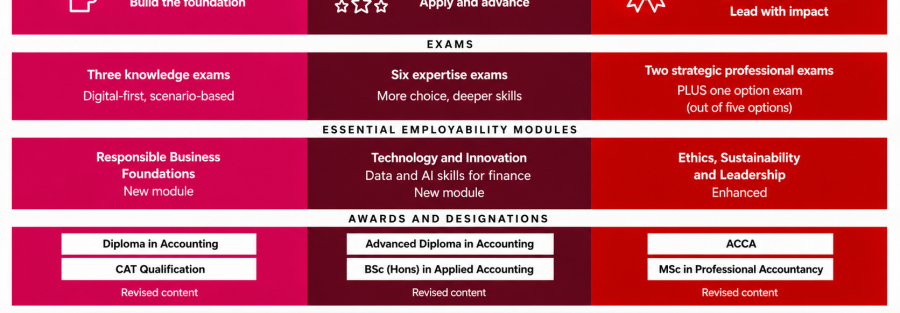
A More Modern Learning Structure
The qualification will introduce a clearer learning journey that progressively develops technical knowledge, business understanding, leadership skills, and strategic thinking.
Each stage has been carefully designed to prepare students for increasingly complex professional responsibilities.
Rather than viewing examinations as isolated academic assessments, ACCA is creating a more integrated learning experience where each level builds naturally upon the previous one.
This makes learning more meaningful and prepares graduates for real business environments.
Artificial Intelligence Becomes Part of Accounting Education
Perhaps the most significant change is the integration of Artificial Intelligence throughout the qualification.AI is already transforming accounting by automating repetitive tasks such as invoice processing, reconciliations, fraud detection, forecasting, budgeting, and financial analysis.
Rather than competing against AI, tomorrow’s accountants will learn how to work alongside it.
Students will develop skills in understanding AI-driven financial tools, interpreting machine-generated insights, evaluating AI outputs professionally, applying ethical judgment when using AI and improving business decision-making using intelligent technologies. This represents a major shift from traditional accounting education. Students studying today will graduate prepared for tomorrow’s workplaces.
At the Institute of Advanced Technology (IAT), learners already benefit from technology-focused training that complements these future ACCA developments, helping them build confidence in digital business environments.
Sustainability and ESG Reporting Will Receive Greater Emphasis
Environmental, Social, and Governance (ESG) reporting has become one of the fastest-growing areas in finance.
Investors, governments, regulators, customers, and international organizations increasingly expect businesses to report not only financial performance but also their environmental and social impact.
Future accountants will therefore need to understand sustainability reporting, climate-related financial disclosures, corporate governance, ethical business practices and long-term value creation.
The redesigned ACCA qualification reflects this global trend by embedding sustainability throughout the learning journey rather than treating it as a standalone topic.
This makes graduates more relevant to multinational corporations, consulting firms, NGOs, government agencies, financial institutions, and listed companies.
Greater Focus on Employability Skills
One of the most innovative features of the new qualification is the introduction of enhanced employability development. Technical knowledge alone no longer guarantees career success. Employers consistently rank communication, leadership, teamwork, adaptability, problem-solving, and critical thinking among the most valuable workplace skills.
The redesigned qualification aims to develop professionals who can confidently present financial recommendations, lead business projects, collaborate across departments, communicate with senior executives, influence organizational decision-making, and solve complex business problems. This means graduates will leave the qualification with stronger workplace readiness than ever before.
Students studying through quality tuition providers such as the Institute of Advanced Technology (IAT) can further strengthen these capabilities through experienced lecturers, practical learning approaches, career guidance, and an environment designed to prepare them for professional success.
Data Analytics Will Become a Core Professional Skill
Modern organizations generate enormous amounts of financial and operational data every day.
The challenge is no longer collecting information. The challenge is interpreting it correctly. Future ACCA students will therefore develop stronger capabilities in data interpretation, financial analytics, business intelligence, digital reporting, performance measurement and decision support.
These skills are becoming essential across virtually every industry.
Rather than simply preparing reports, accountants will increasingly become trusted advisors who transform raw data into meaningful business insights.
A Simplified Qualification Structure for Modern Learners
One of the most anticipated features of the new ACCA qualification is its streamlined learning pathway. ACCA aims to make the student journey more intuitive while maintaining the high professional standards that have made the qualification respected in over 180 countries.
The revised qualification will continue to build students’ knowledge progressively but with stronger integration between technical expertise, business acumen, technology, and professional skills. Learning will become more practical and closely aligned with workplace expectations, ensuring that graduates are ready to contribute from day one.
For students, this means a qualification that is easier to navigate while providing greater value to employers. Every stage of learning will reinforce the skills needed in modern finance roles, making the journey more engaging and career-focused.
Enhanced Employability Modules
One of the most exciting innovations is the introduction of Employability Modules. These modules are designed to bridge the gap between academic knowledge and workplace performance.
Rather than focusing solely on examinations, ACCA will encourage students to demonstrate how they apply their knowledge in practical business situations. Students will strengthen skills such as communication, leadership, collaboration, critical thinking, negotiation, ethical decision-making, and professional judgment.
These competencies are increasingly sought after by employers because technical expertise alone is no longer enough. Organizations need finance professionals who can work effectively with colleagues, communicate confidently with stakeholders, and provide strategic insights that support business growth.
At the Institute of Advanced Technology (IAT), students benefit from an interactive learning environment that complements this employability focus through experienced lecturers, practical case studies, and student support services. Learn more about IAT’s ACCA programmes at https://www.iat.ac.ke/courses/.
Ethics Will Remain at the Heart of the Qualification
Although technology continues to automate many accounting processes, ethics remains one area where human judgment is indispensable. Artificial intelligence can analyse data, identify trends, and generate reports, but ethical decisions require professional judgment, integrity, and accountability. ACCA recognizes this reality by continuing to place ethics at the centre of its qualification.
Students will be expected to demonstrate integrity when handling financial information, exercising professional skepticism, maintaining confidentiality, and making decisions that protect the interests of organizations and society. Employers consistently rank ethics as one of the most valuable qualities in finance professionals, making this continued emphasis especially important.
Digital Finance Will Become the New Normal
Finance departments have evolved rapidly over the past decade. Cloud accounting platforms, robotic process automation (RPA), machine learning, blockchain technologies, and digital payment systems are transforming financial operations across every industry.
The new ACCA qualification reflects these changes by embedding digital finance concepts throughout the learning experience.
Future ACCA graduates will develop a deeper understanding of digital transformation, automation, cybersecurity awareness, financial technologies (FinTech), and digital risk management. These capabilities will help graduates remain competitive as businesses continue investing in digital innovation.
Students who begin their ACCA journey today will therefore be well positioned to take advantage of these developments as they progress through the qualification.
What Happens to Current ACCA Students?
If you are already studying ACCA, you may be wondering whether you need to start again.
Fortunately, ACCA has confirmed that there will be comprehensive transition arrangements to protect students’ progress. Credits earned under the current qualification will continue to be recognized, and transition pathways will ensure that students move smoothly into the revised structure where necessary.
This means current students should continue with confidence rather than delaying their studies. In fact, beginning your ACCA journey now allows you to build a strong technical foundation before the new qualification is fully implemented.
Tuition providers such as the Institute of Advanced Technology (IAT) will also guide students through these transition arrangements, ensuring they understand exactly how the changes affect their individual study plans.
Why Employers Will Value the New ACCA Qualification Even More
Employers are increasingly looking for finance professionals who can do much more than prepare financial statements.
The redesigned ACCA qualification produces graduates who can interpret business data strategically, support digital transformation initiatives, apply artificial intelligence responsibly, manage organizational risks, lead finance teams effectively, communicate financial information clearly, support sustainability reporting, make ethical business decisions, drive business performance and contribute to long-term organizational success.
These enhanced competencies make ACCA graduates even more attractive to multinational corporations, public sector organizations, consulting firms, banks, NGOs, technology companies, manufacturing firms, and entrepreneurial businesses.
Why Now Is the Best Time to Begin Your ACCA Journey
Some prospective students may think they should wait until 2027 before enrolling. In reality, the opposite is true. Beginning your studies today provides several important advantages.
First, you gain valuable knowledge immediately rather than postponing your career progression. Every paper you complete moves you closer to becoming a qualified professional.Second, you’ll have more time to understand the transition arrangements and adapt smoothly to the revised qualification where applicable.Third, employers continue to have strong demand for ACCA students and affiliates. Starting now enables you to begin building practical work experience while completing your qualification.
Finally, learning under experienced lecturers at an established tuition provider gives you the confidence to navigate future curriculum changes successfully.
Why Choose the Institute of Advanced Technology (IAT) for ACCA?
Choosing the right tuition provider is just as important as choosing the right qualification.
The Institute of Advanced Technology (IAT) has built a strong reputation for delivering quality professional training that prepares students for successful careers in accounting, finance, and business.
When you study ACCA at IAT, you benefit from experienced lecturers, student-centred learning, flexible study options, supportive academic guidance, and a learning environment focused on helping you succeed.
Whether you prefer weekday classes, evening classes, or weekend programmes, IAT offers flexible schedules that accommodate both full-time students and working professionals.
To learn more about available programs, visit:
• https://www.iat.ac.ke
• https://www.iat.ac.ke/courses/
• https://www.iat.ac.ke/contact-us/
You can also explore ACCA’s official resources through:
• https://www.accaglobal.com
• https://www.accaglobal.com/gb/en/student.html
• https://www.accaglobal.com/gb/en/qualifications/future-qualification.html
• https://www.accaglobal.com/gb/en/help/exemptions-calculator.html
• https://www.accaglobal.com/gb/en/student/exam-support-resources.html
• https://www.accaglobal.com/gb/en/member/careers.html
• https://www.accaglobal.com/gb/en/about-us.html
Frequently Asked Questions
Will the ACCA qualification still be globally recognized?
Absolutely. ACCA remains one of the world’s leading professional accounting qualifications, recognized by employers in more than 180 countries.
Should I wait until 2027 before registering?
No. Starting now allows you to begin building your professional knowledge immediately while benefiting from established transition arrangements.
Will Artificial Intelligence replace accountants?
No. AI will automate routine tasks, but professional accountants will become even more valuable by providing strategic insights, exercising ethical judgment, interpreting data, and supporting business decision-making.
Will the qualification become easier?
Not necessarily. The qualification will remain rigorous, but learning will become more relevant, practical, and aligned with modern workplace requirements.
Can working professionals study ACCA?
Yes. Many ACCA students successfully balance work and study through flexible learning schedules such as evening and weekend classes offered by institutions like IAT.
What Next?
The accounting profession is entering one of its most exciting periods of transformation. Artificial intelligence, digital technologies, sustainability reporting, and data-driven decision-making are redefining what it means to be a finance professional.
The new ACCA qualification launching from 2027 reflects these changes by preparing graduates who are not only technically competent but also digitally confident, ethically grounded, strategically minded, and highly employable.
Rather than seeing these changes as a reason to delay your studies, view them as an opportunity. Starting your ACCA journey today allows you to build a strong foundation while positioning yourself to benefit from the exciting future of the profession.
If you’re ready to earn a globally respected qualification that opens doors to careers across the world, there’s no better place to begin than the Institute of Advanced Technology (IAT).Visit https://www.iat.ac.ke today, explore the ACCA programme, speak with an admissions advisor, and take the first step towards becoming one of tomorrow’s finance leaders.
Your future in accounting starts today—and the future has never looked brighter.
Blog Writer:Dennis Njeru