
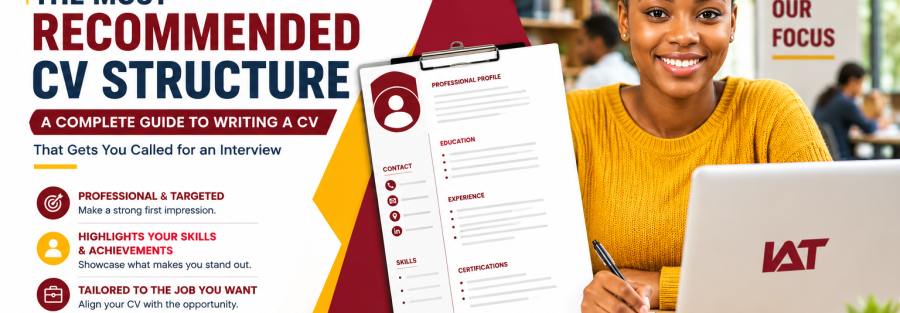
Article Description: Learn the most recommended CV structure and discover what to include in every section of your CV. This practical guide helps students and graduates write professional, targeted and compelling CVs that communicate their value and improve their chances of being shortlisted for interviews.
Estimated Reading Time: 14–16 minutes
Your CV May Be Your First Interview
Imagine spending several years studying for a certificate, diploma or degree, developing practical skills, completing assignments and preparing yourself for the world of work. You finally see an exciting job or internship opportunity, carefully submit your application and wait for the phone to ring. Days pass, then weeks, and eventually you discover that you weren’t shortlisted for an interview. The frustrating question becomes: “If I have the qualifications, why didn’t the employer give me an opportunity to explain myself?”
One possible answer could be hiding in your CV. Your CV is often one of the first opportunities an employer has to assess your professional background, qualifications, skills, experience and potential contribution. The Kenya Labour Market Information System explains that the objective of a CV or resume is to help an applicant obtain an interview while allowing potential employers to quickly understand the applicant’s strengths, aspirations and potential contribution.
This means your CV should not be treated as a document where you simply list everything you have ever done. It should be treated as a carefully structured professional document that presents the information most relevant to the opportunity you are pursuing. A good CV should make it easy for the recruiter to understand who you are, what you can do, what experience you have and why you deserve consideration. Most importantly, it should create enough interest for the recruiter to want to learn more about you during an interview.
For students and recent graduates, CV writing can be particularly challenging because you may feel that you don’t have enough experience to impress an employer. You may have never held a permanent job, yet you could have completed projects, undertaken industrial attachment, volunteered, participated in student leadership, obtained certifications or developed practical technical skills. The key is learning how to present these experiences professionally and connect them to the requirements of the position. This guide therefore explains the recommended CV structure, what every section should contain, the dos and don’ts of CV writing and practical strategies students can use to create stronger CVs.
What Is the Purpose of a CV?
The primary purpose of a CV is to introduce you professionally to a potential employer. It provides a structured summary of your education, experience, skills, achievements, professional training and other information relevant to your career. It should give the employer enough information to determine whether your background appears suitable for the position.
A CV is therefore not the same thing as an autobiography. You don’t need to document every activity you’ve participated in since childhood simply because it happened. Instead, you should select information that supports the professional story you’re trying to communicate. If you are applying for an IT support position, for example, your technical support experience, networking knowledge, troubleshooting skills and relevant projects should receive greater attention than unrelated activities.
Your CV should ultimately answer three important questions for the recruiter. Who are you professionally, what can you offer and why should the employer consider you for an interview? If your CV answers those questions clearly, you have already accomplished an important part of the application process. If the recruiter has to struggle to understand your qualifications or search through several pages to find relevant information, your chances of making a strong first impression may decrease.
The Kenya Labour Market Information System CV and Resume Guide provides useful guidance on contact information, qualifications, experience, additional skills and references, while also explaining different CV approaches such as chronological, functional and combination formats. You can therefore use such professional guidance as a reference point while still tailoring your CV to your industry and individual circumstances. Your objective should always be to produce a document that is accurate, relevant, readable and professionally presented.
The Most Recommended CV Structure
There isn’t one universal CV structure that is perfect for every industry, career stage or country. However, a well-organized CV should follow a logical sequence that allows an employer to find important information quickly. For most students, recent graduates and entry-level applicants, a chronological or reverse-chronological structure is usually practical because it presents education and experience in an easy-to-follow sequence.
A recommended student or graduate CV structure can include the following sections: name and contact information, professional profile, career objective where appropriate, education, work experience, internship or industrial attachment, skills, projects, certifications, leadership and volunteering, achievements, professional memberships where relevant and referees. You don’t necessarily need every section in every CV because relevance should determine what you include. A candidate with extensive employment history may give more space to experience, while a student may give greater prominence to education, projects, practical training and skills.
The reverse-chronological approach is also supported by Europass, which recommends placing the most recent experience first and then presenting previous experience afterwards. This makes it easier for recruiters to understand your current or most recent professional position. Whatever structure you choose, consistency is essential because the document should look deliberate rather than like information copied from several different templates.
1.Name and Contact Information
Your name should appear prominently at the top of your CV because it immediately identifies the document and its owner. Underneath your name, provide appropriate contact information such as your phone number, professional email address and general location. You may also include a professional LinkedIn profile if it is complete, accurate and relevant to your career.
Your email address is particularly important because it can influence the professionalism of your application. An address containing your real name is usually preferable to one based on jokes, nicknames, slang or unrelated phrases. You should also check your phone number carefully before submitting an application because a typing error in your contact information could prevent a recruiter from reaching you.
You generally don’t need to include sensitive or unnecessary personal information such as your national identification number, religion, marital status, height, weight or health information unless a particular application specifically requires it. The Kenya Labour Market Information System recommends beginning the CV with basic contact information such as your name, address, telephone number and email address. Your aim should be to give the recruiter the information needed to identify and contact you without unnecessarily filling the top of the page.
2.Professional Profile or Personal Statement
The professional profile is a short introduction that tells the employer who you are, what you specialize in and what you can potentially contribute. For students and recent graduates, this section can be especially useful because it provides context before the recruiter reaches your limited work experience. It should be concise, specific and connected to the position you are applying for.
Avoid generic statements such as, “I am a hardworking, honest and ambitious individual seeking a challenging opportunity.” Thousands of candidates could write exactly the same sentence, meaning it provides little evidence of what makes you different. Instead, mention your field, relevant skills, practical exposure and career direction.
For example, an ICT student could write: “An enthusiastic Information Technology student with practical exposure to computer networking, database management and technical support. Demonstrates strong problem-solving, communication and teamwork skills developed through academic projects and practical assignments. Seeking an internship opportunity to apply technical knowledge while contributing to an organization’s digital operations.” This profile immediately gives the employer a clearer picture of the candidate’s background and career direction.
Europass similarly advises candidates to highlight skills and experience that match the job they are applying for and to focus on facts and key points rather than providing a full history. Your professional profile should therefore be customized rather than copied unchanged into every application. Think of it as your short professional introduction before the recruiter reads the rest of your CV.
3.Career Objective
A career objective can be useful for students, recent graduates and people changing careers because it explains the type of opportunity they are seeking. However, it should not become a paragraph about how much you want the employer to give you an opportunity. Instead, it should show the type of contribution you hope to make while developing your professional capabilities.
For example, an accounting graduate could write: “To obtain an entry-level accounting position where I can apply my knowledge of financial reporting, bookkeeping and computerized accounting while supporting accurate and efficient financial operations.” This is more useful than saying, “I am looking for a challenging job where I can grow and develop my career.” The first statement tells the employer what the candidate wants to do and what skills they can potentially bring.
If you already have several years of relevant professional experience, a strong professional summary will generally be more valuable than a traditional objective. Your CV should evolve as your career develops because the information that matters most at entry level may not be the same information that matters after several years of professional experience. Students should therefore use the objective strategically rather than including it simply because a template contains the heading.
4.Education and Academic Qualifications
Education is particularly important for students and recent graduates because it may represent some of their strongest evidence of capability. List your most recent or highest qualification first, followed by earlier qualifications in reverse chronological order. Include the institution, qualification, field of study and relevant dates, while adding grades or academic achievements when they strengthen the application.
For example, you could write Diploma in Information Communication Technology, Institute of Advanced Technology, 2024–2026 and then list relevant academic achievements underneath if appropriate. If you are currently studying, clearly state that the programme is ongoing rather than making the recruiter guess whether you have completed it. You should also make sure that all dates, qualification titles and institution names are accurate.
You don’t need to list every subject you have studied throughout your education. Instead, identify modules or areas that directly support the job you’re applying for, particularly when you have limited work experience. For example, an applicant for a data analysis internship could highlight statistics, databases, Excel, Python, data visualization or research-related coursework when these areas are genuinely part of their background.
5.Work Experience
Your work experience section should communicate more than the names of organizations where you have worked. It should show your position, employer, dates, major responsibilities and, where possible, achievements. The strongest descriptions help the employer understand what you actually did and the value you created.
Instead of writing “Responsible for customer service,” consider writing something more specific such as “Responded to customer inquiries through phone, email and in-person channels, resolving routine issues and escalating complex cases to the relevant department.” The second version gives the recruiter a clearer understanding of the candidate’s responsibilities. It also provides evidence that the candidate has communication, problem-solving and customer-handling experience.
Whenever possible, quantify your achievements without exaggerating them. The Kenya Labour Market Information System specifically recommends being specific and quantifying achievements without exaggerating experience or skills. Saying that you handled 30 customer inquiries per day, supported 50 users or helped improve a process is more informative than simply saying you are “good at customer service.” Numbers provide context and can make your contribution easier to understand.
6.Internship and Industrial Attachment
Students should never assume that industrial attachment or internship experience is too insignificant to include on a CV. An internship can demonstrate exposure to real workplace systems, procedures, communication, teamwork and professional expectations. Even when the experience was unpaid or relatively short, it can provide evidence that you have moved beyond classroom theory.
Describe the organization, your position or placement area, the dates and the major responsibilities you performed. You should also mention relevant systems, tools, technologies or processes you encountered during the placement. If you completed a specific project or contributed to an identifiable outcome, explain that achievement clearly.
For example, an ICT student could explain that they supported users with technical problems, installed software, maintained computer systems, documented incidents or assisted with network troubleshooting. An accounting student could describe activities involving financial records, reconciliation, bookkeeping software or document processing. The important point is to translate the experience into skills that are relevant to future employment.
7.Key Skills and Competencies
Your skills section should contain capabilities that are relevant to the position rather than a long list of impressive-sounding words. Technical skills could include programming, networking, data analysis, cybersecurity, graphic design, database management, accounting software or Microsoft Excel. Transferable skills could include communication, teamwork, customer service, problem-solving, presentation, organization and time management.
However, simply claiming a skill doesn’t make the claim convincing. If you state that you possess leadership skills, your CV becomes stronger when another section shows that you led a student group, coordinated a project or served as a class representative. If you claim programming skills, an academic or personal project can provide evidence that you have actually applied them.
The IAT CCNA programme, for example, focuses on networking concepts such as IP addressing, routing, switching, network security and troubleshooting, which are examples of specific technical capabilities that can be presented on a CV when genuinely acquired. Similarly, students developing data skills can reference practical capabilities such as data analysis, visualization and statistical analysis when those skills have actually been developed.
8.Academic and Personal Projects
Projects can be extremely valuable for students because they provide evidence of practical application when formal employment experience is limited. A project demonstrates that you have taken knowledge from the classroom and used it to create, analyze, solve, design or improve something. This can make a significant difference when applying for internships and entry-level positions.
An ICT student might have developed a website, database, mobile application or information management system. A business student might have conducted market research, developed a business plan or completed a financial analysis project. An accounting student might have prepared financial statements or used computerized accounting software for an academic or practical assignment.
When describing a project, explain the project title, your role, the tools or methods used and the result. Instead of simply writing “Developed a website,” you could write “Developed a responsive student information website using HTML, CSS and JavaScript as an academic project, incorporating navigation, structured content and interactive features.” This gives the employer evidence of both the project and the capabilities behind it.
9.Professional Certifications and Training
Professional certifications can strengthen a CV when they are relevant to the position. They demonstrate that you have invested additional time in developing knowledge or skills beyond your main academic qualification. However, the quality and relevance of the training are more important than simply accumulating numerous certificates.
For example, an aspiring network professional may choose relevant networking certification, while a future cybersecurity professional may benefit from appropriate cybersecurity training. IAT currently offers programmes including Data Science and Machine Learning, Cyber Security, Python Programming and Cisco Courses, illustrating how students can build specialized technical capabilities alongside their main education.
When listing a certification, include its correct name, awarding organization and completion date where appropriate. Don’t list courses you haven’t completed or certifications you haven’t actually earned. You should also avoid filling half a page with unrelated short courses simply because you want the CV to look longer.
10.Leadership, Volunteering and Extracurricular Activities
You don’t need to have held a permanent job to demonstrate leadership, teamwork, responsibility and initiative. Student leadership, volunteering, community projects, clubs, societies and organized activities can provide useful evidence of transferable capabilities. The key is to explain what you actually did rather than simply listing membership.
For example, instead of writing “Member of ICT Club,” you could write “Participated in ICT Club activities, supporting peer learning sessions and collaborative technology projects.” If you served as a club leader, class representative or project coordinator, explain the responsibilities you handled and any meaningful results. This can help an employer understand how you operate in collaborative environments.
Volunteering can be particularly valuable for students who have limited formal employment experience. It demonstrates willingness to contribute, interact with others and take responsibility. When relevant to the position, volunteering can therefore provide additional evidence that supports the professional story presented elsewhere in your CV.
11.Achievements and Awards
An achievements section can distinguish you from candidates who possess similar qualifications. Achievements could include academic awards, competitions, innovation challenges, leadership recognition, successful projects, performance awards or measurable contributions at work. The strongest achievements demonstrate results rather than simply stating that you participated.
For example, instead of saying “Participated in a business competition,” you could write “Finalist in a student entrepreneurship competition involving 30 participating teams.” This provides context and demonstrates performance. Similarly, if you improved a process, helped increase sales, reduced errors or completed a major project, explain the result where you can do so accurately.
Be selective when including achievements because relevance matters. An award that directly relates to the position may deserve greater prominence than an unrelated recognition. Your CV should help the recruiter understand your professional potential rather than becoming a catalogue of every certificate or award you’ve ever received.
12.Professional Memberships
Professional memberships can be included where they are relevant to your career and genuinely demonstrate engagement with your profession. Membership of a recognized association can show that you are interested in professional development and industry participation. However, you should avoid including memberships simply to make your CV look more impressive.
If you’re a student, you may also belong to academic or professional student associations. Where these activities involved leadership, projects or professional development, explain your contribution rather than simply listing the organization’s name. The objective is to show meaningful involvement.
13.Referees
Referees are individuals who can provide credible information about your academic performance, professional conduct, skills or character. For students, suitable referees might include lecturers, trainers, internship supervisors or previous employers, depending on the requirements of the application. Always ask someone for permission before listing them as a referee.
The Kenya Labour Market Information System recommends including references and provides guidance on the information that can be supplied for referees. However, the exact expectations can vary between employers and industries. If the vacancy doesn’t request detailed referee information, you may use “Referees available upon request” or follow the employer’s instructions.
Your referees should be people who can genuinely discuss your abilities. Avoid selecting someone simply because they have an impressive job title if they don’t know your work or academic performance. A credible referee who understands your capabilities can provide more useful confirmation than a senior person who barely knows you.
The Must-Have CV Sections
Although CV structures differ, there are several sections that most students and job seekers should prioritize. These normally include your name and contact information, professional profile, education, relevant experience, key skills and relevant projects or certifications. If you have professional experience, that experience should generally receive greater attention.
Students with limited work experience can give more space to education, industrial attachment, projects, leadership, volunteering and practical skills. Recent graduates can gradually shift the emphasis toward professional experience as they gain employment. Experienced professionals should generally prioritize relevant career history, achievements and specialized competencies.
The important principle is that your CV should reflect your current career stage. You shouldn’t give the same amount of space to every section simply because a template provides equal headings. Give prominence to the information that most strongly demonstrates your suitability for the opportunity.
The Recommended CV Structure for Students
For a student or recent graduate, a practical structure could be Name and Contact Information → Professional Profile → Education → Skills → Internship or Industrial Attachment → Projects → Certifications → Leadership and Volunteering → Achievements → Referees. This arrangement allows the recruiter to understand your academic background and capabilities before moving into the evidence of your practical exposure. It is particularly useful when you haven’t yet accumulated several years of employment history.
If you’re an experienced professional, the structure may change to Name and Contact Information → Professional Profile → Key Skills → Professional Experience → Achievements → Education → Certifications → Professional Memberships → Referees. The change reflects the fact that your professional experience becomes stronger evidence of employability as your career develops. There is therefore no need to force every applicant into exactly the same template.
The Europass CV builder provides another practical reference for organizing education, training, work experience and skills, while allowing users to create tailored CVs for different opportunities. You don’t have to copy the design exactly, but the underlying principle of keeping your information organized and tailoring it to the opportunity is highly useful.
How Long Should a CV Be?
The ideal length of a CV depends on your career stage, experience and the requirements of the position. A student with limited experience may be able to present a strong application in one or two pages, while an experienced professional may require more space. The objective should never be to add information simply to reach a particular page count.
The Kenya Labour Market Information System describes a resume as normally being between one and two pages while distinguishing it from a more comprehensive CV. This distinction is useful because employers and industries can use the terms differently. In practical terms, you should focus on producing a document that contains enough relevant evidence without unnecessary repetition.
If your CV is three pages because you have included every school activity, unrelated hobby and short course, it probably needs editing. If your CV is one page but contains almost no evidence of your skills, experience or achievements, it may need more substance. Relevance, clarity and evidence should determine the length.
The Dos of CV Writing
Do tailor your CV to the position you are applying for. A generic CV may fail to communicate why your particular background is relevant to a specific employer. Europass also recommends tailoring your CV and highlighting experiences that match the job requirements.
Do use clear headings and consistent formatting. Your education, skills, experience and other important sections should be easy to locate. The Kenya Labour Market Information System recommends consistency in font and style, bold major headings and clear presentation.
Do use specific evidence wherever possible. Instead of saying you are “excellent at teamwork,” show how you worked with a team on a project or activity. Instead of saying you’re “good at computers,” identify the software, systems or technologies you can actually use.
Do proofread your CV carefully. Spelling and grammar errors can undermine an otherwise strong application because they may create doubts about your attention to detail. Europass specifically recommends checking spelling and grammar and using a professional email address before submitting your CV.
Do quantify genuine achievements. Numbers can help an employer understand the scale of your contribution, provided they are accurate. The Kenyan Labour Market Information System similarly recommends quantifying achievements without exaggerating experience or skills.
The Don’ts of CV Writing
Don’t submit exactly the same CV for every opportunity. You can maintain a master CV containing your complete background, but create a targeted version for each important application. The targeted version should emphasize the qualifications, skills and experiences that genuinely match the vacancy.
Don’t include false information. Never invent employment, qualifications, responsibilities, grades, certifications or achievements because you may be asked to explain them during an interview or have them verified. A shorter truthful CV is far more valuable than an impressive-looking document built around information you cannot defend.
Don’t use an unprofessional email address. Your email address forms part of your professional presentation and should be simple and appropriate. If your current email is based on a nickname or humorous phrase, consider creating a separate professional email account.
Don’t overload your CV with graphics and decoration. A CV should be attractive enough to read but professional enough to communicate information efficiently. Excessive colours, unusual fonts, large photographs and complicated layouts can distract from your qualifications.
Don’t include irrelevant information simply to make the CV longer. Every section should have a purpose and contribute to the professional story you’re presenting. If a piece of information doesn’t strengthen your application, consider removing it.
Common CV Mistakes That Can Reduce Your Chances
One of the biggest mistakes students make is sending the same CV to every employer. A student might create one document containing every course, skill, certificate, project and activity and then submit it unchanged to dozens of organizations. While maintaining a master CV is useful, every application should be adapted to reflect the specific position. IAT’s recent guidance on job and internship applications similarly emphasizes the importance of tailoring your application rather than relying on one generic CV.
Another common problem is poor formatting. Your CV doesn’t need to look like a graphic design portfolio unless you’re applying for a role where visual presentation is itself an important competency. Recruiters should be able to locate your name, contact information, education, experience and skills without struggling with unusual fonts, inconsistent spacing or confusing layouts.
A third mistake is writing responsibilities without demonstrating contribution. Saying that you were “responsible for filing documents” tells the recruiter what you were assigned to do, but it doesn’t necessarily communicate how effectively you performed the responsibility. Where appropriate, use action-oriented language and include measurable results that demonstrate your contribution.
Another mistake is ignoring the job description. Before writing your CV, identify the qualifications, technical skills, experience and competencies the employer has emphasized. Then honestly identify where your background matches those requirements and make that evidence prominent in your CV.
How Students Can Build a Strong CV Before Graduation
You don’t have to wait until graduation to start building your CV. In fact, preparing your CV early gives you a better understanding of the skills and experiences you need to develop before entering the job market. You can begin by creating a master document containing your education, projects, certifications, leadership roles, volunteering activities and practical experiences.
Keep evidence of your achievements in an organized folder. Store certificates, project reports, recommendation letters, internship documentation, competition awards and other useful evidence in a place where you can easily access them. This will make updating your CV much easier whenever an internship, graduate programme or employment opportunity becomes available.
You should also deliberately seek opportunities to develop practical skills alongside your formal education. If you’re studying ICT, for example, consider developing projects, learning relevant software, participating in practical training and creating evidence of what you can actually do. IAT emphasizes hands-on learning and industry-relevant skills across its programmes, while its student support services include career guidance, resume building, internship placement support and interview preparation.
Students interested in specialized areas can also explore relevant skills-development pathways. For example, IAT’s Data Analysis course covers data cleaning, statistical analysis, dashboards, reporting and visualization, while its Cyber Security programme covers areas including network security, penetration testing, cyber laws and security operations. These are examples of how practical skills can give students additional evidence to showcase on their CVs.
How to Tailor Your CV to a Job Advertisement
Before applying for a job, read the vacancy carefully from beginning to end. Identify the required qualifications, experience, technical skills, soft skills and responsibilities before editing your CV. Then compare those requirements with your actual background and determine which parts of your experience provide relevant evidence.
Suppose an employer is looking for a junior data analyst who understands Excel, SQL and data visualization. If you genuinely possess those skills but they are hidden near the bottom of your CV, the recruiter may not immediately recognize your suitability. You can therefore bring relevant skills and projects forward while reducing space given to unrelated information.
Don’t copy the vacancy word for word into your CV. Instead, use the employer’s terminology naturally when it accurately describes your experience and skills. This can make the connection between your background and the vacancy clearer while keeping your application honest and readable.
The principle is simple: one master CV, multiple targeted versions. Keep a comprehensive document containing your full professional history, then select and reorganize the most relevant information for each application. Europass similarly encourages maintaining a profile containing your broader skills and experience and using that information to create tailored CVs for particular opportunities.
Your CV Should Lead to the Interview
Your CV isn’t designed to answer every possible question an employer might have about you. Its immediate purpose is to create enough confidence and interest for the employer to invite you to the next stage. The interview then provides an opportunity to discuss your experience in greater depth and demonstrate your communication, problem-solving and interpersonal abilities.
This is why your CV should be viewed as an invitation rather than a complete professional autobiography. You want the recruiter to finish reading it with a clear understanding of your value and a desire to learn more. If your CV contains too much irrelevant information, the strongest parts of your profile may become difficult to notice.
Before submitting your CV, read it as though you were the recruiter. Ask yourself whether you can identify the candidate’s field, key skills, qualifications and relevant experience within a short period. Then ask the most important question: “Based only on this document, would I have a reason to invite this candidate for an interview?”
A Practical Final CV Checklist
Before sending your CV, check your personal information carefully. Confirm that your name, phone number, email address and location are accurate and professionally presented. Make sure the email account is active and that you regularly check it for responses from potential employers.
Next, review your professional content. Confirm that your profile matches the position, your education dates are accurate, your experience is presented in reverse chronological order and your skills are relevant to the vacancy. Check that your projects, certifications and achievements contain enough detail to demonstrate what you can actually do.
Finally, examine the presentation. Check the font, spacing, headings, alignment and page breaks to ensure that the document is easy to read. Proofread it several times and, where possible, ask another person to review it because a second reader may identify errors or unclear sections that you have overlooked.
Use Your CV as a Career Development Tool
Your CV should not only be updated when you urgently need a job. It should function as a living record of your professional development throughout your education and career. Every time you complete a meaningful project, earn a relevant certification, gain practical experience, receive an award or develop a new skill, consider whether it should eventually be added to your master CV.
This approach also helps you identify gaps in your professional profile. If you notice that you have plenty of academic qualifications but very little practical experience, you know that practical exposure should become a development priority. If you have technical skills but no projects demonstrating them, you can create projects that provide evidence.
Career development therefore becomes much more intentional when you regularly examine your CV. It changes the question from “How do I make my CV look better?” to “What experiences and skills do I need to become a stronger candidate?” That change in mindset can be particularly valuable for students preparing to transition from education into employment.
Where Can Students Get More Career Support?
Writing a strong CV is one part of becoming job-ready. Students also need relevant technical skills, practical experience, professional communication skills, interview preparation and an understanding of what employers expect. A strong combination of qualifications and practical capabilities gives you more evidence to present in your CV and more examples to discuss during an interview.
IAT provides student support services that include career guidance, internship placement support, resume building and interview preparation. IAT also conducts a monthly Free Online Career Fair focused on areas such as workplace readiness, career planning, communication, professionalism and connecting students with employers. Students can therefore use career support alongside their academic and technical development rather than waiting until graduation to begin preparing for employment.
You can explore the IAT main website to review available programmes and career-focused resources. If you’re considering ICT skills development, you can also explore the IAT Python Programming programme, IAT Data Science and Machine Learning programme, or IAT CCNA programme depending on your career interests. Building relevant skills while studying gives you more substantial evidence to include in your CV and discuss during interviews.
THE Take Home: Build a CV That Gets Noticed
A great CV doesn’t simply list your qualifications; it tells a clear professional story. When you organize your education, experience, skills, projects, certifications and achievements logically, you make it easier for an employer to understand your potential. When you tailor that information to the specific vacancy, you make your application more relevant.
For students and recent graduates, lack of formal employment experience doesn’t mean that you have nothing valuable to present. Your academic projects, industrial attachment, volunteering, leadership activities, certifications and practical skills can all demonstrate employability when they are presented properly. The goal is to turn your experiences into evidence that shows what you know, what you can do and how you can contribute.
Your CV is therefore more than a document you attach to an email. It is your professional introduction, your personal marketing document and potentially your first step toward an interview. Write it carefully, tailor it intelligently, proofread it thoroughly and keep improving it as your career develops.
Take the Next Step
Don’t wait until the perfect job or internship advertisement appears before preparing your CV. Create your master CV now, organize evidence of your achievements and regularly update the document as you gain new skills and experiences. When an opportunity appears, you’ll be able to create a targeted application rather than starting from zero.
If you need to strengthen the practical skills behind your CV, explore relevant training opportunities and career support before you begin your next job search. Explore IAT’s Admission Requirements and Programmes and identify programmes that align with your career direction. You can also use IAT Student Life and Career Services to learn more about the career support available to students.
Your next opportunity could begin with a CV that clearly communicates your value. Don’t just create a CV; create a CV that gives an employer a reason to call or short list you.
About the Author
Dennis Njeru is a versatile and results-driven professional with broad experience across finance, human resource management, ICT, operations management, general management digital marketing and multimedia production. His professional journey has given him exposure to diverse organizational environments, enabling him to develop a practical understanding of business operations, people management, technology, financial processes and organizational development.
He has extensive experience in financial management, accounting, data analysis, human resource management, administration, compliance, operations, project coordination and customer service. His technical capabilities extend to IT support, networking, IT service management, CCTV systems, digital marketing, UI/UX design, graphic design, camera operations, video editing and content creation, giving him a multidisciplinary perspective on the evolving demands of today’s workplace.
Dennis is also experienced in resource mobilization, proposal writing, monitoring and evaluation, programme coordination, and organizational performance. His exposure to different professional functions has strengthened his ability to analyse challenges from multiple perspectives, develop practical solutions, coordinate teams and resources, and communicate effectively with diverse audiences.
A strong advocate of continuous learning and professional development, Dennis has continually expanded his knowledge across business, technology, management, digital transformation, and creative fields. This multidisciplinary approach reflects his belief that today’s professionals need to go beyond academic knowledge by developing practical, adaptable, and technology-enabled skills that remain relevant in a rapidly changing employment environment.
Through his professional work and writing, Dennis is particularly interested in career development, employability, workplace skills, technology, professional growth, and the transition from education to employment. His perspective is informed by extensive exposure to organizational environments and an understanding of the challenges faced by students, graduates, professionals, and organizations in an increasingly competitive and technology-driven world.
His work and insights encourage students and emerging professionals to develop practical skills, present themselves professionally, embrace continuous learning, leverage technology, and take a strategic approach to building their careers.