
Article Description: Thinking about a penetration testing certification in Kenya? Mid-level ethical hackers and penetration testers in Kenya now earn a lot. Here is the certification that makes the difference between doing it illegally and getting paid to do it professionally.
Hack Legally. Get Paid Professionally.
What if your next job required you to break into a company’s systems—and rewarded you for finding every security weakness before the criminals do? It sounds like something out of a movie, but it’s one of the fastest-growing careers in cybersecurity today. Most job descriptions are forgettable: maintain systems, support end users, respond to tickets. But somewhere right now, a company is posting something genuinely unusual—find every way to break into our network, our applications, and our cloud infrastructure. Don’t patch anything. Don’t defend anything. Just get in, document exactly how you did it, and report back. Most people reading this have, at some point, wondered what it would feel like to do exactly that. Penetration testing is the career built around that instinct-and CompTIA PenTest+ is the certification that transforms that curiosity into a respected profession.
The Difference Between an Ethical Hacker and a Cybercriminal
The distinction between a penetration tester and a criminal is not primarily technical. Both use the same tools. Both look for the same vulnerabilities. Both exploit the same weaknesses in systems that were never designed to be perfectly secure. The difference is a signed contract, a defined scope, a legal framework, and the documented proof of professional methodology that a certification like CompTIA PenTest+ (PT0-003) provides.
Without that framework, the same skills that make a penetration tester valuable can also make someone prosecutable under Kenya’s Computer Misuse and Cybercrimes Act. The certification is therefore more than a career credential—it is the legal boundary between offensive cybersecurity conducted professionally and illegal cyber intrusion.
Why Kenya Needs More Penetration Testers Than Ever
Kenya’s demand for professionals who can operate inside that legal boundary is no longer theoretical. Tim Theuri, CISO at M-PESA, told Nucamp in April 2026 that many organizations across Kenya “know cyber risk is a top threat, but very few have rehearsed what failure actually looks like.”
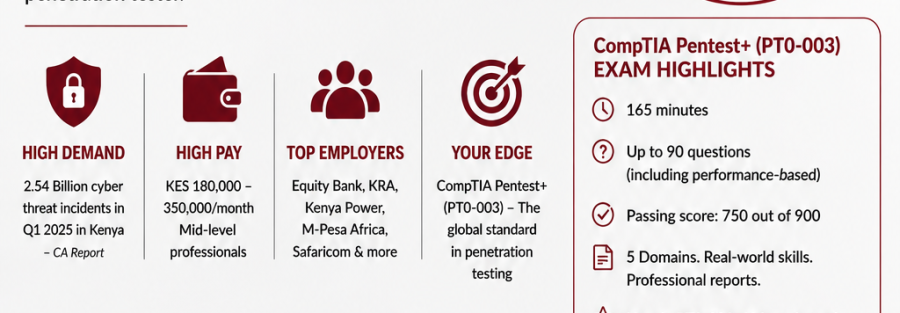
That rehearsal is exactly what penetration testing provides—a controlled, documented simulation of a real cyberattack before an actual attacker strikes. Hi Tech Data Group, a Nairobi-based cybersecurity firm, is actively recruiting ethical hackers to conduct Vulnerability Assessment and Penetration Testing (VAPT) engagements for clients across multiple industries. According to the firm’s cybersecurity jobs analysis, organizations such as Equity Bank, Kenya Revenue Authority, Kenya Power, M-Pesa Africa, and Safaricom are among the major employers seeking professionals with penetration testing skills.
The urgency is backed by numbers. The Communications Authority of Kenya recorded 2.54 billion cyber threat incidents in Q1 2025, representing a 201.7% increase from the previous quarter. That figure is not a prediction of future attacks—it is evidence that organizations are already under continuous assault and need qualified professionals to identify weaknesses before attackers exploit them.
The Salary Makes the Skill Worth Learning
Demand naturally drives compensation. According to AscendurePro’s May 2026 analysis of Kenya’s cybersecurity sector, citing Tuko salary data, mid-level ethical hackers and penetration testers earn between KES 180,000 and KES 350,000 per month. Senior professionals working for leading technology firms can earn over KES 400,000 monthly, according to Nucamp’s April 2026 Kenya cybersecurity employer analysis.
These salaries reflect the specialist nature of penetration testing. Unlike many IT roles that scale with team size, penetration testing scales with expertise. Skilled professionals remain relatively scarce, making experienced ethical hackers among the most sought-after cybersecurity specialists in Kenya.
What You’ll Learn in CompTIA PenTest+ (PT0-003)
CompTIA PenTest+ PT0-003, launched on 17 December 2024, is the latest version of the certification, replacing PT0-002, which was retired on 17 June 2025.
The certification exam:
- Duration: 165 minutes
- Questions: Up to 90 (including performance-based questions)
- Passing Score: 750 out of 900
The exam is divided into five domains:
- Engagement Management (13%) – Legal requirements, contracts, scope definition and rules of engagement.
- Reconnaissance and Enumeration (21%) – OSINT, Nmap, Maltego and information gathering techniques.
- Vulnerability Discovery (17%) – Identifying weaknesses across systems and applications.
- Attacks and Exploits (35%) – Network, cloud, API, web application and IoT exploitation techniques.
- Post-Exploitation (14%) – Lateral movement, persistence, privilege escalation and evidence collection for reporting.
The latest PT0-003 version also introduces expanded coverage of AI-based attacks, cloud environments, and API exploitation, making it highly relevant to today’s increasingly cloud-based infrastructures.
This Is Not Just Another Multiple-Choice Exam
CompTIA PenTest+ measures practical ability—not simply theoretical knowledge.
Performance-based questions require candidates to analyze tool outputs, interpret source code, execute attack strategies, identify vulnerabilities, and prepare professional penetration testing reports.
Success depends on demonstrating the same skills expected during a real client engagement. The final deliverable—a professional penetration testing report explaining what was discovered, how it was exploited, the associated risks, and recommended remediation—is every bit as important as the technical attack itself.
Train for CompTIA PenTest+ at IAT
The Institute for Advanced Technology (IAT) offers CompTIA PenTest+ training through flexible learning options, including physical classes, online classes, day sessions, evening sessions and private corporate arrangements
The course also complements:
- CompTIA CySA+ for defensive cybersecurity and threat analysis.
- Certified Ethical Hacker (CEH) for learners pursuing EC-Council’s offensive security pathway.
For course duration, upcoming intakes, and tuition fees, contact IAT:Phone: +254 725 040 588 Email: registrar@iat.ac.ke
The Curiosity Is Already There. Now Build the Career.
If you’ve read this far and your first reaction was, “I’d love to do that,” you’re already thinking like a penetration tester. Curiosity is the foundation. Professional training provides the methodology. Certification provides credibility. And the contract provides the legal authority.
Somebody is already getting paid to break into systems. It might as well be you.
Blog Writer:James Gitonga
James Gitonga is a technology writer and cybersecurity researcher with a passion for translating complex IT concepts into practical, engaging, and career-focused content. He specializes in emerging technologies, cybersecurity, cloud computing, artificial intelligence, and professional IT certifications, helping students and professionals understand industry trends, develop in-demand skills, and make informed career decisions. Through his writing, James aims to bridge the gap between technology and opportunity by providing insightful, research-driven articles that empower readers to thrive in today’s rapidly evolving digital economy.