
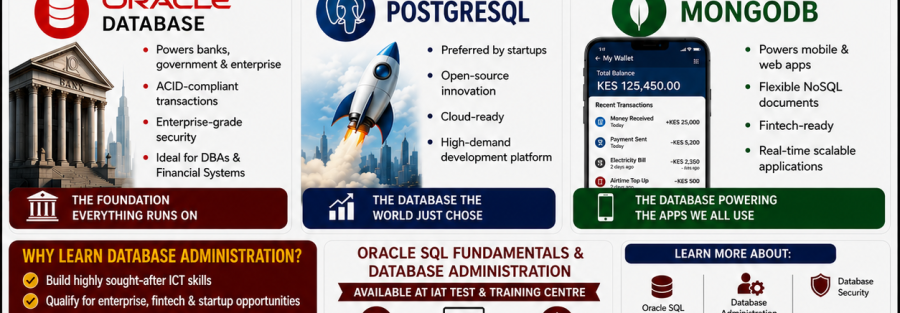
Article Description: Considering database training in Kenya? Oracle runs the banks. PostgreSQL runs the startups. MongoDB runs the apps. Here is what each one does, who in Nairobi is hiring for each and why understanding the difference between them is one of the most financially valuable things a Kenyan IT professional can learn right now.
Kenya’s digital economy does not run on one database. It runs on three completely different ones, each built for a different era, a different type of work, and a different kind of organization. Every time your bank processes a transaction, Oracle is probably underneath it. Every time a Nairobi startup ships a new feature, PostgreSQL is probably storing it. Every time you open a fintech app and it loads your transaction history in under a second, MongoDB is probably serving it. The IT professional who understands what is running under the system is fundamentally more valuable than the one who only understands what is on top of it — and right now, across Kenya’s banks, government institutions, technology companies and growing startup ecosystem, the demand for people who understand all three is outpacing the supply of professionals who can explain even one.
Oracle: The Foundation Everything Runs On
Oracle Database has powered enterprise computing for four decades. The Central Bank of Kenya, the Kenya Revenue Authority, Jubilee Insurance, Old Mutual — these are not organizations that choose their database infrastructure casually. They choose Oracle because it handles structured financial data with the ACID compliance, regulatory auditability and transactional precision that regulators require and that the consequences of getting wrong are measured in billions of shillings. Oracle controls 10.6% of global developer usage according to the 2025 Stack Overflow Developer Survey — a modest number that does not reflect its dominance in the specific environments where it actually lives: banking, government, insurance and telecoms. The salary data tells the real story. PayScale’s Kenya research on Oracle-certified professionals places the Oracle Certified Professional DBA range at Ksh.765,000 to Ksh.24,000,000 annually, based on 11 salary submissions from Kenya. The floor of that range already represents serious professional compensation. The ceiling reflects what senior Oracle expertise commands inside Kenya’s financial sector institutions, where losing database availability for an hour is a regulatory event, not merely an inconvenience.
The career opportunity inside Oracle is also sharpening. KORE1’s DBA salary guide, published June 2026, documents what is happening globally — a significant portion of the Oracle DBA workforce is in their fifties and sixties, they learned the platform two decades ago and they are now retiring. The talent pool for experienced Oracle administrators is not just undersupplied. It is actively shrinking. A young Kenyan professional who builds genuine Oracle expertise now is entering a field where the competition will decrease over the next decade, not increase.
PostgreSQL: The Database the World Just Chose
Something decisive happened in the developer community between 2018 and 2025. PostgreSQL went from 33% developer adoption to 55.6%, according to the 2025 Stack Overflow Developer Survey, which drew responses from 50,000 developers across 177 countries. It is now the most used, most loved, and most desired database for three consecutive years — with professional developer adoption reaching 58.2%, creating an 18.6 percentage point lead over the nearest competitor. As of 2026, 39,062 verified companies globally run PostgreSQL, according to Landbase’s technology adoption database. AWS, Google Cloud and Microsoft Azure all offer managed PostgreSQL services. Nairobi’s Silicon Savannah — the startup ecosystem that attracted $482 million in venture capital in just Q1 of 2024 alone, according to SDK Finance’s Kenya fintech landscape report — is building primarily on open-source infrastructure. PostgreSQL is the default choice for that infrastructure.
The professional argument for PostgreSQL expertise in Kenya is different from Oracle but equally compelling. Oracle pays more in established institutions. PostgreSQL pays in volume — there are simply more organizations building on it, more teams hiring for it, and more Nairobi startups that need someone who understands how to manage, optimize and secure a PostgreSQL instance before it becomes a production system that cannot be allowed to fail.
MongoDB: The Database Powering the Apps Everyone Actually Uses
MongoDB is a document database, which means it stores data not in rigid rows and columns but in flexible JSON-like documents that can hold different structures from record to record. That flexibility is exactly why it became the default backend for a specific category of application — the mobile and web apps where data is varied, high-volume and needs to load in milliseconds. Uber runs MongoDB for real-time ride data and location tracking. eBay uses it to store billions of product listings and user profiles. Electronic Arts relies on it for gaming data at scale.
In Africa specifically, MongoDB’s strategic intent is explicit. TechCabal reported in May 2025 that MongoDB officially entered Africa through Nigeria, calling it part of a broader “$100 billion digital opportunity” across the continent, with the company citing fintechs and established banks among the organizations already running MongoDB at the core of their applications. Africa’s mobile-based fintech users crossed 180 million in 2025, with Kenya at the forefront, according to CoinLaw’s fintech adoption statistics published March 2026. The real-time transaction apps, mobile lending platforms and digital savings products that those users depend on daily are precisely the environments MongoDB was designed to serve. The professionals who understand how to administer, scale and secure a MongoDB deployment are the ones the teams building those applications need.
What This Means for a Career Decision
Corporate Staffing Services, one of Kenya’s largest recruitment firms, currently lists database administrator vacancies in Nairobi ranging from Ksh.38,000 to Ksh.587,000 per month. That range spans three different database worlds — entry-level maintenance roles at one end, senior Oracle administration in financial services at the other. The database market globally crossed $119.7 billion in 2025 and is projected to reach $161 billion by 2026, according to Towards AI’s database market analysis published April 2026. Every organization contributing to that figure needs professionals who understand the systems running underneath it.
At the Institute for Advanced Technology, database training connects directly to Kenya’s three-tier database reality. The Oracle SQL Fundamentals and Database Administration course provides the structured foundation in the enterprise database environment that Kenya’s banks, insurers, and government institutions run on — the specific platform where the salary premium is most pronounced and where the talent pool is actively contracting. For professionals building toward broader data capability, this pairs naturally with Data Science and Machine Learning and Cyber Security, where database knowledge becomes the foundation for both the analytical and compliance work that Kenyan organizations increasingly require from the same professional. Course duration, intake dates, and pricing are available directly from IAT — contact the team for details specific to your study format.
Three Databases. One Career Decision.
The IT professional who can work across all three of these environments is not a specialist. They are infrastructure. Every fintech app, every bank system, every government portal, and every startup product running in Nairobi today is sitting on top of one of these three databases. The question is not which one matters. The question is which one you are going to understand first — and whether you will stop there.
Call +254 725 040 588, email registrar@iat.ac.ke, or go directly to the Oracle SQL and Database Administration course page and begin your online registration.
About the Blog Writer