Article Description: Discover the inspiring stories of Muslim women who are building technology companies, pioneering artificial intelligence, transforming healthcare, education, e-commerce and crowdfunding and creating opportunities for other women in tech. Their journeys can inspire young girls in Kenya to study ICT courses at the Institute of Advanced Technology (IAT) and pursue careers in software engineering, artificial intelligence, data science, programming, cybersecurity, networking, databases and technology entrepreneurship.
What If the Next Great Technology Founder Is You?
Imagine walking into your first ICT class with nothing more than curiosity and a desire to learn. You may not yet know how to write a program, analyze data, build a website or develop an artificial intelligence system, but what if that classroom becomes the starting point of a technology career that eventually changes thousands of lives? The stories of Muslim women who have built successful careers and technology companies demonstrate that extraordinary technology journeys often begin with ordinary decisions to learn, experiment and solve problems.
Across the global technology industry, Muslim women are contributing as entrepreneurs, engineers, computer scientists, inventors, health-tech leaders, education innovators and technology ecosystem builders. Their journeys show that you don’t need to fit one particular image to succeed in technology. You can come from Kenya, study ICT at the Institute of Advanced Technology (IAT), develop practical skills and eventually use technology to create solutions for your community and beyond.
The women highlighted in this article work across artificial intelligence, healthcare, education technology, electronics, e-commerce, crowdfunding and technology communities. Their careers offer something particularly valuable for a young girl considering ICT: proof that technology can become a platform for creativity, leadership, entrepreneurship and social impact.
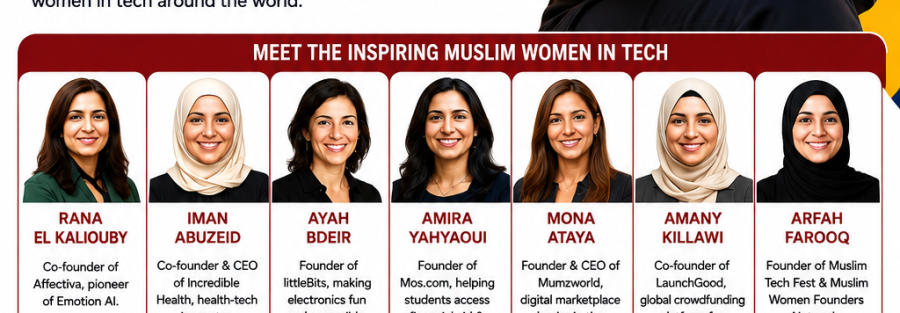
Rana el Kaliouby: Pioneering Emotion AI
What happens when artificial intelligence begins to understand human emotions? This question sits at the heart of the work of Rana el Kaliouby, an Egyptian-American computer scientist and entrepreneur who co-founded Affectiva, a pioneering company associated with the development of Emotion AI.Emotion AI explores technologies that can interpret signals such as facial expressions and voice characteristics to understand aspects of human emotional states. El Kaliouby’s career demonstrates how computer science and artificial intelligence can be applied to questions that go far beyond traditional computing.
For you as an aspiring ICT student, her story should expand your understanding of what AI can become. Artificial intelligence isn’t only about chatbots or automated tasks; it can intersect with healthcare, communication, automotive technology, customer experience, education and human-computer interaction.At IAT, you can begin exploring this rapidly developing field through Artificial Intelligence training and Data Science & Machine Learning. You don’t need to begin by developing the next generation of Emotion AI. You can start by learning programming, understanding data and gradually building projects that demonstrate how intelligent systems can solve practical problems.
Iman Abuzeid: Combining Medicine and Technology
Iman Abuzeid, a Sudanese-American physician and entrepreneur, demonstrates another powerful pathway into technology. She co-founded Incredible Health, a health-tech company that uses technology to help healthcare professionals navigate career opportunities.
Her journey is particularly important because it demonstrates the power of combining disciplines. Abuzeid didn’t have to abandon her interest in medicine to become a technology entrepreneur. Instead, she brought knowledge from healthcare into technology and used that combination to address a real problem.
This is an important lesson for you if you’re a young girl wondering whether ICT means giving up your other interests. It doesn’t. If you love healthcare, agriculture, finance, education, business or communication, technology can become the tool that helps you transform that interest into innovative solutions.You could study Computer Programming, learn Python Programming and eventually apply those skills to healthcare technology, financial technology, educational platforms or other industries.
Ayah Bdeir: Making Electronics More Accessible
Ayah Bdeir, a Lebanese-Canadian inventor and interactive artist, founded littleBits, an electronics platform designed around modular building blocks that make electronics and engineering more accessible and engaging.Her story demonstrates that technology doesn’t always have to be intimidating. Sometimes innovation means taking complicated concepts and presenting them in a way that allows more people to experiment, understand and create.
For a young girl who enjoys building things, solving puzzles or understanding how technology works, this is an important message. ICT isn’t simply about sitting behind a computer and typing code. It can involve hardware, software, electronics, networks, databases, artificial intelligence and the creative process of turning an idea into something people can use.At IAT, a foundation in ICT can give you exposure to the technologies and concepts that underpin the modern digital economy. The institution’s current ICT portfolio includes programming, web development, databases, networking, data science and other technology disciplines.
Amira Yahyaoui: Technology, Education and Financial Access
Amira Yahyaoui, a Tunisian entrepreneur and activist, founded Mos.com, an education and financial technology platform designed to help students navigate financial aid and scholarship opportunities.
Her story shows how technology can address challenges that students experience in their everyday lives. Education can be expensive and complicated to navigate, while information about financial opportunities isn’t always easy to find or understand. Digital platforms can simplify these processes and connect people with information and opportunities.
For you, this is an important entrepreneurial lesson. Don’t simply ask yourself, “What technology can I build?” Ask yourself, “What problem do people around me need help solving?”Perhaps students in your community struggle with educational information. Maybe small businesses need better digital systems. Perhaps farmers need better access to market information. Maybe healthcare workers need easier ways to manage information. Technology gives you tools that can help you explore these challenges.
Mona Ataya: Transforming E-Commerce Through Technology
Mona Ataya, founder and CEO of Mumzworld, demonstrates how technology can transform traditional commerce. Mumzworld developed into a major digital marketplace serving families and consumers in the Middle East.When you purchase something through an online marketplace, it may look simple from the customer’s perspective. Behind that experience, however, are websites, databases, payment systems, cybersecurity controls, inventory systems, logistics platforms and data analytics.
That means an e-commerce company can create opportunities for professionals across multiple ICT disciplines. You could become a software developer building the platform, a database specialist managing information, a cybersecurity professional protecting transactions or a data analyst helping the business understand customer behaviour.At IAT, you can explore technologies such as Oracle Database, PostgreSQL and MongoDB, all of which can contribute to your understanding of modern information systems.
Amany Killawi: Connecting Technology With Social Impact
Amany Killawi is a co-founder of LaunchGood, a global crowdfunding technology platform that connects people and communities with fundraising opportunities.Crowdfunding demonstrates how technology can bring people together around causes, projects and community initiatives. But behind the platform are sophisticated digital systems involving user accounts, databases, payment technologies, cybersecurity, analytics and web applications.
For an aspiring ICT student, this illustrates how technology can have both commercial and social value. You can build technology that helps businesses make money, but you can also create platforms that help communities solve problems or support meaningful causes.Your technology career doesn’t have to be defined only by the job title you eventually receive. It can also be defined by the problems you’re able to solve.
Arfah Farooq: Creating Space for Muslim Women in Technology
Some technology leaders build companies. Others build the communities that help technology professionals succeed. Arfah Farooq represents the second pathway through her work founding Muslim Tech Fest and the Muslim Women Founders Network.
Her work focuses on connecting and highlighting Muslim technical talent, engineers and startup founders across technology ecosystems. This matters because successful technology industries require more than brilliant products. They also require mentorship, networking, collaboration, visibility and opportunities.
For a young Muslim girl considering ICT, this is an especially powerful lesson. You don’t have to build your career alone. Find teachers, classmates, mentors and professional communities that encourage you to learn and experiment.You could eventually become the person who helps another young girl discover technology. Your success can therefore create opportunities beyond yourself.
What Do These Muslim Women Have in Common?
At first glance, these women may appear to have very little in common. Their businesses operate in different industries, their professional backgrounds differ and their technology solutions address different problems.Yet their journeys share a powerful pattern. They identified opportunities, developed knowledge, built solutions and continued learning. They also demonstrate that technology entrepreneurship can emerge from many different disciplines.
Rana el Kaliouby connects computer science with human emotion. Iman Abuzeid connects medicine with health technology. Ayah Bdeir connects creativity with electronics, while Amira Yahyaoui connects entrepreneurship with education and financial technology.Mona Ataya demonstrates the power of digital commerce, Amany Killawi demonstrates the potential of crowdfunding platforms and Arfah Farooq demonstrates the importance of building technology communities.
The message for you is simple: there is no single definition of a woman in technology.
Why Should a Young Girl Study ICT?
If you’re a young girl considering your future, you may wonder whether ICT is really for you. You may think technology is only for people who have been programming since childhood or that you need to be exceptionally good at mathematics before you can succeed.Those assumptions can hold you back unnecessarily. ICT is a broad field containing many different pathways, and your first course doesn’t have to determine your entire career.
At IAT, the current ICT programme covers areas including computer networks, software applications, hardware, cybersecurity, databases and emerging technologies. This can provide a broad foundation before you decide which area interests you most.
You could discover that you love software development. You might become fascinated by artificial intelligence or data science. You could discover an interest in cybersecurity, networking, databases or cloud computing. The important thing is to start.
Software Engineering Can Turn Ideas into Applications
If you enjoy creating things and solving problems, software engineering could be an exciting pathway. Modern technology companies depend on developers who can design, build, test and maintain digital applications.Think about the businesses discussed in this article. Affectiva required software and AI expertise. Mos.com requires digital platforms. Mumzworld operates through e-commerce technology, while LaunchGood depends on a sophisticated online platform.
Learning Software Engineering at IAT can therefore give you a foundation for understanding how ideas become working software.
Your first application doesn’t need to have millions of users. Build something small. Learn from it. Improve it. Then build something better.
Data Science Can Help You Turn Information into Insights
Technology companies generate enormous amounts of information. Understanding that information requires professionals who can collect, organize, analyze and interpret data.If you’re naturally curious and enjoy discovering patterns, Data Science & Machine Learning could be a pathway worth exploring. Data skills can be applied across healthcare, finance, education, agriculture, government, telecommunications and technology.
IAT also provides Data Analysis training and R Programming, giving learners additional routes into working with data.Imagine being able to take a large dataset and turn it into information that helps a business make a better decision. That’s the kind of practical capability that can make technology skills valuable across many industries.
Networking and Cybersecurity Keep Digital Systems Running
You may see a website or mobile application on your phone, but behind it are networks and infrastructure that allow information to move between users, servers and data centres.If you enjoy understanding how computers communicate, CCNA and CCNP can provide pathways into networking and infrastructure. IAT’s authorized training portfolio currently includes both programmes alongside programming, databases and other technology disciplines.
Cybersecurity is equally important. The larger digital systems become, the greater the need for professionals who can protect applications, networks, databases and information. IAT’s current training portfolio includes cybersecurity-related certifications such as CompTIA Security+ and CompTIA PenTest+, among other programmes. If you’re interested in protecting people and organizations from digital threats, cybersecurity could become your technology pathway.
Don’t Wait Until You’re an Expert
One of the biggest mistakes you can make is believing that you must know everything before you begin. Every successful technology professional started somewhere.Your first programming exercise may be difficult. Your first database project may contain errors. Your first website may not look professional. Your first attempt at data analysis may produce confusing results. That’s normal. The purpose of your first project isn’t to compete with global technology companies. It’s to develop your ability to learn, experiment, troubleshoot and improve.
At IAT, the emphasis on industry-relevant and technical training is designed to help learners develop skills that can be applied beyond the classroom. IAT describes itself as an ICT and business training institution established in 1991, with programmes focused on technology and professional skills.
Build Your Own Technology Portfolio
A certificate can demonstrate that you’ve completed training, but a portfolio can show what you can actually create. That’s why you should begin building projects as you learn.If you study programming, create a simple application. If you study web development, create a website for a community organization or small business. If you study databases, develop a basic information-management system.
If you’re interested in data science, analyze an appropriate dataset and create visualizations. If cybersecurity interests you, develop your skills through authorized learning environments and document what you learn.Each project becomes another step toward confidence and competence.
Your Background Doesn’t Have to Limit Your Future
The women featured in this article come from different countries, professional backgrounds and areas of expertise. Their journeys demonstrate that your starting point doesn’t necessarily determine your destination.You might be a young girl in Nairobi, Mombasa, Kisumu, Nakuru or another part of Kenya who is currently deciding what to study. Perhaps you’ve never written a line of code before. Maybe you’ve only used technology as a consumer.That’s okay.You can start learning.
The Institute of Advanced Technology offers a broad range of technology pathways, including programming, software engineering, AI, data science, networking, databases and cybersecurity. Its current course portfolio also includes professional and TVET-CDACC programmes.
The Next Muslim Woman in Technology Could Be You
Rana el Kaliouby, Iman Abuzeid, Ayah Bdeir, Amira Yahyaoui, Mona Ataya, Amany Killawi and Arfah Farooq have demonstrated different ways women can contribute to the technology ecosystem.You don’t have to copy their careers. Your story can be completely different.
You could develop an AI solution for African businesses. You could build software for schools. You could become a cybersecurity specialist protecting organizations. You could develop a healthcare application, create an agricultural technology platform or build a digital marketplace for African entrepreneurs.The important thing is to develop the skills that allow you to turn ideas into solutions.
Your ICT Journey Starts at IAT
If you’re a young girl thinking about studying ICT, don’t ask only, “What job will I get?” Ask yourself a bigger question: “What problems could I solve if I understood technology?”That question can change how you approach your education. Instead of seeing ICT as another course to complete, you begin seeing it as a toolkit for creating possibilities.
Explore the Institute of Advanced Technology and its range of ICT programmes. IAT currently offers pathways across software engineering, programming, web development, artificial intelligence, data science, networking, databases, cybersecurity and other technology fields.You don’t need to have your entire career planned today. Start with one course. Learn one skill. Build one project. Solve one problem.Then keep going.
Muslim Women in Technology Can Inspire Your Future
The stories of successful Muslim women in technology prove that women can become founders, engineers, inventors, entrepreneurs, technology executives and ecosystem builders. Their achievements demonstrate that technology isn’t reserved for a particular gender, country or background.
If you’re a young girl considering ICT, your future could begin with a simple decision to learn. Your first programming class could become a software career. Your first database project could lead to data engineering. Your interest in mathematics could lead to artificial intelligence, while your curiosity about computers could lead to cybersecurity or networking.The next great technology solution doesn’t have to come from Silicon Valley. It could come from Kenya. It could come from Africa. And it could come from you.
Start Your ICT Journey Today
Explore the ICT courses at IAT, identify the technology area that excites you and take your first step toward becoming a technology creator rather than simply a technology user. IAT’s current programmes include Software Engineering, Computer Programming, Web Design & Development, Data Science & Machine Learning, Python Programming, CCNA, CCNP, databases and other technology disciplines.
Your future in technology could start with one decision: choose to learn.
Muslim Women in Technology: Your Future Starts With ICT
About the Blog Writer
Dennis Njeru is a business, technology and education professional with more than 10 years of experience spanning management, finance, human resources, information technology, digital marketing and business operations. His multidisciplinary background allows him to examine technology not only from a technical perspective but also through the lens of education, career development, entrepreneurship and business transformation.
Dennis is passionate about ICT education, digital skills development and inspiring young people to pursue careers in technology. His writing focuses on making complex technology topics relatable while connecting them to practical opportunities for students and aspiring professionals. In this article, he highlights the journeys of Muslim women such as Rana el Kaliouby, Iman Abuzeid, Ayah Bdeir, Amira Yahyaoui, Mona Ataya, Amany Killawi and Arfah Farooq to demonstrate that women can become technology founders, engineers, innovators, entrepreneurs and ecosystem builders.
Through his articles, Dennis particularly seeks to encourage young girls in Kenya to see ICT as a pathway to creativity, leadership, entrepreneurship and social impact. His message in this article is that a young girl doesn’t need to know everything before starting her technology journey; she can begin by learning one skill, building one project and solving one problem. He connects these lessons to opportunities at the Institute of Advanced Technology (IAT), encouraging aspiring technology professionals to explore areas such as software engineering, programming, artificial intelligence, data science, networking, databases and cybersecurity.
Dennis believes that the next great technology solution could come from Kenya, Africa and from a young person who chooses to learn today. His goal is to use practical and inspirational storytelling to help students move from simply consuming technology to understanding, creating and using it to solve real-world problems.