
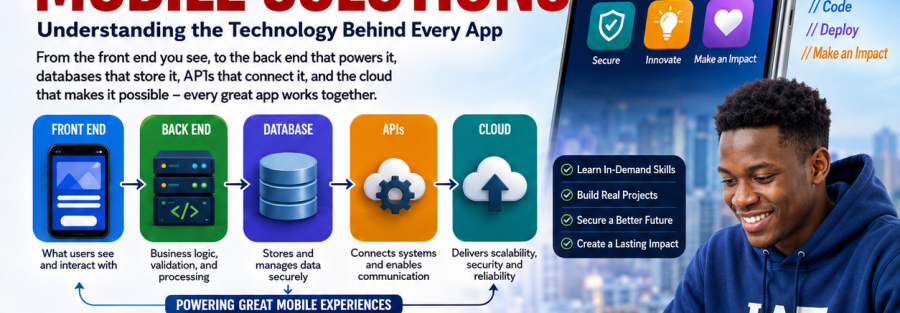
Article Description: Discover how mobile applications work by understanding the front end, back end, databases, APIs, and cloud services. Learn how these technologies connect and how studying mobile programming at the Institute of Advanced Technology (IAT) can prepare you for a successful career in Android, iOS, and cross-platform application development.
Could you build the next mobile app that millions of people use every day? Think about how many times you unlock your smartphone every day. Whether you’re checking your bank balance, ordering food, shopping online, booking a taxi, attending an online class, chatting with friends, or watching your favourite videos, you’re relying on mobile applications. Have you ever wondered what happens behind the scenes when you simply tap a button? Understanding how these applications work could be the first step toward building the next innovative app that transforms lives.
Let’s Dig in
Your smartphone is far more than a communication device-it is a powerful computer that gives you instant access to banking, education, healthcare, entertainment, shopping, transportation, and countless other digital services. Every time you order food, send money, track your fitness goals, reserve a hotel, or attend an online class, you interact with a sophisticated mobile application powered by multiple interconnected technologies. Although these interactions feel effortless, complex processes occur behind the scenes within seconds. Understanding how these technologies work together is one of the most valuable skills you can develop if you want to pursue a successful career in software development.
Businesses today invest heavily in mobile application development because customers increasingly prefer accessing services through smartphones and tablets rather than desktop computers. Across Kenya and around the world, organizations are accelerating their digital transformation initiatives to improve customer experience, streamline operations, and remain competitive. Financial institutions, hospitals, universities, logistics companies, retailers, media houses, telecommunications providers, and government agencies all require skilled professionals who can design, build, secure, and maintain modern mobile applications. This growing demand has made mobile application development one of the most exciting and rewarding career opportunities within the ICT industry.
If you’re planning to become a mobile application developer, choosing the right institution is just as important as selecting the right programming language. The Institute of Advanced Technology (IAT) equips you with practical programming skills that prepare you for real-world software development projects. Through industry-oriented programmes such as the Computer Programming Course and the Software Engineering Programme, you gain the knowledge required to develop modern web and mobile applications using industry-standard technologies. These practical programmes emphasize problem-solving, software engineering principles, and project-based learning that employers consistently value.
In this article, you’ll discover how mobile applications work by exploring the front end, back end, databases, APIs, cloud infrastructure, and the communication that connects them into one seamless system. You’ll also learn about the programming languages, frameworks, databases, and cloud technologies that professional developers use every day. Most importantly, you’ll see how IAT can help you build the knowledge, practical skills, and confidence required to launch a rewarding career in mobile software engineering.
What Is a Mobile-Based Application?
A mobile-based application, commonly called a mobile app, is software specifically designed to operate on smartphones, tablets, and other portable devices. Unlike traditional desktop software, mobile applications are optimized for touchscreens, compact displays, mobile processors, and wireless connectivity. This allows you to access services wherever you are, making mobile apps one of the most widely used forms of software in today’s digital economy. From banking applications and ride-hailing platforms to healthcare portals, educational systems, messaging services, social media platforms, and productivity tools, mobile applications have become part of everyday life.
Mobile applications generally fall into three categories: native applications, hybrid applications, and cross-platform applications. Native applications are built specifically for one operating system, such as Android or iOS, enabling them to deliver exceptional performance while taking full advantage of device features. Hybrid and cross-platform applications, on the other hand, allow developers to write code once and deploy it across multiple operating systems, significantly reducing development costs while maintaining excellent user experiences. Choosing the most appropriate approach depends on your business goals, available budget, target audience, long-term maintenance strategy, and technical requirements.
Most mobile applications also communicate continuously with remote servers to synchronize information. For example, when you update your profile picture, send a message, transfer money, or purchase an item online, your information is securely transmitted to a server before being stored inside a database. This continuous communication enables you to access the same information across multiple devices while ensuring that your data remains accurate, synchronized, and secure. Without this seamless interaction, modern mobile applications would not be able to deliver the convenience users expect today.
Understanding these concepts gives you a strong foundation for developing enterprise-quality mobile applications. At IAT, you gain practical programming experience that enables you to understand both the technical and business aspects of mobile application development. This balanced approach prepares you to develop applications that satisfy modern user expectations while following internationally recognized software engineering best practices.
Understanding the Mobile Front End
Whenever you open a mobile application, the first thing you notice is its appearance and how easily you can interact with it. Everything you see on your screen-including menus, buttons, icons, images, animations, forms, notifications, and navigation-is known as the front end. It is the part of the application that creates your first impression and determines whether using the app feels simple, enjoyable, and efficient. If you’ve ever stopped using an app because it was confusing or slow, you’ve already experienced the impact of poor front-end design.
A successful mobile application is more than just attractive colours and beautiful graphics. As a developer, you need to create an interface that responds quickly, works smoothly on different screen sizes, supports accessibility features, and provides users with a consistent experience regardless of the device they are using. Every button, animation, and screen transition should help users accomplish their tasks effortlessly. When the front end is carefully designed, users spend more time using the application, are more satisfied with the experience, and are more likely to recommend it to others.
The programming language and framework you choose depend largely on the platform for which you are developing the application. Native Android applications are primarily built using Kotlin and Java because these technologies provide excellent performance and seamless integration with Android devices. Native iOS applications are commonly developed using Swift, which was specifically designed by Apple to build fast, secure, and modern applications for iPhones and iPads. If your goal is to build one application that works across multiple operating systems, frameworks such as Flutter, React Native, and .NET MAUI enable you to develop high-quality cross-platform applications while significantly reducing development time and maintenance costs.
Creating an excellent front end also requires careful consideration of performance and usability. As a developer, you must optimize your application to minimize battery consumption, reduce loading times, support offline functionality where appropriate, and ensure smooth navigation between screens. You also need to accommodate different screen resolutions, operating systems, accessibility requirements, and user preferences to create an application that feels natural to everyone who uses it. These considerations transform a technically functional application into one that users genuinely enjoy using.
If you’re planning to become a professional mobile application developer, mastering front-end development is one of the most important steps in your learning journey. Before diving into advanced mobile frameworks, you should first build a solid understanding of programming logic, object-oriented programming, and software engineering principles. At the Institute of Advanced Technology (IAT), the Computer Programming Course introduces you to the programming fundamentals that every developer needs, while the Software Engineering Programme equips you with the practical skills required to design, build, test, and maintain professional software applications. By developing these core competencies first, you’ll find it much easier to master Android development, iOS development, and modern cross-platform mobile application frameworks.
Understanding the Mobile Back End
Although users spend most of their time interacting with the mobile application’s interface, the real work happens behind the scenes. The back end is the invisible engine that processes requests, applies business rules, manages security, communicates with databases, and coordinates information between your mobile device and remote servers. Every time you log into an application, make an online payment, upload a photograph, send a message, or update your personal information, the back end is responsible for processing those actions accurately and securely. Without a reliable back end, even the most beautifully designed mobile application would be unable to perform useful tasks.
Imagine opening your favourite mobile banking application to check your account balance. After entering your username and password, your mobile application securely sends your login credentials to a remote server. The server verifies your identity, confirms your permissions, retrieves your account information from the database, and sends the requested information back to your smartphone within just a few seconds. This entire process occurs almost instantly, demonstrating the remarkable coordination between mobile devices, servers, and databases.
Developers build mobile back ends using powerful programming languages such as Python, Java, PHP, C#, Node.js, Go, and Ruby. These programming languages are supported by widely used frameworks including Django, Flask, Laravel, Spring Boot, ASP.NET Core, and Express.js. Together, these technologies help developers build secure, scalable, and high-performance mobile application servers capable of supporting thousands-or even millions-of users simultaneously.
As you progress in your programming journey, you’ll discover that back-end development offers numerous exciting career opportunities. Learning server-side programming enables you to build enterprise applications, integrate cloud services, secure user information, process online payments, and develop sophisticated mobile platforms. At IAT, you’ll strengthen these skills through practical software development projects that mirror real industry requirements. This hands-on learning approach ensures that you graduate with both the technical expertise and practical experience employers seek in today’s rapidly growing mobile application industry.
Understanding Mobile Databases: The Memory Behind Every App
Every mobile application you use depends on a database to store, organize, retrieve, and manage information efficiently. Whether you’re saving contacts, sending messages, making mobile payments, shopping online, or tracking your fitness progress, your information needs to be stored securely so that it can be retrieved whenever you need it. Without databases, mobile applications would lose your information every time you closed the app, making them impractical for everyday use. Databases therefore act as the permanent memory that allows modern mobile applications to deliver reliable and personalized experiences.
Think about your favourite online shopping application. Every product you browse has a name, price, description, stock quantity, supplier information, customer reviews, and product images. Instead of storing this information inside the application itself, all these records are organized within a database that can retrieve thousands of products almost instantly. Whenever you search for an item, your request is sent to the database, which quickly locates the relevant information before displaying it on your mobile device. This remarkable speed is one of the reasons databases are such an essential component of mobile application development.
Most enterprise mobile applications rely on relational database management systems because they provide excellent accuracy, consistency, and security. Popular relational databases include MySQL, PostgreSQL, Oracle Database, and Microsoft SQL Server. Developers communicate with these databases using Structured Query Language (SQL) to create, retrieve, update, and manage information efficiently. These technologies are widely used in banking, healthcare, education, government, insurance, and enterprise business systems where maintaining accurate and secure data is essential.
Modern mobile applications also make extensive use of NoSQL and cloud-based databases, especially when managing large amounts of rapidly changing information. Technologies such as MongoDB provide exceptional flexibility for handling unstructured data, while Firebase enables real-time synchronization between mobile devices and cloud servers. Applications that need to continue functioning without internet connectivity often use embedded databases such as SQLite or Realm Database to store information locally before synchronizing it when connectivity returns. By understanding the strengths of these different database technologies, you’ll be able to select the most appropriate solution for every mobile application you develop.
As you progress in your programming journey, database design becomes one of the most valuable technical skills you can acquire. Understanding how to structure information efficiently enables you to build applications that are faster, more reliable, and easier to maintain. Through practical software development projects at the Institute of Advanced Technology (IAT), you’ll gain hands-on experience designing and integrating databases into real-world mobile applications. These practical skills are highly valued by employers because almost every business application depends on effective data management.
APIs: The Communication Bridge That Connects Mobile Applications
Although mobile applications appear to perform many tasks independently, they constantly communicate with servers and external systems behind the scenes. This communication is made possible through Application Programming Interfaces (APIs), which act as secure messengers between different software systems. APIs enable your mobile application to request information, send data, process payments, display maps, authenticate users, and integrate with countless online services without exposing the internal workings of those systems. As a result, APIs have become one of the most important technologies in modern mobile application development.
Imagine opening a ride-hailing application to request transportation. Within seconds, the application determines your location, displays nearby drivers, estimates the fare, calculates the route, processes your payment, and sends notifications to both you and the driver. Although this appears to happen effortlessly, your mobile application is actually communicating with several independent systems simultaneously through APIs. Mapping services, payment gateways, customer databases, messaging platforms, and location services all exchange information continuously to provide the seamless experience you enjoy.
Most mobile developers build applications using REST APIs because they are lightweight, efficient, and compatible with virtually every programming language and mobile platform. Increasingly, organizations are also adopting GraphQL because it allows applications to retrieve only the specific information they require, improving performance while reducing unnecessary data transfers. Some enterprise organizations continue to rely on SOAP web services where strict security, standardized messaging, and regulatory compliance are essential. Understanding these technologies enables you to build mobile applications capable of integrating seamlessly with cloud services, enterprise systems, and third-party platforms.
As you develop more sophisticated applications, you’ll discover that APIs make it possible to extend your application’s capabilities without building every feature yourself. Instead of creating your own payment system, weather service, mapping platform, or messaging infrastructure, you can securely connect to specialized providers through well-designed APIs. This approach accelerates development, improves reliability, and enables your applications to deliver richer functionality. Learning API development and integration is therefore an essential milestone for every aspiring mobile application developer.
The Interconnection Between the Mobile Front End, Back End, and Database
The true strength of a mobile application does not lie in its front end, back end, or database individually-it lies in the way these three components work together as one integrated system. Every time you tap a button, submit a form, make a payment, upload a photograph, or search for information, your request travels through each of these layers before the final result appears on your screen. This entire process usually takes only a few seconds, making the interaction feel effortless even though numerous technologies are working together behind the scenes.
Imagine registering for a programming course at the Institute of Advanced Technology (IAT) using your smartphone. You begin by completing an online registration form presented by the application’s front end. When you tap the Submit button, your information is securely transmitted to the back end, where validation rules verify that every required field has been completed correctly and confirm that your email address has not already been registered. Once the information has been validated, it is stored inside the database before a confirmation message is sent back to your mobile application, notifying you that your registration has been completed successfully.
Exactly the same sequence occurs whenever you log into a mobile banking application, reserve a flight, purchase products online, stream music, schedule a hospital appointment, or send a message through a social networking platform. The front end captures your request, the back end processes the business logic, and the database stores or retrieves the necessary information before the results are returned to your mobile device. Every layer depends on the others to complete the transaction accurately, securely, and efficiently. If any one of these components fails, the entire application can become unavailable or unable to perform its intended function.
Understanding this interconnected architecture enables you to become a more effective software developer because you begin to appreciate how every component contributes to the overall user experience. Rather than viewing mobile development as simply writing code for smartphone screens, you’ll understand how programming languages, APIs, databases, cloud services, and servers collaborate to create the applications people depend on every day. This holistic understanding is exactly what modern employers seek when recruiting software developers capable of designing, building, and maintaining enterprise-quality mobile applications.
Mobile Application Security: Protecting Your Users and Their Data
As you develop mobile applications, one responsibility should always come before adding new features-protecting your users and their information. Mobile applications frequently handle sensitive personal, financial, medical, educational, and business data, making them attractive targets for cybercriminals. Every time someone logs into a banking application, pays for goods using a mobile wallet, accesses confidential business information, or stores personal records, they trust the application to keep that information safe. Building that trust requires security to be integrated into every stage of the software development process rather than being added at the end of a project.
Security begins on the mobile application’s front end by validating the information users enter before it is sent to the server. However, as a developer, you should understand that client-side validation alone is never enough because attackers can bypass the mobile interface and attempt to communicate directly with backend systems. The back end therefore performs additional authentication, authorization, encryption, and validation to ensure that only legitimate users gain access to protected resources. These multiple security layers help defend applications against common threats such as SQL Injection, insecure APIs, session hijacking, malware, and unauthorized access.
Another important aspect of mobile security is protecting information while it travels across the internet. Modern mobile applications use secure communication protocols such as HTTPS, which relies on Transport Layer Security (TLS) to encrypt information exchanged between mobile devices and servers. Developers also implement secure password storage, encrypted databases, biometric authentication, secure authentication tokens, and regular security testing before applications are released to users. These practices help ensure that confidential information remains protected even when applications are used on public networks.
As you build your programming career, you’ll discover that cybersecurity knowledge significantly increases your value in the technology industry. Employers increasingly seek developers who understand how to build secure applications rather than simply functional ones. Through practical programming and software engineering projects at the Institute of Advanced Technology (IAT), you can develop the habit of incorporating security into every phase of application development. This proactive approach prepares you to build mobile applications that users and organizations can trust.
Cross-Platform Mobile Development: Build Once, Deploy Everywhere
One of the biggest challenges facing software developers is creating applications that work seamlessly on both Android and iOS devices. Developing two completely separate applications often increases development costs, extends project timelines, and creates additional maintenance work whenever updates are required. Cross-platform development frameworks solve this challenge by allowing you to write a single codebase that can be deployed across multiple operating systems with minimal modification. This approach enables organizations to reach larger audiences while reducing overall software development costs.
Among today’s most popular cross-platform frameworks is Flutter, which uses the Dart Programming Language to build high-performance mobile applications with attractive and responsive user interfaces. Another widely used framework is React Native, which enables developers with JavaScript experience to build native-like applications efficiently. Microsoft’s .NET MAUI also allows developers to create applications for Android, iOS, Windows, and macOS using a single codebase written in C#. These technologies continue to grow in popularity because they combine efficiency, flexibility, and excellent user experiences.
Although cross-platform frameworks offer many advantages, native development remains the preferred choice for certain high-performance applications. Developers who require deep integration with Android hardware typically use Kotlin, while those building applications specifically for Apple devices often rely on Swift. Understanding both native and cross-platform approaches allows you to select the most suitable technology based on performance requirements, business goals, available resources, and long-term maintenance considerations.
As your programming skills continue to grow, you’ll find that learning cross-platform frameworks becomes much easier once you have mastered programming fundamentals and software engineering principles. This is why IAT emphasizes building strong foundational programming skills before introducing advanced mobile development technologies. By following this structured learning pathway, you’ll be well prepared to develop applications for multiple platforms while meeting the expectations of modern employers.
Cloud Computing: Powering Modern Mobile Applications
Most mobile applications today rely on cloud computing to provide the speed, reliability, and scalability that users expect. Instead of storing all application data on a smartphone, cloud platforms securely store information on remote servers that can be accessed from anywhere in the world. This allows you to log into the same application from multiple devices while seeing the same information, preferences, and account details. Cloud computing has therefore become an essential part of modern mobile application development.
Leading cloud providers such as Amazon Web Services (AWS), Microsoft Azure, and Google Cloud Platform (GCP) provide developers with secure infrastructure for hosting mobile applications, databases, authentication services, file storage, analytics, artificial intelligence, and application monitoring. These services allow developers to build highly available systems capable of supporting millions of users without investing in expensive physical servers. As user demand increases, cloud platforms automatically allocate additional computing resources to maintain performance.
Cloud computing also simplifies application maintenance, disaster recovery, software deployment, data backup, and global accessibility. Developers can release updates rapidly while ensuring users always receive the latest application features and security improvements. For businesses, this translates into reduced operational costs, improved reliability, and greater flexibility when expanding into new markets. Understanding cloud technologies therefore gives you an important competitive advantage as you prepare for a career in software development.
At the Institute of Advanced Technology (IAT), students are encouraged to understand not only programming languages but also the technologies that support modern enterprise applications. Combining mobile programming with cloud computing knowledge prepares you for careers in mobile software development, cloud engineering, backend development, DevOps, and digital transformation. This broader skill set makes you more adaptable in an industry where technology continues to evolve rapidly.
DevOps: Delivering Better Mobile Applications Faster
Developing a mobile application does not end when the coding is complete. Modern software development requires continuous testing, deployment, monitoring, maintenance, and improvement throughout an application’s lifecycle. This collaborative approach is known as DevOps, and it has become one of the most important practices in professional software development. By bringing software developers and IT operations teams together, DevOps enables organizations to release high-quality applications more quickly and reliably.
A key component of DevOps is version control, which enables development teams to collaborate without losing track of changes made to application code. Technologies such as Git, together with platforms like GitHub and GitLab, allow developers to manage source code efficiently, review changes, and collaborate across distributed teams. Automated testing, Continuous Integration (CI), and Continuous Deployment (CD) further improve software quality by ensuring that new features are tested before they are released to users.
As you prepare for a career in mobile application development, you’ll discover that employers expect more than programming skills alone. They value professionals who understand collaborative software development, version control, automated testing, cloud deployment, and continuous improvement practices. Developing these complementary skills enables you to contribute effectively to professional software engineering teams while producing reliable, maintainable, and high-quality mobile applications. By mastering both coding and DevOps principles, you’ll be better equipped to succeed in today’s fast-moving technology industry.
Career Opportunities in Mobile Application Development
If you’re considering a career in technology, mobile application development offers some of the most exciting and rewarding opportunities available today. As businesses continue to embrace digital transformation, mobile applications have become essential tools for delivering products and services across virtually every industry. From banking and healthcare to education, agriculture, logistics, retail, telecommunications, media, manufacturing, and government, organizations rely on mobile applications to connect with customers and improve operational efficiency. This growing dependence on mobile technology has created a strong demand for skilled developers who can build secure, scalable, and user-friendly applications.
By developing expertise in mobile application development, you open the door to a wide range of professional roles. Career opportunities include Android Developer, iOS Developer, Cross-Platform Mobile Developer, Mobile Software Engineer, Backend Developer, API Developer, Database Developer, Cloud Engineer, DevOps Engineer, Mobile Security Specialist, Quality Assurance (QA) Automation Engineer, Solutions Architect, Technical Consultant, and Software Project Manager. If entrepreneurship appeals to you, these same skills can also help you launch your own technology startup or create innovative mobile applications for distribution through app stores. The ability to solve real-world problems through software is one of the greatest advantages of learning mobile application development.
Another significant benefit of this profession is its global reach. Today’s software developers frequently work with organizations located in different countries without leaving their home offices. Remote working, freelancing, and international software development projects have made geographical location far less important than technical competence and problem-solving ability. By building a strong portfolio and continuously improving your programming skills, you can compete for opportunities both within Kenya and across the global technology marketplace.
The Institute of Advanced Technology (IAT) prepares learners for these opportunities by combining theoretical knowledge with extensive practical experience. Through project-based learning, students develop applications that demonstrate their technical abilities while building professional portfolios that employers value. This practical approach helps graduates transition confidently from the classroom into the workplace.
Future Trends in Mobile Application Development
Technology never stands still, and mobile application development continues to evolve at an incredible pace. As you build your programming career, you’ll encounter emerging technologies that are transforming how mobile applications are designed, developed, and used. Understanding these trends will help you remain competitive and prepare for the future demands of the software development industry.
One of the most influential developments is the integration of Artificial Intelligence (AI) into mobile applications. AI enables applications to recognize speech, translate languages, recommend products, personalize learning experiences, analyse user behaviour, detect fraud, and provide intelligent virtual assistants. These capabilities are already transforming industries such as healthcare, finance, education, agriculture, and customer service. As AI technologies continue advancing, mobile developers who understand how to integrate intelligent features into their applications will be increasingly sought after.
Another rapidly growing area is the Internet of Things (IoT), where mobile applications communicate with connected devices such as smart homes, wearable fitness trackers, industrial sensors, connected vehicles, healthcare equipment, and agricultural monitoring systems. Emerging technologies such as 5G, Augmented Reality (AR), Virtual Reality (VR), edge computing, blockchain, and machine learning are also expanding what mobile applications can achieve. These innovations are creating new opportunities for developers to build faster, smarter, and more immersive digital experiences that improve the way people live and work.
Preparing for these technological advances requires more than simply learning the latest programming language. It requires a solid understanding of programming fundamentals, software engineering principles, databases, APIs, cloud computing, cybersecurity, and application architecture. This strong foundation enables you to adapt quickly as new technologies emerge throughout your career.
Your Mobile Application Development Learning Roadmap at IAT
Every successful software developer begins with the same first step-learning the fundamentals of programming. Before building sophisticated mobile applications, you need to understand programming logic, variables, data structures, functions, algorithms, object-oriented programming, debugging, and problem-solving techniques. These core concepts provide the foundation upon which every modern programming language and software framework is built. Once these fundamentals become second nature, learning new technologies becomes much faster and more enjoyable.
After establishing your programming foundation, you can begin specializing in mobile application development. Learning Kotlin and Java prepares you for Android development, while Swift opens the door to native iOS development. If your goal is to create applications for multiple operating systems from a single codebase, you can expand your skills by learning Flutter, React Native, or .NET MAUI. Mastering these technologies enables you to build modern, high-performance applications for a wide range of mobile devices.
Your learning journey should also include backend development, database management, API integration, cloud computing, software testing, cybersecurity, version control, and DevOps. Modern mobile applications depend on all these technologies working together to deliver secure, scalable, and reliable digital services. By developing expertise across these interconnected areas, you’ll become a well-rounded software developer capable of contributing to enterprise-level software projects from start to finish.
The Institute of Advanced Technology (IAT) provides a structured pathway that helps you build these competencies progressively. Whether you begin with the Computer Programming Course, continue into the Software Engineering Programme, or explore other programmes through the Faculty of Information & Communication Technology, you’ll gain industry-relevant knowledge through practical, hands-on learning. This approach equips you with the confidence and technical expertise needed to succeed in today’s competitive technology sector.
On to the Next One
Every mobile application you use—from banking and e-commerce platforms to healthcare systems, learning portals, and entertainment services—is powered by the seamless collaboration of the front end, back end, database, APIs, cloud infrastructure, and modern software engineering practices. Although users typically see only the attractive interface on their smartphones, an extensive ecosystem of technologies works behind the scenes to process requests, secure information, manage data, and deliver the fast, reliable experiences that people expect. Understanding how these components interact gives you the knowledge required to design, develop, and maintain professional mobile applications that solve real-world problems.
As organizations continue investing in digital transformation, the demand for skilled mobile application developers will only continue to grow. Employers increasingly seek professionals who understand not only programming languages but also databases, cloud computing, APIs, cybersecurity, DevOps, and application architecture. By building expertise across these areas, you’ll position yourself for exciting career opportunities in software development, cloud engineering, digital innovation, and technology entrepreneurship.
Whether your ambition is to develop Android applications, build iOS solutions, create cross-platform mobile applications, or establish your own software company, your journey begins with acquiring the right knowledge and practical experience. By investing in your education today, you’ll be preparing yourself to build the digital solutions that shape tomorrow’s businesses, communities, and economies.
Start Your Mobile App Development Journey with IAT
Are you ready to turn your passion for technology into a rewarding career? The Institute of Advanced Technology (IAT) offers industry-focused programmes that equip you with the programming, software engineering, database, and mobile application development skills employers are actively seeking.
Begin by exploring the Computer Programming Course, advance through the Software Engineering Programme, and discover additional ICT training opportunities through the Faculty of Information & Communication Technology. With experienced trainers, practical projects, industry-relevant curricula, and a strong focus on hands-on learning, IAT provides the foundation you need to succeed in the rapidly evolving world of software development.
The next mobile application that transforms an industry, improves lives, or launches a successful technology business could begin with the programming skills you choose to learn today. Let IAT help you build that future.
About the Blog Article Writer
Dennis Njeru is a technology writer and educator with a focus on demystifying complex software development concepts for a broad audience. Through this work, he demonstrates a deep understanding of modern web application architecture-from front-end interfaces to back-end logic, databases, and APIs. He is passionate about bridging the gap between theoretical knowledge and practical, industry-relevant skills, consistently connecting technical principles to real-world business applications. His writing, as seen in this article, positions him as an advocate for practical ICT education, particularly promoting the value of comprehensive programming and software engineering.