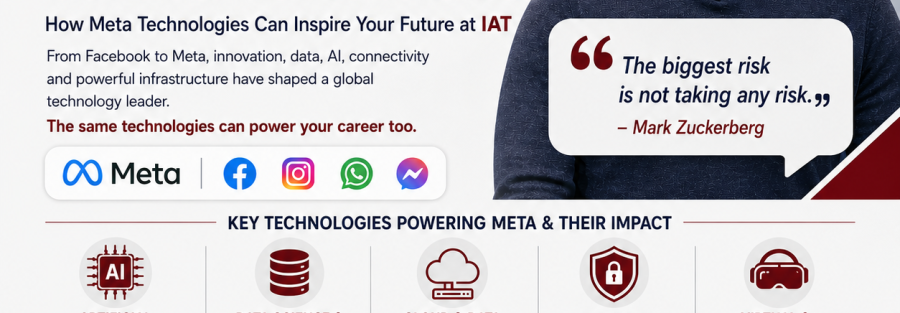
Article Description: Discover how the technologies behind Mark Zuckerberg’s Meta companies can inspire current and future ICT students at the Institute of Advanced Technology (IAT) to pursue careers in artificial intelligence, programming, data science, networking, cybersecurity, databases, cloud computing and emerging technologies.
What Can You Learn from Mark Zuckerberg’s Technology Journey?
When you open Facebook, Instagram or WhatsApp, you’re using technologies that operate at a massive global scale. Behind these familiar applications are programmers, database specialists, network engineers, cybersecurity professionals, data scientists, artificial intelligence specialists and infrastructure experts. For an ICT student, this technology ecosystem provides an opportunity to understand how the skills you learn today can eventually be transformed into products and services used by millions of people.
Mark Zuckerberg is best known as the co-founder of Facebook and the founder and CEO of Meta Platforms. What started as a social networking platform has developed into a much broader technology ecosystem involving Facebook, Instagram, WhatsApp, Messenger, artificial intelligence, virtual reality, augmented reality, wearable devices and large-scale computing infrastructure. Meta’s technology journey therefore provides an excellent case study for students who want to understand how different ICT disciplines can come together to create innovative digital solutions.
For students at the Institute of Advanced Technology (IAT), the story is particularly relevant because IAT offers training in many of the same technology areas that underpin modern digital companies. IAT describes its mission as preparing learners through hands-on learning, industry partnerships and technology-focused training while bridging the gap between academic theory and real-world practice. This means you shouldn’t look at Zuckerberg’s companies simply as successful social media businesses, but as examples of where ICT skills can take you.
From Facebook to a Global Technology Ecosystem
Facebook began with a relatively simple idea of connecting people online. As the number of users increased, however, the technology required to support the platform became increasingly sophisticated. The company needed powerful databases, scalable software, reliable networks, secure infrastructure and systems capable of processing enormous quantities of information.
This is an important lesson for you as an IAT student. You may begin by creating a simple website, database or software application, but the principles you learn can eventually be applied to much larger systems. IAT currently offers programmes covering Software Engineering, Computer Programming, Web Design & Development and Python Programming, giving students opportunities to develop several of these foundational skills.
The technology journey of Meta therefore demonstrates why practical ICT education matters. When you learn a programming language at IAT, you aren’t simply learning syntax for an examination. You’re developing a skill that can help you create applications, automate processes and solve real problems.
Artificial Intelligence and the Future Of ICT
Artificial intelligence is now one of the most important technologies in Meta’s ecosystem. AI can support recommendation systems, content understanding, natural-language processing, computer vision and other digital experiences. Meta has also invested heavily in the infrastructure required to train and deploy increasingly sophisticated AI models. Meta’s AI infrastructure involves powerful computing systems, GPUs, high-speed networking, storage and specialized software. The company has described large-scale GPU clusters designed to support AI workloads, demonstrating that modern artificial intelligence requires expertise across software, hardware, networking and data. For instance, Meta’s partnerships with NVIDIA involve deploying millions of advanced GPUs to build hyperscale data centres optimized for AI training and inference, and they are even developing custom AI chips.
This is where IAT students can connect Zuckerberg’s technology journey to their own education. IAT currently offers Artificial Intelligence training as well as Data Science & Machine Learning and Python Programming. These areas can provide a starting point for students who want to understand how intelligent systems are designed and applied.
You don’t need to begin by trying to build the next major AI platform. You can start by learning programming, understanding data and developing small projects that demonstrate how AI can solve practical problems.
Python and the Programming Skills Behind Innovation
Programming is one of the foundations of modern technology. Applications such as social networks, business systems, websites, mobile applications and AI solutions all require developers who understand how to translate ideas into working software.
Python has become particularly important in areas such as artificial intelligence, data analysis and automation. IAT offers Python Programming as part of its technology training portfolio, giving learners an opportunity to develop programming skills that can be applied across multiple technology fields.
As an IAT student, you can therefore view programming as more than a classroom subject. You can use it to develop your own projects, automate repetitive tasks, analyze information and create digital solutions. The journey of Zuckerberg’s companies demonstrates that successful technology products begin with people who can turn ideas into functioning systems.
Data Science and the Power of Information
Facebook, Instagram and other digital platforms depend heavily on data. Every large digital platform needs technologies capable of storing, processing, analyzing and interpreting enormous quantities of information. Data can then help organisations understand users, improve products, identify patterns and make better decisions.
This is why data science is an important career area for ICT students. IAT offers Data Science & Machine Learning as well as Data Analysis and R Programming, giving learners different pathways into working with data.
You can connect this directly to the technologies behind Meta. When you study data analysis at IAT, think about the millions of pieces of information that large digital platforms must process every day. The skills you develop can eventually be applied in banking, healthcare, education, agriculture, telecommunications, government and technology companies.
Databases and the Technology Behind Social Platforms
A social network is fundamentally a data-intensive system. Information about users, accounts, posts, messages, connections and interactions needs to be stored and retrieved efficiently. Without effective database systems, platforms handling large amounts of information would struggle to deliver reliable services.
This makes database management an important part of your ICT journey. IAT offers training in technologies including Oracle Database, PostgreSQL and MongoDB, providing learners with exposure to different approaches to database management .
Imagine the knowledge required to build a system that stores information for millions of users. You need to understand database design, queries, indexing, security, backup, performance and reliability. These are the kinds of technical concepts that can turn your classroom knowledge into practical ICT skills.
Networking and Connecting the Digital World
You may see Facebook or Instagram as applications on your smartphone, but behind those applications are extensive networks connecting computers, servers and data centres. Networking makes it possible for information to move between users and the systems that provide digital services.
Meta’s infrastructure includes high-performance networks designed to support demanding computing and AI workloads. Its engineers have described the importance of high-bandwidth and low-latency networking when connecting large numbers of GPUs and other computing resources. For instance, Meta has adopted the NVIDIA Spectrum-X Ethernet networking platform to provide low latency, predictable performance for its AI infrastructure.
This creates a direct connection with IAT’s CCNA and CCNP training. If you enjoy understanding how computers communicate, networking can provide a pathway into network administration, infrastructure management, cybersecurity, cloud computing and data-centre operations. The CCNA certification is widely recognized as the foundational step for a career in Cisco networking.
Cybersecurity and Protecting Digital Systems
The larger a technology platform becomes, the more important security becomes. Digital organisations need to protect accounts, applications, databases, networks and infrastructure against threats while also maintaining the confidentiality and integrity of information.
This makes cybersecurity another important area for students considering their ICT careers. IAT offers programmes such as CompTIA Security+, CompTIA Cyber Security Analytics, CompTIA PenTest+ and other cybersecurity-related certifications .
The connection to Meta is straightforward. A social networking platform that serves huge numbers of users needs professionals who understand how to secure systems and respond to security challenges. As an IAT student, cybersecurity training can therefore help you understand one of the most important responsibilities of modern ICT professionals.
Cloud Computing and Scalable Technology
A large technology platform cannot depend on a single computer. It requires distributed infrastructure capable of handling large numbers of users, applications, requests and data transactions.
Meta’s infrastructure demonstrates the importance of scalability because technology designed for a small system must evolve when the number of users and the complexity of workloads increase. The same principle applies to businesses developing websites, mobile applications, e-commerce platforms and digital services.
For an IAT student, this is a reason to explore cloud computing alongside networking and programming. IAT’s technology portfolio includes CompTIA Cloud+, which validates skills in cloud architecture, deployment, operations, and security for multi-cloud environments. Its broader authorized training programmes cover networking, programming, databases and other technologies that contribute to modern infrastructure.
Virtual Reality and Emerging Technologies
Meta has also invested in virtual reality and augmented reality through its Reality Labs initiatives. These technologies demonstrate how ICT is moving beyond traditional websites and applications toward more immersive digital experiences.
For students, this creates opportunities to explore computer graphics, software development, user experience design, gaming technologies, 3D environments and emerging computing platforms. The important lesson is that the ICT industry continues to evolve, meaning that your career opportunities can expand as new technologies emerge.
IAT’s emphasis on technology and practical skills provides students with a foundation from which they can continue exploring these emerging areas. The institution describes its approach as focusing on hands-on learning and real-world technology applications.
Why IAT is Relevant to Your Technology Future
The story of Zuckerberg’s technology companies shows why choosing the right ICT training environment matters. You need an institution where you can develop technical foundations while also understanding how those skills are applied in the real world.
IAT states that it was established in 1991 and focuses on IT and business training, with programmes designed to provide industry-relevant skills. Its current technology portfolio includes programming, web development, AI, data science, databases, networking, cybersecurity and other specialized areas.
This means an IAT student can build a technology learning pathway based on personal interests. You could begin with ICT fundamentals, progress into programming, then specialize in AI, data science, cybersecurity, networking, databases or another technology area.
From Learning Technology to Building Technology
The most important lesson you can learn from Mark Zuckerberg’s technology journey isn’t that you should try to build another Facebook. The real lesson is that technology creates opportunities for people who can identify problems and develop solutions.
As an IAT student, you should therefore challenge yourself to move beyond classroom theory. If you’re studying programming, build an application, while if you’re studying databases, create a practical information-management system. If you’re studying networking, build and troubleshoot a network laboratory, while if you’re learning data analysis, create dashboards that answer real questions.
Your first project doesn’t need to have millions of users. It needs to solve a genuine problem and demonstrate that you can apply what you’ve learned.
Build Your ICT Portfolio at IAT
One of the best ways to prepare for a technology career is to build evidence of your skills. A certificate can show that you completed training, but a portfolio can demonstrate what you can actually create.
You could build a website, mobile application, database system, data-analysis project, AI prototype or cybersecurity laboratory project. You can then document what problem you were solving, which technologies you used and what you learned during development.
This approach can help you become more confident because every completed project adds another practical experience to your ICT journey. It can also help you identify the technology areas that you genuinely enjoy.
Which IAT Course Could Match Your Technology Interests?
If Mark Zuckerberg’s technology journey inspires you, you can use it as a starting point for thinking about your own ICT career. Students interested in building applications can explore Software Engineering, Computer Programming, Web Design & Development and Python Programming.
Students interested in intelligent technologies can explore Artificial Intelligence, Data Science & Machine Learning, Data Analysis and R Programming. Students who enjoy infrastructure can explore CCNA, CCNP, Linux+, Cloud+ and database technologies, while those interested in security can explore IAT’s cybersecurity and CompTIA programmes.
The choice ultimately depends on your interests and career goals. The important thing is to begin developing skills that allow you to participate in the digital economy rather than simply watching technological innovation happen around you.
The Future Starts with What You Learn Today
Mark Zuckerberg’s companies demonstrate what can happen when programming, data, artificial intelligence, networking, databases, infrastructure and creativity come together. The technologies powering Meta may be operating at a scale that seems impossible for an individual student, but the underlying concepts can be learned step by step.
This is where IAT can become part of your technology journey. Through its broad portfolio of ICT and technology programmes, IAT provides learners with opportunities to develop practical skills across programming, AI, data science, networking, databases, cybersecurity and other technology areas.
You don’t have to wait until you become a professional to start innovating. Start with one skill, build one project, solve one problem and keep learning.
Build Your Future With IAT
Mark Zuckerberg’s technologies can inspire your ICT journey at IAT. The technology behind Meta shows that ICT skills can become powerful tools for solving real-world problems. At IAT, you can build a foundation in areas such as programming, AI, data science, networking, databases and cybersecurity and then use those skills to explore your own technology ideas.
Start Your ICT Journey Today
If you’re considering an ICT career, don’t only ask yourself what job you want in the future. Ask yourself what problems you want to solve using technology.
Explore the ICT programmes available at the Institute of Advanced Technology and identify a pathway that matches your interests. Your journey may begin with a programming class, a networking course, an AI programme or a database certification, but with consistent learning and practical projects, those skills can become the foundation for your technology career.
Your next big technology idea could start at IAT.
About the Blog Writer
Dennis Njeru is a business, technology and education professional with more than 10 years of experience across management, finance, human resources, information technology, digital marketing and business operations. His multidisciplinary experience allows him to explore technology from both a technical and business perspective, making complex ICT concepts easier to understand and connecting them to practical career and entrepreneurship opportunities.
Dennis writes with a strong focus on technology education, career development, digital transformation and emerging ICT trends. In this article on Mark Zuckerberg’s technology empire, he explores how the technologies powering Meta—including programming, artificial intelligence, data science, databases, networking, cybersecurity, cloud computing and emerging technologies-can inspire students to develop practical skills and pursue careers in the digital economy.
His approach to technology writing goes beyond celebrating successful technology companies. Dennis focuses on the lessons that students can take from their journeys and apply to their own development. The article encourages IAT students to move beyond classroom theory by building websites, applications, databases, data-analysis projects, AI prototypes and networking or cybersecurity projects that demonstrate what they can actually create.
Dennis is particularly passionate about skills development and lifelong learning. He believes that technology education should equip learners not only with qualifications but also with the practical problem-solving abilities needed to create solutions, adapt to emerging technologies and identify opportunities in a rapidly changing digital economy.
Through his writing, Dennis aims to inspire students and young professionals to see ICT as more than a career path. Whether you’re interested in programming, artificial intelligence, data science, cybersecurity, networking, databases or cloud computing, his message is consistent: start with one skill, build one project, solve one problem and keep learning.