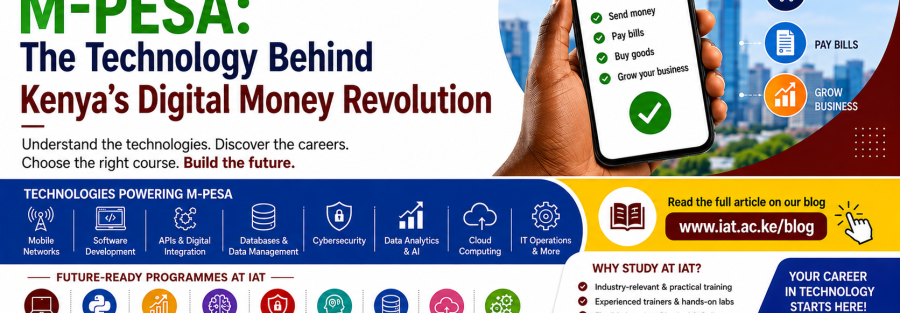
Article Description: Discover how M-PESA transformed mobile money in Kenya and explore the technologies, skills and professional disciplines that make a digital platform of this scale possible. This practical guide uses M-PESA as a real-world technology case study to help students understand why programming, networking, cybersecurity, databases, data analytics, artificial intelligence, cloud computing, software engineering, business analysis and digital finance are increasingly important career pathways. It also shows how the different technologies behind a platform such as M-PESA can help prospective students make more informed decisions about the courses they choose. Most importantly, the article connects these technology pathways to training opportunities at the Institute of Advanced Technology (IAT).
Estimated Reading Time: 18–22 minutes
M-PESA Is More Than a Mobile Money Service
Imagine sending money to another person using nothing more than a mobile phone, paying a business without carrying cash, purchasing a service through a digital payment channel and receiving confirmation within seconds. For millions of Kenyans, these activities have become so ordinary that it can be easy to overlook the sophisticated technology working behind the experience. M-PESA is not simply a menu on a mobile phone or a convenient payment option; it is an example of how telecommunications, software, databases, cybersecurity, financial technology, APIs, data and large-scale transaction processing can work together to solve everyday problems. The story of M-PESA therefore provides an excellent technology case study for students who are trying to understand what happens behind the digital services they use every day.
M-PESA began as an experiment associated with mobile technology and microfinance before evolving into a much broader financial technology platform. According to Safaricom, M-PESA was officially launched in Kenya on 6th March 2007, and its early growth demonstrated that customers could use mobile technology for much more than the original concept anticipated. The platform subsequently expanded into a broad range of financial and commercial services, changing how people interact with money, businesses and digital services.
The growth of M-PESA also demonstrates why students should avoid thinking about technology careers too narrowly. A major digital platform requires software developers, network professionals, database specialists, cybersecurity experts, data analysts, cloud professionals, business analysts, project managers, service-management professionals and people who understand finance and operations. There are therefore many different careers connected to the same technology ecosystem. For a student deciding what to study after secondary school, college or another qualification, M-PESA provides a practical way to understand how apparently different courses can eventually connect to one digital product.
This is where the Institute of Advanced Technology (IAT) becomes particularly relevant to the discussion. IAT describes its approach around hands-on learning, industry partnerships and programmes intended to prepare learners for technology-driven workplaces. Its current portfolio covers areas including ICT, programming, networking, data, cybersecurity, artificial intelligence, databases and professional technology training.
Why M-PESA Is an Excellent Technology Case Study
M-PESA is an excellent case study because it sits at the intersection of several industries and technologies. It connects mobile telecommunications with financial services, software systems, digital payments, customer applications, databases, security and business operations. A transaction that appears extremely simple to a customer can require multiple systems to communicate, authenticate information, apply rules, process instructions, update records and communicate the outcome. The simplicity experienced by the user is therefore supported by considerable technological complexity behind the scenes.
The wider mobile-money ecosystem also demonstrates the importance of digital infrastructure to the Kenyan economy. The Central Bank of Kenya publishes information and statistics relating to payments and financial systems, illustrating the importance of digital payments and mobile financial services within Kenya’s broader financial environment. This means that mobile money is not merely a consumer convenience but part of an ecosystem involving technology, financial services, regulation, business operations and infrastructure. For students, that creates an important lesson: large digital platforms create opportunities for professionals with very different academic and technical backgrounds.
The most important lesson is not that every student should study M-PESA specifically. The real lesson is that one successful digital platform can create demand for many different professional capabilities. One person may write software, another may configure networks, another may design databases, another may analyze transaction information, another may investigate cybersecurity threats and another may coordinate technology projects. The student therefore needs to ask, “Which part of the technology ecosystem interests me most?” rather than simply asking, “Which technology course is the best?”
How Does an M-PESA Transaction Work?
When a customer initiates a digital payment, the visible process is intentionally straightforward. The customer may use a mobile phone, application, merchant interface or another supported channel, depending on the service being accessed. Behind that simple interaction, however, a digital payment platform needs to process information accurately and consistently because financial transactions have real-world consequences. The system must be capable of handling requests, verifying information, applying appropriate rules and communicating the result to the relevant parties.
At a conceptual level, a digital payment system receives an instruction, identifies the parties involved, validates the request, applies business rules, processes the transaction and communicates the outcome. It also needs reliable records that support legitimate operational activities such as reconciliation, reporting, customer support and investigation. This explains why databases, authentication, APIs, networking, software engineering and cybersecurity are so important in digital finance. It also demonstrates why a technology student should understand how different components interact rather than studying each subject as if it exists independently.
It is important, however, to distinguish between publicly documented M-PESA interfaces and the proprietary internal architecture of Safaricom’s production systems. Students can study public APIs and developer documentation to understand how applications integrate with M-PESA services, but public documentation should not be interpreted as a complete technical blueprint of the underlying platform. The public developer environment nevertheless provides an excellent educational example of how modern applications can communicate with payment services. This distinction is important because responsible technology education should focus on legitimate development, security and learning rather than attempting to reproduce or interfere with private production systems.
Technology One: Mobile Telecommunications and Networking
One of the foundations of M-PESA is mobile telecommunications. The service became powerful because it placed financial functionality within a communication environment that people were already familiar with and using regularly. Mobile connectivity helped reduce the dependence on traditional physical access points for many everyday transactions. The broader lesson is that technology becomes especially powerful when it is integrated into infrastructure that people can access conveniently.
For students, this makes networking an important career pathway to understand. Modern networks are responsible for connecting computers, mobile devices, servers, applications and digital services, and they support everything from mobile payments to cloud computing and internet applications. Networking involves concepts such as IP addressing, routing, switching, protocols, wireless technologies, network monitoring and troubleshooting. These skills can lead toward careers in network administration, infrastructure engineering, telecommunications, cloud networking and network security.
Students who are still uncertain about their specialization may benefit from a broader ICT foundation before moving into a narrower pathway. IAT’s current CCNA training programme, for example, covers networking concepts including IP addressing, routing and switching, network security, wireless technologies, automation and troubleshooting. The lesson from M-PESA is that networks are not simply about connecting computers in an office; they are part of the infrastructure that allows digital services to communicate and operate.
A student who enjoys understanding how devices communicate may therefore find networking more interesting than programming. Someone who enjoys solving infrastructure problems, configuring equipment and troubleshooting connectivity issues may naturally fit into networking or systems administration. Networking knowledge can also provide a strong foundation for later specialization in cybersecurity or cloud computing. This is one reason students should think about their interests and strengths before choosing a course simply because it is currently popular.
Technology Two: Software Development and Programming
Software is another fundamental component of any sophisticated digital platform. Applications need to receive instructions, process information, communicate with other systems, apply business logic, handle errors and provide users with reliable experiences. Programming is therefore one of the foundational skills behind many digital products even though customers rarely see the underlying code. The buttons, menus and transaction interfaces that look simple to users are ultimately supported by software.
Students interested in software development should understand that programming is much more than memorizing commands. Professional development involves logical thinking, algorithms, data structures, testing, debugging, version control, APIs, architecture and secure coding practices. A good developer must think not only about what happens when everything works correctly but also about what happens when a user enters incorrect information, a network fails or another system becomes unavailable. This mindset is especially important when working on applications connected to financial transactions.
Python’s official documentation provides students with a useful reference for learning the language, while IAT’s Python Programming programme provides a structured pathway covering programming fundamentals and applications including web development, data analysis, machine learning and automation. Python can therefore be particularly attractive to students who want a programming foundation that can later lead into several different technology areas.
Students should nevertheless understand that learning one programming language does not automatically make someone a professional software engineer. A strong developer needs to understand how applications interact with databases, networks, operating systems, APIs and users. Students should also learn software-development practices such as testing, documentation, version control and project collaboration. The M-PESA example therefore encourages learners to develop broader computing knowledge instead of treating programming as an isolated skill.
Technology Three: APIs and Digital Integration
One of the most important technologies students can learn from the M-PESA ecosystem is the Application Programming Interface, commonly known as an API. An API allows different software systems to communicate according to defined rules. Instead of one application needing to understand the complete internal design of another system, it can make requests through an agreed interface and receive appropriate responses. This concept is fundamental to modern digital services because organizations increasingly need different systems to work together.
Consider how many digital services interact with one another. An online shop may need to communicate with a payment provider, an application may need to communicate with a database, an accounting system may need information from another business platform and a mobile application may need to send notifications through an external service. APIs make many of these integrations possible. This means students who understand APIs are learning a capability that extends far beyond mobile money.
Safaricom’s Daraja Developer Portal provides a particularly useful real-world example. Daraja 3.0 provides access to Safaricom and M-PESA APIs and is designed to create a bridge between payment services and web or mobile applications. Students can also explore the Daraja API documentation to understand how developers work with APIs in a legitimate development environment.
A student who learns programming and APIs can eventually build applications that accept payments, automate business processes or connect different systems. This is particularly valuable for entrepreneurs because payment integration can transform a basic website or application into a commercially useful digital product. However, students should also learn that APIs require strong security, authentication and access controls. The OWASP API Security guidance provides an excellent introduction to common API security risks and why developers need to treat interfaces as security-sensitive components.
Technology Four: Databases and Transaction Records
Every serious digital financial platform requires reliable information management. A payment system must maintain appropriate records so that transactions can be processed, reconciled, reported and supported. Databases provide the structured environment through which information can be stored, queried and managed. Without reliable data management, even a well-designed application could struggle to operate consistently.
A database is much more than a digital spreadsheet. Database professionals work with data structures, relationships, queries, indexing, access controls, backup strategies, performance and data integrity. As applications become larger, database design becomes increasingly important because poor architecture can affect performance, reporting and reliability. Students who enjoy organizing information and solving logical problems may therefore find database technologies particularly interesting.
PostgreSQL documentation provides students with an authoritative technical resource for learning relational database concepts and SQL. IAT’s current course catalogue also includes database-related training such as PostgreSQL and MongoDB. This creates a practical pathway for learners who want to understand how information systems store, retrieve and manage structured information.
Database skills are useful far beyond financial technology. Hospitals, universities, government institutions, supermarkets, telecommunications companies, logistics organizations and technology startups all depend on information systems. A student who learns SQL and database design can therefore apply those skills in many different industries. This is another important lesson from M-PESA: technology skills should be developed with transferable applications in mind.
Technology Five: Cybersecurity
Financial technology cannot succeed without cybersecurity. Customers expect their money and personal information to be protected, while organizations must manage threats involving unauthorized access, fraud, malicious software, social engineering and other forms of cyber risk. Security therefore cannot be treated as an optional feature that is added after an application has been completed. It needs to be considered throughout design, development, deployment and operation.
Cybersecurity professionals do much more than install antivirus software. Modern security involves identity and access management, secure software development, network security, vulnerability management, monitoring, incident response, risk assessment, security awareness and governance. These areas require both technical knowledge and an understanding of organizational processes. A student who enjoys investigation, problem-solving and understanding how systems can be attacked may find cybersecurity particularly rewarding.
IAT’s Cyber Security programme covers areas including network security, penetration testing, cyber laws and secure software development. Students can also use the NIST Cybersecurity Framework as an external reference for understanding how organizations approach cybersecurity risk management. NIST’s CSF 2.0 provides a structured approach to cybersecurity outcomes and risk management across different types of organizations.
The M-PESA example makes the importance of cybersecurity particularly clear because digital financial systems cannot afford to treat security casually. Students should therefore develop a security mindset even when cybersecurity is not their primary specialization. Programmers need secure coding skills, network professionals need secure configuration knowledge and database professionals need to understand access controls and data protection. The strongest technology professionals increasingly understand that security is a shared responsibility across the entire digital ecosystem.
Technology Six: Data Analytics
Every large digital platform generates information. Transactions and interactions can produce data that organizations can analyze to understand service performance, customer behaviour, operational patterns and business trends when the information is collected and used appropriately. This creates opportunities for data analysts who can transform raw information into useful insights. For students who enjoy numbers, patterns and evidence, data analytics can therefore be an attractive career direction.
Data analytics requires more than creating colourful charts. A capable analyst needs to understand data cleaning, statistical reasoning, visualization, interpretation, reporting and communication. The analyst must also be able to distinguish between meaningful patterns and misleading results. This combination of technical and reasoning skills makes data analytics useful in telecommunications, finance, healthcare, government, research, retail and many other industries.
IAT’s Data Analysis programme covers tools including Advanced Excel, STATA, SPSS, Power BI and R Programming, alongside practical areas such as data cleaning, statistical analysis, dashboards, reporting and visualization. This provides a useful example for students who are wondering how mathematical or analytical interests can become practical workplace capabilities.
A student interested in mobile-money analytics could, for example, work with synthetic or properly anonymized datasets to examine fictional transaction volumes, trends or customer behaviour. Such a project could demonstrate data cleaning, analysis, visualization and communication skills without requiring access to real customer financial information. This is an important distinction because financial data can be sensitive and must be handled responsibly. The goal of education should be to demonstrate analytical capability while respecting privacy, ethics and security.
Technology Seven: Data Science and Machine Learning
Data analytics and data science overlap, but they are not identical. Data analytics often focuses on understanding information, identifying patterns and supporting decisions, while data science and machine learning can extend those capabilities toward predictive models and more advanced analytical applications. Modern organizations increasingly explore ways to use data to identify patterns, estimate future outcomes and support decision-making. Such applications can be relevant to financial technology, telecommunications, retail, healthcare and many other industries.
Students interested in data science need a stronger foundation in mathematics, statistics, programming and analytical reasoning. They also need to understand what models are doing rather than simply treating machine-learning tools as black boxes. This means that students should be prepared to invest time in foundational subjects before attempting advanced machine-learning concepts. Patience is important because data science combines several technical disciplines.
IAT’s Data Science and Machine Learning programme includes Python for data science, data analysis and visualization, statistics, machine-learning fundamentals, an introduction to deep learning and model evaluation. This makes the pathway particularly relevant to students who enjoy mathematics, programming and analytical problem-solving. The M-PESA case study can help students understand why such capabilities matter in an economy increasingly dependent on digital information.
The important lesson is that data has value only when professionals know how to use it responsibly. Large quantities of data do not automatically create useful business outcomes. Professionals must ask good questions, select appropriate analytical methods, interpret results carefully and communicate findings clearly. Students who develop these capabilities will be better prepared to work with data across many industries rather than limiting themselves to one specific technology platform.
Technology Eight: Artificial Intelligence
Artificial intelligence is increasingly influencing how organizations automate tasks, analyze information and support decision-making. Although AI should not be treated as a magical replacement for human expertise, it is becoming an important component of modern technology strategy. Students entering the digital economy should therefore understand AI even if they eventually specialize in another field. The key is to learn AI as part of a broader technical foundation.
AI can connect with software engineering, data science, cybersecurity, customer service, automation and business intelligence. A developer may integrate an AI service into an application, a data professional may develop predictive models, a cybersecurity professional may use AI-assisted analysis and a business analyst may use AI tools to improve productivity. This demonstrates that AI is not necessarily a separate career universe disconnected from other technologies. Instead, it increasingly acts as a capability that can be added to different professional disciplines.
IAT’s AI and Artificial Intelligence training currently includes practical AI pathways focused on areas such as workplace productivity, AI-enabled decision-making, workflow automation and education. For students, the important lesson is that AI skills can complement foundational abilities in programming, data, business and technology. Students should avoid assuming that simply knowing how to use an AI tool is equivalent to becoming an AI professional.
The M-PESA example also demonstrates why strong foundations remain important even as advanced technologies develop. AI systems depend on data, software, computing infrastructure, security and governance. A student with strong programming, database, networking and analytical foundations will have a better platform from which to understand advanced technologies. The future is therefore likely to reward students who combine emerging skills with solid fundamentals rather than students who chase every new technology without understanding the basics.
Technology Nine: Cloud Computing and Infrastructure
Modern digital services require infrastructure capable of supporting applications, databases, networking, security, monitoring and other workloads. Cloud computing has changed how many organizations acquire and manage computing resources by making infrastructure and services available through networked platforms. According to Google Cloud’s cloud-computing guide, cloud computing provides on-demand access to computing resources such as storage and infrastructure over the internet.
Cloud careers can include cloud administration, cloud engineering, cloud architecture, DevOps, infrastructure automation and cloud security. These roles require knowledge of operating systems, networking, security and sometimes programming. This again demonstrates how technology disciplines overlap. A student cannot always become an effective cloud professional by studying cloud concepts in isolation without understanding the infrastructure underneath them.
IAT’s current professional training portfolio includes cloud-related pathways such as CompTIA Cloud+ and other technology certifications. Students interested in infrastructure can therefore consider building foundational ICT and networking knowledge before moving into cloud technologies. Another student with a programming background might approach cloud from the application-development side.
The important lesson is that there is no single route into cloud computing. Someone who enjoys configuring infrastructure may follow a different path from someone who enjoys developing cloud applications. Networking, cybersecurity, programming and systems administration can all provide useful foundations. M-PESA therefore illustrates how one digital platform can connect several technology specializations rather than requiring every professional to follow the same career path.
Technology Ten: IT Service Management and Operations
A large technology platform is not successful simply because engineers can build it. It must also be operated, monitored, supported and continuously improved. When users encounter problems, organizations need processes for identifying incidents, resolving issues, managing changes and maintaining service quality. This is where IT service management becomes an important part of the technology ecosystem.
IT service management can suit students who enjoy technology but are equally interested in organization, processes, customer service and management. Such professionals help ensure that technology services support business objectives and that operational problems are addressed systematically. They may work with service processes, incidents, changes, performance and continual improvement. This shows that a technology career does not always mean becoming a full-time programmer or cybersecurity specialist.
IAT’s ITIL training programme provides training in IT service management concepts, service processes, service delivery and support. Students can therefore explore a pathway that combines technology with organization and service management. This may be particularly attractive to learners who have strong communication and coordination abilities alongside an interest in technology.
The M-PESA example demonstrates why operations matter. A digital platform used at scale needs monitoring, support, incident management, operational discipline and continuous improvement. Behind every successful digital service are professionals whose work may not be visible to customers but is essential to keeping the service dependable. Students should therefore recognize operations and service management as legitimate and valuable technology careers.
Technology Eleven: Software Engineering, Business Analysis and Project Management
Technology projects exist to solve human or business problems. Developers can write technically excellent software, but if the system does not solve the right problem, the project may still fail. This is why software engineering, business analysis and project management are important parts of the technology ecosystem. They help organizations move from an idea or business requirement toward a usable and sustainable digital solution.
A business analyst may study user requirements, document processes, identify problems and help define system requirements. A project manager may coordinate people, budgets, timelines, risks and deliverables. A software engineer may apply systematic approaches to designing, developing, testing and maintaining software. These roles demonstrate that students interested in technology do not necessarily have to choose programming as their only professional direction.
IAT’s Software Engineering programme covers software-development principles including requirements analysis, software design, coding, testing, debugging, version control and maintenance. The programme illustrates how software development can be approached as an engineering discipline rather than simply learning a programming language. This distinction is important for students who want to build scalable, maintainable and professionally developed applications.
M-PESA itself demonstrates the importance of multidisciplinary thinking. A digital platform that affects financial behaviour requires technology professionals, business professionals, operational teams, security specialists, financial experts, customer-service teams and leadership. Students should therefore think about the role they would enjoy playing in a technology ecosystem rather than asking which course is universally “best.” The best course is the one that aligns with the student’s interests, abilities, academic foundation and long-term career direction.
So, Which Course Should a Student Choose?
The answer depends on the student’s interests, strengths and desired career direction. There is no single course that prepares every student for every technology career. Instead, students should identify the types of problems they enjoy solving and then select a learning pathway that develops the capabilities needed to solve those problems professionally. M-PESA provides a useful framework because almost every major technology discipline can be connected to some aspect of its broader ecosystem.
If you enjoy building applications, websites and software systems, programming or software engineering should be high on your list. IAT’s Web Design and Development programme, for example, covers areas including HTML, CSS, JavaScript, responsive design, web frameworks, databases, version control and application deployment. Students who enjoy creating things and solving logical problems may find software development particularly satisfying.
If you enjoy understanding how computers communicate, networking and infrastructure may be a better fit. If you are fascinated by cyber threats, investigation and protecting systems, cybersecurity could be your direction. If you enjoy numbers, statistics, patterns and evidence, data analysis or data science may be more appropriate. If you enjoy organization, customer service and coordinating technology services, IT service management may offer a better fit.
Your current academic level also matters. A beginner who has limited technology experience may benefit from a broad ICT foundation before specializing. Someone who already understands programming might be ready for Python, software engineering, data science or another focused pathway. A working professional may prefer a short professional certification that adds a specific technical capability to an existing career.
A Practical Course-Selection Guide Based on the M-PESA Ecosystem
Choose ICT if you want a broad technology foundation. ICT can expose students to areas such as hardware, software, networking, databases and cybersecurity. It is particularly useful for students who know they want a technology career but have not yet decided on a specialization. The goal should be to develop enough foundation to identify the area in which you want to specialize.
Choose Programming if you want to build software. Programming is suitable for students who enjoy logical thinking, problem-solving and creating applications. Python can provide a versatile foundation that can later connect to software development, automation, data science and artificial intelligence. Students should eventually complement programming with databases, APIs, testing, version control and software-engineering practices.
Choose Networking if you want to build and maintain infrastructure. Networking suits students who enjoy understanding how devices and systems communicate. It can lead toward network administration, telecommunications, infrastructure engineering, cloud networking and network security. Networking knowledge can also strengthen the foundation of a cybersecurity career.
Choose Cybersecurity if you want to protect digital systems. Cybersecurity suits students who enjoy investigation, risk analysis and technical problem-solving. The field can lead toward security analysis, security administration, ethical security testing, information security and security governance. Strong cybersecurity professionals benefit from understanding networking, operating systems, programming and databases.
Choose Data Analysis if you enjoy turning information into decisions. Data analysis suits students who enjoy statistics, business questions, visualization and evidence-based decision-making. Tools such as Excel, Power BI, SPSS, STATA and R can provide practical analytical capabilities. These skills can be applied across telecommunications, banking, government, healthcare, research, retail and many other sectors.
Choose Data Science and Machine Learning if you enjoy mathematics, programming and prediction. This pathway is more technical and requires commitment to statistics, programming and mathematical reasoning. It can lead toward roles involving predictive analytics, machine learning and data science. Students should build progressively rather than attempting to master every advanced technology at once.
Choose AI if you want to explore intelligent automation and emerging technology. AI is increasingly relevant across business and technology. However, students should develop foundational programming, data and problem-solving skills rather than relying entirely on AI tools. AI should be viewed as part of a wider technology ecosystem.
Choose databases if you enjoy organizing and managing information. Database specialists work behind many digital systems and help ensure that information can be stored, retrieved and managed effectively. Database skills can lead toward database administration, data engineering, software development and analytics. SQL and database design are particularly useful foundations.
Choose cloud computing if you enjoy infrastructure and scalable systems. Cloud technology connects networking, operating systems, security, automation and application deployment. It can lead toward cloud administration, cloud engineering, DevOps and cloud security. Students should ideally develop strong IT and networking foundations before specializing.
Choose IT service management or project management if you enjoy coordinating technology and people. Technology organizations need professionals who can manage requirements, processes, projects and service delivery. These pathways can suit students who enjoy leadership and organization as much as technical problem-solving. They can also complement a technical qualification and support progression into technology management.
What M-PESA Teaches Students About the Future of Work
The first major lesson is that technology careers are increasingly interconnected. A software developer who understands databases has a broader perspective than someone who knows only programming syntax. A cybersecurity professional who understands networking can investigate security problems more effectively, while a data analyst who understands business processes can produce more useful insights. The future therefore belongs increasingly to professionals who understand how their specialization connects to the wider technology ecosystem.
The second lesson is that practical skills matter. Employers and organizations need people who can demonstrate what they can do rather than simply list subjects they studied. A student who has built a small simulated payment application, created a database, developed a dashboard or configured a test network has evidence that can be discussed during an interview. This is why students should look for opportunities to convert classroom knowledge into practical projects.
The third lesson is that students should develop projects alongside their studies. A programming student could create a simulated payment application, a database student could design a fictional transaction database and a data student could create dashboards using synthetic transaction data. A cybersecurity student could build a controlled educational environment and document authentication, access control and security-testing principles. These projects should never involve real customer financial information or unauthorized access to production systems.
The fourth lesson is that continuous learning is unavoidable. Digital platforms evolve, programming tools change, security threats develop and new technologies emerge. A qualification provides an important foundation, but professional relevance requires continued learning throughout a career. Students should therefore develop the habit of updating their knowledge rather than assuming that one qualification will remain sufficient forever.
Build an M-PESA-Inspired Student Technology Project
Students can turn the M-PESA case study into an impressive portfolio project without attempting to reproduce the real M-PESA platform. A programming student could create a fictional mobile-payment application that allows users to register, deposit simulated funds and transfer fictional money between accounts. The application could use Python or another programming language and connect to a database. Such a project would demonstrate application logic, data storage, validation and problem-solving.
A database student could design tables representing fictional customers, accounts, transactions and merchants. They could create SQL queries to retrieve transaction histories, calculate fictional balances and generate reports. The project could include documentation explaining relationships between tables, constraints and data-management decisions. This would provide evidence of database design and logical thinking without exposing real financial information.
A data-analysis student could create a synthetic dataset containing fictional transaction records. They could analyse transaction volumes, identify trends, create dashboards and explain what the fictional information appears to show. A good project could demonstrate data cleaning, statistical analysis, visualization and communication. It would also demonstrate that the student understands the difference between raw data and useful insight.
A cybersecurity student could design a fictional payment application and perform a security assessment in a controlled educational environment. The project could document authentication requirements, access controls, password policies, secure coding principles and possible vulnerabilities. The objective would be to demonstrate a security mindset rather than attempting to attack a real financial platform. This approach gives the student practical evidence while maintaining ethical boundaries.
How Students Can Turn Technology Skills Into Employability
Learning a course is only the beginning. Students should think about how each new capability can become evidence of competence that they can eventually present to employers. If you study Python, build projects; if you study networking, document configurations and troubleshooting exercises; if you study data analytics, create dashboards; and if you study cybersecurity, document controlled laboratory exercises. The result should be a growing portfolio that demonstrates what you can actually do.
A portfolio gives employers something concrete to evaluate beyond an academic qualification. It can also make interviews easier because you can explain projects you have personally completed and discuss the challenges you encountered. Instead of saying, “I studied Python,” you can say, “I used Python to develop a simulated payment application, connected it to a database and implemented transaction validation.” The second statement provides evidence of application and problem-solving.
Students should also learn to communicate technical work to non-technical audiences. A software developer may eventually need to explain a technical issue to a manager, while a data analyst may need to explain a dashboard to a business executive. A cybersecurity professional may need to explain a risk to senior management without using unnecessarily technical language. Technical ability and communication skills therefore complement one another.
IAT’s broad training portfolio reflects this multidisciplinary approach by combining technology, data, business and professional-development pathways. Students can therefore think about building combinations of skills rather than limiting themselves to one narrow competency. For example, someone might combine programming with databases, networking with cybersecurity, data analysis with business knowledge or ICT with project management. These combinations can make a student’s professional profile more adaptable.
The Importance of Cybersecurity in Digital Finance
Digital finance demonstrates why cybersecurity should not be considered only after a system has been built. Security needs to influence application design, authentication, authorization, data management, network configuration, monitoring and incident response. Students entering technology should therefore develop a security mindset even when cybersecurity is not their primary specialization. Security awareness can strengthen almost every technology career.
For programmers, this means learning secure coding practices and understanding common application vulnerabilities. For network professionals, it means understanding secure configurations, segmentation and monitoring. For database professionals, it means understanding access control, backups and data protection. For data analysts, it means understanding responsible data handling and the importance of privacy.
The financial context makes these principles particularly important because digital financial systems process information that can have real-world consequences. Accuracy, reliability, confidentiality and appropriate access controls are therefore fundamental considerations. Students should learn that technology should not be developed merely because something is technically possible. Responsible technology professionals must also consider security, ethics, privacy, user impact and organizational requirements.
Why Data Skills Will Continue to Matter
M-PESA also demonstrates the growing importance of data. Digital transactions can generate information that organizations may use for operational decision-making, business intelligence and service improvement when it is collected, governed and analysed appropriately. This means students who develop data skills are preparing themselves for opportunities beyond traditional data-entry roles. Modern organizations increasingly need people who can turn information into useful decisions.
Modern data professionals need to understand the journey from raw information to useful insight. This includes accessing information appropriately, cleaning it, analysing it, visualizing it, explaining it and communicating recommendations. IAT’s data-management portfolio includes areas such as Advanced Excel, business analytics, Power BI, R, SPSS and STATA, providing several possible entry points for students interested in analytical careers. Students can therefore build from practical tools toward increasingly advanced data capabilities.
Students should also understand that data is not automatically objective simply because it appears in a spreadsheet. Data can contain errors, missing values, biases or misleading patterns. Professional data work therefore requires critical thinking, statistical understanding and responsible interpretation. These capabilities are valuable not only in fintech but also in government, healthcare, research, finance, marketing and business.
The M-PESA Lesson for Entrepreneurs
Students interested in entrepreneurship can also learn important lessons from M-PESA. One of the most important lessons is that successful innovation often begins by solving a genuine problem. M-PESA’s history shows how an idea associated with mobile technology and financial services evolved as users demonstrated new ways of using the platform. This illustrates the importance of listening to customers and adapting technology to real-world needs.
Technology entrepreneurs should therefore spend time understanding users before immediately building complicated software. An impressive application that solves no meaningful problem will struggle to create sustainable value. Entrepreneurs need to understand customers, business models, technology, payments, security, operations and marketing. This is another reason students should consider multidisciplinary education.
An entrepreneur who understands technology and business can communicate more effectively with developers and customers. Someone with programming skills can prototype an idea, while someone with data skills can analyse market behaviour and measure performance. Someone with cybersecurity knowledge can identify risks, while someone with project-management skills can coordinate the development process. The M-PESA story therefore reinforces the value of combining technical knowledge with business thinking.
What Prospective Students Should Ask Before Choosing a Course
Before enrolling in a technology programme, students should first ask what they actually enjoy doing. Do you enjoy solving logical problems, working with numbers, investigating suspicious activity, building applications, configuring networks, organizing information or coordinating people? Your answer can provide an important clue about which specialization may suit you. Choosing a career based only on salary discussions or popular trends can result in a poor long-term fit.
Students should also ask what level of study they need. A beginner may require foundational ICT knowledge, while someone with previous computing experience may benefit from a more specialized professional certification. Choosing a course far above your current foundation can create unnecessary frustration. Choosing something that is too basic, however, may fail to challenge you sufficiently.
Another important question is whether the programme provides practical exposure. Students should ask whether they will complete projects, practical exercises, laboratories, simulations or other activities that allow them to apply what they learn. The M-PESA example demonstrates why practical knowledge matters because real digital systems involve multiple technologies interacting with one another. Learning should therefore ideally move beyond memorizing concepts for examinations.
Finally, consider how the course fits into your longer-term career plan. You do not need to know exactly what job you will hold ten years from now, but you should understand the direction you want to explore. A student can begin with ICT, discover an interest in networking and later specialize in cybersecurity or cloud computing. A student can begin with data analysis and later progress toward data science and machine learning.
A Possible Technology Career Roadmap Inspired by M-PESA
A beginner could start with foundational ICT and computer skills. After gaining confidence, the student could explore programming, networking, databases and cybersecurity before choosing a specialization. This broad exposure can help learners understand how different components of technology work together. It also gives students an opportunity to discover which areas they genuinely enjoy.
A student interested in software could progress from basic programming to Python, databases, APIs and web or application development. Later, the student could specialize in backend systems, cloud applications, automation or data engineering. M-PESA provides a useful conceptual example because payment applications need software to communicate with other systems. The important principle is progressive development rather than trying to master everything simultaneously.
A student interested in security could begin with ICT and networking before moving into cybersecurity. From there, the learner could explore ethical security testing, security operations, information security management, cloud security or governance. IAT’s current cybersecurity offering provides pathways covering both foundational and more advanced cybersecurity education.
A student interested in data could begin with Excel and data analysis before progressing to statistics, SQL, Power BI, Python, R, machine learning and artificial intelligence. This pathway is particularly suitable for students who enjoy mathematics and analytical reasoning. The important point is to build progressively rather than attempting to master every advanced technology at the same time. Strong foundations often make advanced learning easier.
The Future Will Belong to Technology-Enabled Professionals
The future of work is unlikely to be divided neatly between “technology jobs” and “non-technology jobs.” Technology is increasingly becoming part of accounting, marketing, finance, healthcare, logistics, education, manufacturing and government. Kenya’s Ministry of Information, Communications and the Digital Economy identifies advanced digital skills such as AI, big data, coding, cybersecurity, IoT and mobile application development among important areas for a digital economy.
M-PESA demonstrates this transformation clearly because it connects technology with finance, retail, telecommunications and everyday commerce. The same pattern is visible across many other industries as organizations digitize their operations. Students should therefore consider how technology can complement their existing interests rather than assuming they must choose between business and technology. A future accountant may need analytics, a finance professional may need fintech knowledge and a business professional may need digital systems skills.
An accounting student, for example, can add data analytics and financial systems skills. A business student can learn digital marketing, analytics and technology project management. A finance student can explore fintech, data science and cybersecurity, while a communications student can develop digital content and AI capabilities. These combinations can create professionals who understand both their industry and the technology transforming it.
The strongest professionals of the future may therefore be those who combine domain knowledge with technology. M-PESA is a powerful example because it is not purely a telecommunications product, purely a financial service or purely a software application. It sits at the intersection of several disciplines. That is one of the most important lessons students should take from its story.
From Classroom Knowledge to Industry Skills
Studying theory is important because it provides the conceptual foundation needed to understand technology. However, students should deliberately look for opportunities to apply what they learn. Practical projects, internships, industrial attachments, competitions, student clubs, supervised laboratories and personal experiments can help bridge the gap between education and employment. The objective is to move from knowing about technology to demonstrating that you can use it.
A student learning databases should not stop after passing a database examination. They could design a fictional financial database and document its structure, relationships and queries. A programming student could build a simulated payment application, while a cybersecurity student could conduct controlled security exercises. A data student could build dashboards using synthetic transaction data.
This approach also improves employability because students have stories to tell during interviews. Instead of saying, “I studied Python,” a candidate can explain how they used Python to develop a simulated application, connect it to a database and implement transaction validation. Instead of simply saying, “I studied cybersecurity,” the candidate can explain a controlled security project and the lessons learned. Practical evidence makes technical skills easier for employers to understand.
Why IAT Is Relevant to This Technology Journey
IAT’s current programme portfolio makes it relevant to students seeking technology skills connected to the digital economy. Its programmes cover broad and specialized areas including ICT, software engineering, Python, networking, cybersecurity, data analysis, data science, AI, databases and IT service management. This gives prospective students the opportunity to think about education as a progression rather than selecting a single isolated skill.
A student starting from the beginning may benefit from building a broad foundation and then specializing. Another learner who already has technical knowledge may prefer a focused professional programme such as Python, cybersecurity, data analysis or networking. A working professional may choose a shorter programme to add a specific capability to an existing career. The correct choice depends on the learner’s background, interests, objectives and level of specialization.
IAT also provides different delivery options for several programmes, including physical and online learning. Prospective students should always review the current programme information before enrolling because entry requirements, course duration, intakes and delivery modes can change. The IAT Admissions and Admission Requirements page provides a useful starting point for students who want to understand the institution’s current programme and admissions information.
The Bigger Lesson: Technology Solves Problems
The most important lesson from M-PESA is not the technology itself. It is the idea that technology becomes powerful when it solves meaningful problems and is supported by appropriate infrastructure, people, processes and responsible innovation. M-PESA connected mobile technology with a real financial need and evolved as users discovered additional ways to use the service. The result demonstrates the importance of designing technology around people rather than technology for its own sake.
Students should adopt the same mindset when learning technology. Do not learn programming merely because everyone says programming is important; learn it because you want to build things, automate processes and solve problems. Do not study data simply because data careers are growing; study it because you enjoy identifying patterns and using evidence to support decisions. Do not choose cybersecurity only because you have heard that it is a lucrative field; choose it because you are genuinely interested in how systems work and how they can be protected.
Long-term career success requires interest, discipline and continuous learning. Technology changes rapidly, and professionals need to remain adaptable throughout their careers. The most valuable qualification is therefore not simply the certificate itself but the combination of knowledge, practical capability, problem-solving ability and willingness to continue learning. Students should choose education that helps them build that combination.
A Practical Checklist for Students Choosing a Technology Course
Before choosing your course, identify the type of problems you enjoy solving. If you like building things, consider programming or software engineering; if you like infrastructure, consider networking and cloud; if you like protection and investigation, consider cybersecurity; and if you like numbers and patterns, consider data analysis or data science. If you enjoy coordinating people and technology, consider IT service management, project management or business analysis.
Next, evaluate your current academic foundation. Ask whether you have the mathematics, computing or programming background required for your intended programme. If you do not have the required foundation, consider beginning with a broader programme and progressing gradually. A carefully planned learning pathway can be more effective than rushing into an advanced specialization without adequate preparation.
You should also investigate the practical component of the programme. Ask whether the course includes projects, laboratories, exercises, simulations or other hands-on learning opportunities. The technology behind platforms such as M-PESA is highly practical, so students should aim to develop practical competence rather than relying entirely on theoretical knowledge. A good course should help you move toward being able to demonstrate what you can do.
Finally, think about where the course could take you. You do not need to predict your entire career, but you should identify several realistic directions that interest you. For example, programming could lead toward software development, automation, data or AI, while networking could lead toward infrastructure, cloud or cybersecurity. Understanding these connections can make your course choice more deliberate and less influenced by short-term trends.
Your Next Step: Build Skills That Solve Real Problems
The M-PESA story is ultimately a story about technology, innovation and problem-solving. It demonstrates how mobile connectivity, software, databases, APIs, cybersecurity, data and infrastructure can combine to create services that influence everyday life. It also demonstrates why technology careers are interconnected rather than isolated. For students, this provides an opportunity to look beyond course titles and understand the skills that organizations actually need.
If you are preparing to enter the technology field, begin by identifying the part of this ecosystem that interests you most. If you want to build applications, explore programming and software engineering; if you want to understand connectivity, explore networking; if you want to protect systems, explore cybersecurity; and if you enjoy numbers and patterns, explore data analysis or data science. You can then progressively add complementary skills such as databases, cloud, AI, APIs and project management.
IAT can be part of that learning journey by providing pathways across several of these technology disciplines. Prospective students can review the current IAT course catalogue, compare programmes and identify a pathway that matches their academic foundation and career interests. The institution’s current portfolio includes technical, professional and emerging-technology training designed around the changing needs of the digital economy.
Your objective should not simply be to obtain a certificate. Your objective should be to develop skills that allow you to build, analyse, secure, manage and improve real systems. M-PESA provides an excellent reminder that technology has its greatest impact when technical knowledge is connected to genuine human and business needs. If you approach your education with that mindset, you can make a more informed course choice and begin building a career that remains adaptable as technology continues to evolve.
Take Home: Let M-PESA Help You Choose Your Technology Path
M-PESA is much more than a mobile-money service. It is a practical illustration of how telecommunications, software engineering, programming, APIs, databases, cybersecurity, data analytics, artificial intelligence, cloud infrastructure, IT service management and business operations can come together to create a large-scale digital ecosystem. For students, this makes M-PESA one of the most relatable technology case studies available in Kenya. You interact with the service as a customer, but behind the simple experience are numerous professional disciplines.
The most important lesson is that there is no single “M-PESA course.” There are programmers, network engineers, cybersecurity professionals, database specialists, data analysts, cloud professionals, business analysts, project managers and service-management professionals contributing to the wider technology ecosystem. Each specialization requires different interests and abilities. Students should therefore choose courses according to the problems they enjoy solving and the professional role they would like to explore.
The second major lesson is that technology skills should be combined. A programmer who understands databases and APIs can build more capable systems, while a cybersecurity professional who understands networks and software can investigate problems more effectively. A data analyst who understands business processes can produce more meaningful insights, while a project manager with technical knowledge can communicate more effectively with engineering teams. Combining complementary capabilities can therefore make a professional more adaptable.
The final lesson is simple: choose a course, but build a career pathway. Start with the right foundation, develop practical skills, create projects, seek industry exposure and continue learning. Whether your destination is software development, networking, cybersecurity, data, AI, cloud computing or technology management, the M-PESA story shows that technology is ultimately about solving real problems. That is the mindset that can help you turn education into employability and skills into meaningful professional opportunities.
Take the Next Step with IAT
If the M-PESA technology ecosystem has helped you identify an area of interest, the next step is to explore the training pathway that fits your goals. You can start with a broad ICT foundation if you are still exploring your options, or select a focused programme if you already know the technical area you want to pursue. IAT’s current programmes cover a wide range of technology and professional disciplines, allowing learners to build skills progressively.
Students interested in software can explore programming and software engineering, while learners interested in infrastructure can consider networking and cloud-related training. Those interested in protecting digital systems can explore cybersecurity, while students who enjoy statistics and patterns can consider data analysis or data science. Learners interested in emerging technologies can also explore artificial intelligence and related digital skills.
The important thing is to choose intentionally. Compare the programme requirements, duration, delivery method and learning outcomes, and think about how the skills connect to the career direction you want to explore. You can begin your research through IAT’s official website and then examine individual programmes before making your decision.
Your technology career does not have to begin with knowing everything. It begins with identifying a direction, learning the fundamentals and consistently building practical capability. M-PESA shows what can happen when technology, people, infrastructure and innovation come together to solve real problems. Your own career journey can begin in exactly the same way: learn a skill, solve a problem, build something useful and keep learning.
About the Author
Dennis Njeru is a versatile and results-driven professional with broad experience across finance, human resource management, ICT, operations management, general management, digital marketing and multimedia production. His professional journey has given him exposure to diverse organizational environments, enabling him to develop a practical understanding of business operations, people management, technology, financial processes and organizational development. This multidisciplinary experience informs his interest in the relationship between technology, business and professional development.
He has extensive experience in financial management, accounting, data analysis, human resource management, administration, compliance, operations, project coordination and customer service. His technical capabilities extend to IT support, networking, IT service management, CCTV systems, digital marketing, UI/UX design, graphic design, camera operations, video editing and content creation. This combination of technical and business exposure provides a practical perspective on how technology continues to change the modern workplace.
Dennis is also experienced in resource mobilization, proposal writing, monitoring and evaluation, programme coordination and organizational performance. His exposure to different professional functions has strengthened his ability to analyse challenges from multiple perspectives, develop practical solutions, coordinate teams and resources, and communicate effectively with diverse audiences. These experiences have reinforced his belief that professionals increasingly need combinations of technical, business and interpersonal skills.
A strong advocate of continuous learning and professional development, Dennis has continually expanded his knowledge across business, technology, management, digital transformation and creative fields. His multidisciplinary approach reflects the belief that today’s professionals need to go beyond academic knowledge by developing practical, adaptable and technology-enabled capabilities. Through his professional work and writing, he is particularly interested in career development, employability, workplace skills, technology, professional growth and the transition from education to employment.
His work and insights encourage students and emerging professionals to develop practical skills, present themselves professionally, embrace continuous learning, leverage technology and take a strategic approach to building their careers. The M-PESA technology case study reflects this philosophy because it demonstrates that successful digital careers are rarely built around one isolated skill. Instead, they emerge from the combination of knowledge, practical experience, problem-solving, adaptability and a willingness to keep learning.