Article Description: Discover the technologies behind Jeff Bezos’ companies, including Amazon, AWS and Blue Origin, and learn how cloud computing, AI, robotics, databases, networking and software can inspire your ICT career at IAT.
What If the ICT Skills You’re Learning Today Could Help You Build the Next Amazon?
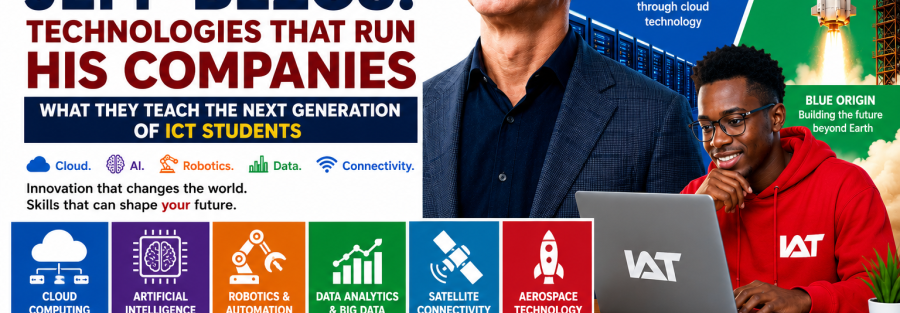
What if the programming, cloud computing, data analytics or networking skills you’re learning today could one day help you build a company that serves millions of people around the world? Technology is no longer simply a tool used by businesses-it is the engine driving some of the world’s most successful and influential companies. Jeff Bezos’ journey provides a powerful example of how technology, innovation and business thinking can come together to create organizations that operate at extraordinary scale. From Amazon’s e-commerce platform and AWS cloud infrastructure to artificial intelligence, robotics, satellite connectivity and aerospace technology through Blue Origin, Bezos’ companies demonstrate how different technologies can work together to solve complex problems and create new opportunities. For you as an upcoming ICT student, this is an important reminder that the skills you learn today can become the foundation for an exciting career across technology, business, finance, healthcare, telecommunications, manufacturing, aerospace and many other industries tomorrow.
Jeff Bezos founded Amazon in 1994 and transformed it from an online bookstore into a global technology and commerce company. He also founded Blue Origin, an aerospace company focused on making access to space more affordable and reusable, while Amazon has expanded into areas such as cloud computing, artificial intelligence, robotics, digital services and satellite connectivity. The interesting part isn’t simply the size of these companies; it’s the technologies behind them. When you understand those technologies, you begin to see why ICT remains one of the most important fields for anyone preparing for a technology-driven career.
Cloud Computing: The Technology Behind Amazon’s Scale
One of the most important technologies associated with Amazon is cloud computing, particularly through Amazon Web Services, commonly known as AWS. AWS provides computing, storage, database, networking, analytics, security and artificial intelligence capabilities that allow organisations to build and operate digital services without having to create every part of their infrastructure themselves. The growth of cloud computing has fundamentally changed how businesses deploy applications, store information and scale their operations. Amazon’s own experience with technology infrastructure helped create the environment from which AWS emerged and eventually became one of the world’s major cloud platforms.
For you as an ICT student, cloud computing is particularly important because it connects many areas of technology that you may already be learning. Networking, databases, operating systems, cybersecurity, programming and system administration all contribute to successful cloud environments. At the Institute of Advanced Technology (IAT), you can explore technology pathways that include cloud-related learning alongside networking, programming, databases and cybersecurity. IAT’s current course offerings include CompTIA Cloud+, CCNA, Python Programming, Oracle Database, PostgreSQL, MongoDB and other technology programmes, giving learners opportunities to build complementary skills.
Artificial Intelligence and Machine Learning
Artificial intelligence is another major technology shaping Amazon’s businesses and the wider technology industry. Amazon says it has been developing and deploying AI and machine-learning models for more than 25 years, including technologies used for customer recommendations, operational processes and robotics. Today, Amazon is also developing generative AI, agentic AI and AI infrastructure through AWS and other parts of its technology ecosystem.
Amazon’s AI applications show that artificial intelligence isn’t only about chatbots or futuristic machines. Amazon has used AI for demand forecasting, delivery-location accuracy and intelligent robotics, demonstrating how machine learning can address practical business problems. Its forecasting systems can help predict what customers may want, where they may want it and when they may need it, while newer robotics systems combine AI with physical machines. For you, this means learning Python, data analysis, statistics, databases and machine learning concepts can give you a foundation for participating in this rapidly developing field.
Robotics and Automation
Amazon’s fulfilment operations demonstrate another important technology area: robotics and automation. Modern warehouses increasingly combine people with robotic systems that can move, sort, lift and organize products, helping organizations handle large volumes of work efficiently. Amazon continues to invest in robotics and AI, including technologies such as Proteus and Vulcan, which are designed to assist employees and improve the movement of goods through fulfilment environments.
Robotics is particularly interesting for an ICT student because it combines several disciplines. A modern robot can require programming, sensors, networking, artificial intelligence, computer vision, databases and embedded computing to operate effectively. IAT’s technology training environment can help you build some of these foundations through programmes such as computer programming, Python, C++, data science and machine learning, networking and ICT. Once you understand these foundations, you can begin seeing how software can interact with the physical world.
Databases And Big Data
Behind every large digital company is another technology that users may rarely see: databases. Amazon processes enormous amounts of information related to products, customers, orders, deliveries, payments and business operations, creating a need for reliable systems that can store, retrieve and process information efficiently. Database technologies therefore become essential components of digital platforms, whether those platforms are used for online shopping, banking, healthcare, education or logistics.
This is where database skills can become valuable to your ICT career. Learning SQL, relational databases, database administration and NoSQL technologies can help you understand how organizations manage information at scale. IAT offers training in technologies including Oracle Database, PostgreSQL and MongoDB, allowing students to explore different approaches to modern data management. When you combine database knowledge with programming, analytics or cloud computing, you can create an even stronger technology foundation.
Data Analytics and Business Intelligence
Having huge amounts of data isn’t enough for a company to succeed. Organizations need professionals who can transform raw information into useful insights that support better decisions. Amazon uses data across areas such as customer experience, supply-chain planning, forecasting and operations, showing why data analytics has become such an important part of modern business. AI systems themselves also depend on high-quality data for training, testing and continuous improvement.
This creates an excellent opportunity for you if you enjoy working with numbers, patterns and problem-solving. IAT currently offers Data Analysis training designed to develop practical data-analysis skills, while its wider technology portfolio includes data science and machine learning. You can begin with tools such as Excel and Power BI, progress into SQL and statistical analysis, and eventually explore Python, R, machine learning and advanced business intelligence.
Networking And Digital Infrastructure
Amazon’s global operations would not function without sophisticated computer networks and digital infrastructure. Customers need to connect to websites and applications, data centres need to communicate with one another, employees need secure access to systems and cloud services need reliable connectivity. Networking therefore remains one of the fundamental technologies supporting the digital economy.
For an ICT student, this means networking skills continue to matter even as cloud computing and artificial intelligence become more prominent. Learning concepts such as IP addressing, routing, switching, wireless communication, network security and cloud networking can give you a foundation for careers in infrastructure and technology operations. IAT offers programmes such as CCNA, CCNP, CompTIA Network+ and other networking-related courses, helping students develop skills relevant to modern network environments.
Cybersecurity: Protecting The Technology
As companies become increasingly dependent on technology, cybersecurity becomes equally important. Cloud platforms, databases, applications, networks and AI systems all need to be protected against unauthorized access, data loss and other security threats. Amazon operates security technologies across its cloud and digital ecosystem, while AWS provides a wide range of security services for organizations using its infrastructure.
You can therefore think of cybersecurity as the technology that protects other technologies. IAT offers a broad range of cybersecurity-related programmes, including CompTIA Security+, CompTIA CySA+, CompTIA PenTest+, information-security training and ISACA programmes. If you’re interested in understanding how systems can be protected, cybersecurity can become a strong career direction that connects networking, operating systems, cloud computing, databases and risk management.
Custom Computer Chips and Advanced Computing
Another fascinating part of Amazon’s technology strategy is its investment in custom computing hardware. AWS develops processors such as Graviton for cloud workloads, demonstrating that Amazon’s technology interests extend beyond websites and software into computer architecture and specialized computing infrastructure. Amazon has continued developing Graviton processors as demand grows for efficient computing across cloud and AI workloads.
For you, this is a reminder that ICT doesn’t stop at application development. Computers depend on processors, memory, operating systems, networks and storage systems, and understanding these components can help you become a more capable technology professional. IAT’s ICT and programming pathways can help you build the fundamentals required to understand how software and hardware interact. From there, you can explore specialised areas such as embedded systems, high-performance computing or hardware-oriented technology.
Amazon Leo And Satellite Connectivity
Jeff Bezos’ broader technology ecosystem also connects with the growing field of satellite communications. Amazon Leo, formerly known as Project Kuiper, is Amazon’s low-Earth-orbit satellite network designed to provide internet connectivity to locations that may be difficult to serve through traditional infrastructure. Amazon says the system uses thousands of satellites, optical links, ground stations, fibre and internet connection points to create a connected network.
The technology creates another interesting connection to ICT because satellite connectivity depends on networking, telecommunications, radio systems, data processing, software and cybersecurity. Amazon has also highlighted plans to use the network to improve connectivity in underserved areas, including parts of Africa. If you’re studying networking or telecommunications, developments such as Amazon Leo show you how the skills you acquire can potentially connect to industries far beyond traditional office IT.
Blue Origin: Where ICT Meets Space Technology
Blue Origin provides perhaps the most dramatic example of how ICT skills can contribute to an industry that may initially seem unrelated to computing. The company develops reusable spaceflight technologies, including New Shepard, which Blue Origin describes as a fully reusable and autonomous suborbital rocket system. Modern aerospace systems require extensive use of software, sensors, communications, control systems, simulation, data processing and embedded computing.
This is an important lesson for you because an ICT career doesn’t necessarily mean working in an IT department. The same programming, networking, data and computing principles can be applied to aviation, manufacturing, telecommunications, automotive technology, healthcare, robotics and aerospace. At IAT, the range of technology programmes can help you establish a foundation that can later be applied to different industries. The more you understand how technologies connect, the more opportunities you can potentially identify.
Software Development: The Technology Connecting Everything
Behind cloud platforms, AI systems, databases, websites, robots and many other technologies is software development. Software provides the instructions that tell computers what to do, while programming allows developers to turn ideas and requirements into functioning digital solutions. Amazon’s scale demonstrates why software needs to be designed not only to work but also to handle large numbers of users, transactions and processes.
This is why programming is such a useful foundation for an upcoming ICT student. IAT offers programming pathways including Python and C++, as well as computer programming and software-related programmes. You don’t have to learn every programming language at once; instead, start with one language, understand programming logic, build practical projects and gradually expand your knowledge as your interests develop.
What Jeff Bezos Can Teach an Upcoming ICT Student
The biggest lesson from Bezos’ technology journey isn’t that you should try to build another Amazon. Instead, it’s that successful technology professionals need to understand problems, people, technology and how those elements fit together. Amazon’s operations combine e-commerce with cloud computing, AI, databases, robotics, networking and logistics, while Blue Origin combines aerospace engineering with software, computing and automation.
You should therefore think beyond the question, “Which ICT course should I take?” A better question is, “What problems do I want to solve with technology?” If you enjoy analyzing information, explore data analytics and business intelligence, while someone interested in building applications might explore programming and software engineering. If you’re fascinated by infrastructure, networking and cloud computing could be suitable, while students interested in protecting systems can explore cybersecurity.
Build Your ICT Career One Skill at a Time
You don’t need to master all these technologies immediately. The best approach is to choose a starting point, learn the fundamentals, practice what you learn and gradually add complementary skills. A student who starts with programming can move into databases, then data analytics or AI, while someone who starts with networking can progress into cloud computing and cybersecurity. The important thing is to keep learning and understand how one technology can connect with another.
This is where an institution such as IAT can become part of your journey. IAT’s current portfolio includes ICT, programming, data analysis, AI, data science and machine learning, networking, cybersecurity, databases, cloud-related certifications and other technology programmes. You can explore the available programmes at IAT – Institute of Advanced Technology and identify a learning pathway that matches your interests and career goals.
The Future Needs ICT Professionals Who Can Connect Technologies
Technology is evolving quickly, and the boundaries between different ICT disciplines are becoming less distinct. AI needs cloud infrastructure, cloud platforms depend on networking, databases support applications, cybersecurity protects digital systems and robotics combines software with physical machines. As these technologies converge, professionals who understand how different systems work together can become increasingly valuable.
For you as an upcoming ICT student, this should be encouraging rather than intimidating. You don’t have to know everything before you begin, and you don’t have to predict exactly which technology will dominate the future. What you need is a willingness to learn, practise, experiment, solve problems and keep adapting as technology changes.
Your ICT Journey Can Start Today
Jeff Bezos’ companies demonstrate that technology can transform an idea into a global operation when the right skills, systems and vision come together. Amazon’s ecosystem shows the power of cloud computing, AI, robotics, databases, networking, data analytics and software, while Blue Origin demonstrates how computing technologies can contribute to aerospace innovation. Amazon Leo further shows how networking and satellite technologies can be combined to address connectivity challenges around the world.
As an upcoming ICT student, you don’t need to become Jeff Bezos to make an impact. You need to develop skills that allow you to identify problems and create practical solutions using technology. Whether your future takes you into software development, AI, data analytics, cloud computing, networking, cybersecurity, databases or another ICT field, your learning journey can begin with one skill and grow from there.
Start Now…
If Jeff Bezos’ technology journey has inspired you to explore the possibilities of ICT, this is the time to start building your skills. IAT offers a broad range of ICT and technology programmes, including Certificate and Diploma ICT programmes, AI, Data Analysis, Python Programming, Data Science and Machine Learning, CCNA, CompTIA certifications, databases and cybersecurity.
Visit www.iat.ac.ke to explore available programmes and identify the technology pathway that best matches your interests. IAT describes itself as an ICT and business training institution offering technical training programmes designed to develop industry-relevant skills for the ICT and business sectors. Your journey doesn’t have to begin with a big idea; it can begin with your decision to learn one technology today and use it to build something tomorrow.
Your future in ICT starts with what you choose to learn today.
About the Blog Writer
Dennis Njeru is an experienced business and technology professional with over 10 years of experience spanning ICT, business management, finance, HR, digital marketing and operations. His interests include artificial intelligence, data analytics, cybersecurity, digital transformation and emerging technologies. Through his writing, Dennis simplifies complex technology and business concepts while helping students and professionals understand emerging trends, develop relevant skills and make informed education and career decisions.