
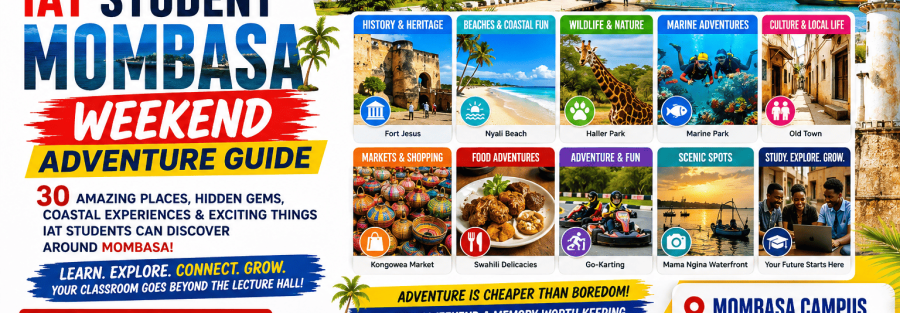
30 AMAZING PLACES, HIDDEN GEMS, COASTAL EXPERIENCES AND EXCITING THINGS IAT STUDENTS CAN DISCOVER AROUND MOMBASA
Article Description: Discover 30 amazing places and affordable things to do in Mombasa as an IAT student, from Fort Jesus and Old Town to beaches, marine parks, wildlife, culture, food, markets, history, photography and entrepreneurship.
MOMBASA IS WAITING FOR YOU
Imagine finishing your classes at IAT on Friday afternoon and realizing that an entire coastal city is waiting outside the classroom. Instead of spending the entire weekend in your room scrolling through your phone, you could be exploring historic streets, standing beside centuries-old architecture, watching the Indian Ocean, discovering marine life or sampling Swahili cuisine. Mombasa combines history, culture, business, tourism, wildlife, beaches, technology and entertainment in a way that creates almost unlimited opportunities for students. The biggest question is not whether there is something to do, but whether you are willing to step outside and discover it.
For an IAT student, Mombasa can be much more than a holiday destination. IAT is as a leading ICT and business training institution and has a dedicated Mombasa Campus at Biashara Building on Nyerere Avenue, making the institution directly connected to one of Kenya’s most dynamic coastal cities. This creates an exciting opportunity to connect classroom learning with the real world around you. Whether you are studying ICT, business, programming, digital skills, data, cybersecurity, marketing or another professional field, Mombasa gives you countless environments in which to observe how people, technology, businesses and communities operate.
Mombasa is officially promoted as a destination rich in cultural heritage, with a history stretching back centuries and a distinctive combination of Swahili, Arab, Persian, Indian, Portuguese and European influences. The city’s Old Town, Fort Jesus, marine environment, beaches and contemporary businesses create a remarkable mixture of the historical and modern. You can therefore spend one morning studying history and architecture and the next hour thinking about digital marketing, hospitality, tourism or entrepreneurship.
This guide is designed to help IAT students make the most of their weekends without assuming that every adventure requires a huge budget. Some destinations are free or relatively inexpensive, while others require advance planning and a larger budget. Where reliable current prices are available, they have been included as a planning reference, but students should confirm prices, opening hours and booking requirements before travelling. Your objective is not to visit all 30 places in one weekend; your objective is to gradually discover the city around your campus.
THE IAT MOMBASA STUDENT EXPLORER MINDSET
1.START WITH THE IDEA THAT MOMBASA IS YOUR CLASSROOM
The first step is changing the way you look at the city. If you are studying business, every shop, restaurant, hotel, market and tour operator can become a case study in entrepreneurship and customer service. If you are studying ICT, every digital payment, booking platform, website, security system and communication channel can become an example of technology operating in the real world. If you are interested in photography, design, tourism or communication, Mombasa provides an enormous visual and cultural laboratory.
Try asking yourself different questions whenever you go somewhere. Instead of asking only whether the place is fun, ask what you can learn from it and how the experience connects with your future career. Observe how businesses attract customers, how people communicate, how information is displayed and how technology is being used. By doing this, a simple weekend outing can become research, inspiration, networking and portfolio development.
IAT’s current website provides information on its courses, campuses and training opportunities, while its Mombasa Campus is specifically listed at Biashara Building on Nyerere Avenue. This means students do not have to travel to Nairobi to access IAT as an institution. Your Mombasa student experience can therefore combine formal training with the extraordinary learning opportunities offered by the coastal environment.
2.FORT JESUS-STEP INTO MOMBASA’S HISTORY
Fort Jesus is arguably one of the most important places for a student to visit in Mombasa because it brings history, architecture, trade and technology together in one location. National Museums of Kenya(NMK) explains that the fort was built by the Portuguese between 1593 and 1596 to protect the port of Mombasa. It later experienced successive periods of Portuguese, Omani Arab, Swahili and British control and was declared a UNESCO World Heritage Site in 2011.
For an IAT student, the fort is more than a collection of old walls. Its design provides an opportunity to think about engineering, military technology, architecture, communication and the importance of Mombasa as an Indian Ocean trading centre. A technology student can ask how communication and surveillance worked centuries ago, while a business student can investigate why control of the port was so economically valuable. A photography or multimedia student can also find endless opportunities for visual storytelling.
CURRENT 2026 PRICE
The current National Museums of Kenya 2026 tariff lists Fort Jesus at KSh 550 for an adult Kenyan/East African citizen and KSh 300 for a child. The same tariff lists a combined Fort Jesus Museum and Butterfly House adult ticket at KSh 650 for Kenyan/East African citizens.
Before travelling, check the National Museums of Kenya official website for current admission information. NMK states that its current museum and site payments are made through eCitizen rather than cash. If you are planning a student group trip, checking the latest arrangements in advance can save you unnecessary delays.
3.MOMBASA OLD TOWN-WALK THROUGH A LIVING HISTORY BOOK
Mombasa Old Town is one of those places where you can learn simply by walking. Magical Kenya describes the area as a historic neighborhood characterized by Swahili architecture, narrow streets, carved wooden doors, markets, artisans, traditional crafts and centuries of cultural interaction. The environment creates a fascinating mixture of architecture, commerce, religion, food, culture and everyday life.
For an IAT student, Old Town can become an informal research laboratory. A business student can observe small enterprises and customer relationships, while a multimedia student can document architectural details and street stories. A web designer can imagine creating an interactive Old Town guide, while a digital marketer can study how local businesses communicate their products to visitors. You could even create a personal project called “Old Town Through an IAT Student’s Eyes.”
Walking is one of the best ways to experience the area because the streets themselves are part of the attraction. However, students should remain respectful of residents, businesses, religious spaces and private property. Ask before photographing people or entering spaces that are not clearly open to the public. A responsible visitor does not simply take memories from a place; they leave the place respected.
4.MOMBASA MARINE NATIONAL PARK-DISCOVER THE WORLD UNDER THE WATER
Mombasa Marine National Park and Reserve gives students an opportunity to experience an ecosystem that is completely different from Nairobi’s forests and terrestrial wildlife. Magical Kenya highlights activities such as snorkelling, diving, glass-bottom boat rides, sailing, windsurfing and other water experiences around the marine environment. The park also protects coral habitats and marine life, making it an excellent place to think about conservation.
For students, the marine park provides an extraordinary multimedia opportunity. Imagine creating a short digital story about coral reefs, marine pollution or coastal tourism using photographs, video and interviews. A data student could research marine biodiversity, while a business student could investigate how marine tourism supports local livelihoods. A digital marketing student could study how coastal destinations are promoted to domestic and international travellers.
Marine activities can become more expensive once boat trips, equipment and guides are added to the park admission. KWS publishes its conservation fees and other charges, but students should confirm the current Mombasa-specific tariff and activity costs before booking. The important thing is to distinguish the park entry fee from additional activities. Never assume that a boat trip, snorkelling equipment or guide is automatically included.
5.NYALI BEACH-YOUR CLASSROOM WITH AN OCEAN VIEW
Nyali Beach is ideal when you simply need to breathe, relax and get away from academic pressure. The sound of the ocean, open sky and beach environment create a completely different atmosphere from a classroom or computer laboratory. You can walk, sit with friends, photograph the coastline or simply watch the waves. Sometimes the best weekend activity is one that gives your brain permission to slow down.
A beach visit can also become a practical photography exercise. Try photographing reflections, footprints, waves, shadows, people and changing light without turning the experience into a stressful assignment. If you are interested in multimedia, record environmental sounds and experiment with creating a short coastal video. You can later edit the material into a portfolio project.
Beach safety should always come first. Avoid swimming in unfamiliar areas without understanding the conditions and follow local guidance. Keep your valuables secure and travel with friends rather than wandering alone into unfamiliar areas. Relaxation becomes much more enjoyable when you have planned responsibly.
6.BAMBURI BEACH-SUN, SAND AND STUDENT ADVENTURE
Bamburi Beach is another popular coastal destination where students can enjoy the ocean environment without necessarily turning the day into an expensive holiday package. The beach can be used for walking, photography, socializing and enjoying the coastal atmosphere. You can also combine it with nearby attractions such as Haller Park. This makes it useful for students who want to create a full day around one general area.
The real student trick is to avoid paying for an activity simply because everyone else is doing it. Decide what you actually want from the day before spending money on water sports or other activities. A group can have an enjoyable afternoon simply by walking, talking, photographing the coastline and watching the sunset. The objective is value, not spending.
If you are carrying a camera or smartphone, use the beach to experiment with composition. Photograph the relationship between people and the environment rather than taking only conventional beach pictures. Try wide shots, close-ups, silhouettes and environmental portraits where appropriate. The resulting collection could become part of a digital portfolio.
7.HALLER PARK-FROM QUARRY TO WILDLIFE SANCTUARY
Haller Park is one of Mombasa’s most interesting examples of environmental transformation. The attraction was created on land associated with a former quarry and now provides visitors with wildlife, forest trails, botanical experiences and conservation education. The official Haller Park website currently lists giraffe feeding, a Butterfly Pavilion, botanical gardens, forest trails and birdwatching areas among the visitor experiences.
This is a particularly useful destination for students because it demonstrates how an environmentally damaged landscape can be transformed into a productive recreational and educational space. A business student can investigate how conservation and tourism create economic value, while an ICT student can think about how visitor systems and digital marketing support the attraction. A multimedia student can document the transformation from quarry to sanctuary through a photo essay using skills from IAT’s course catalogue.
CURRENT PUBLISHED PRICE
Haller Park currently publishes KSh 1,000 for Kenyan citizen adults and KSh 500 for Kenyan citizen children. East African citizen adults are listed at KSh 1,100, while non-resident adults are listed at KSh 3,000.
The park is currently listed as open from 8:00 a.m. to 5:00 p.m., with last entry at 4:30 p.m., and the organization recommends allowing at least two hours to enjoy the experience. Check the official Haller Park website before travelling because opening arrangements and prices can change.
8.MOMBASA BUTTERFLY HOUSE-SMALL CREATURES, BIG LESSONS
The Mombasa Butterfly House at Fort Jesus provides an opportunity to learn about coastal biodiversity in a controlled environment. National Museums of Kenya describes it as a live butterfly exhibit where visitors can learn about tropical butterflies, their habits and their ecological and economic importance. The facility can therefore be interesting to students studying environmental issues, tourism, photography and communication.
The Butterfly House is also a reminder that conservation does not always involve large animals. Small insects play important roles in ecosystems, and communicating that importance to the public requires good storytelling. A multimedia student could produce a short educational video about butterflies, while a web designer could create an interactive digital guide. A marketing student could examine how an educational attraction makes biodiversity interesting to ordinary visitors.
The current NMK 2026 tariff lists the combined Fort Jesus Museum and Butterfly House adult citizen admission at KSh 650. This makes combining the two experiences a logical option when planning a student day. Check NMK’s current rates before travelling because official fees are subject to revision.
9.MAMBA VILLAGE CENTRE-WILDLIFE AND CURIOSITY
Mamba Village Centre provides another opportunity to encounter wildlife in a different setting. It is particularly known for crocodiles and has become one of the recognizable attractions associated with the Nyali area. Students interested in tourism and customer experience can observe how a wildlife attraction packages an experience for visitors. The destination can therefore be both entertaining and educational.
If you are studying business, think about the customer journey from arrival to departure. What attracts visitors, what information do they receive, how are products or services presented and what makes people want to recommend the place? These questions can be turned into a small business case study. The same visit can therefore produce material for a classroom discussion or personal portfolio.
As with all wildlife experiences, follow the site’s safety instructions. Do not attempt to touch animals or enter restricted areas for photographs. Wildlife attractions exist to provide controlled experiences, not opportunities for reckless behaviour. Check current entrance fees and operating arrangements before travelling because privately operated attraction charges can change.
10.WILD WATERS-WHEN THE WEEKEND NEEDS SOME ADRENALINE
Sometimes you do not want a historical lecture or a quiet nature walk. Sometimes you want a day where your biggest academic concern is temporarily replaced by water slides, games and laughter. Wild Waters provides a recreational option for students who want a more energetic outing. It can be especially fun when several classmates decide to go together.
The important student skill here is budgeting. Water parks and entertainment venues can become expensive once admission, food, transport and additional activities are combined. Set your spending limit before arriving and decide whether you are willing to pay for optional activities. A fun day should not become a financial headache on Monday morning.
The experience can also provide an unexpected lesson in hospitality and operations. Watch how queues are managed, how staff communicate safety instructions and how the venue keeps customers engaged. Business and hospitality students can observe these details while enjoying themselves. Sometimes the best case studies are the ones where you are having fun.
11.MAMA NGINA WATERFRONT-WATCH MOMBASA MOVE
Mama Ngina Waterfront offers a very different perspective of Mombasa because it combines public space, views, recreation and the wider coastal environment. It is a good place for students who want to spend time outdoors without necessarily committing to a costly attraction. You can walk, take photographs, meet friends and watch the movement around the waterfront. The location can also become an excellent starting point for a broader Mombasa city exploration.
Look around and observe the relationship between people, businesses, public infrastructure and tourism. Ask yourself how a waterfront space can create economic opportunities for vendors, restaurants, transport operators, event organisers and other businesses. An IAT business student can turn this into an informal entrepreneurship study. An ICT student can think about how smart-city technology could improve visitor information, security, payments and navigation.
The waterfront also provides strong opportunities for photography and video. Sunrise, sunset, boats, architecture and human movement can produce powerful visual material. Use the opportunity to practise storytelling rather than simply collecting selfies. A well-edited coastal photo series could become one of your first student portfolio projects.
12.THE MOMBASA TUSKS-PHOTOGRAPH THE ICONIC CITY LANDMARK
The Mombasa Tusks are among the city’s most recognizable symbols. Located along Moi Avenue, the aluminium structures form a distinctive landmark and provide an easy starting point for students interested in urban photography. They also illustrate how a landmark can become part of a city’s identity and tourism branding. A simple photograph can therefore lead to questions about history, branding and public spaces.
Challenge yourself to photograph the tusks from different perspectives. Try wide-angle compositions, close-ups, symmetry and photographs showing the surrounding traffic and buildings. A design student can study how the landmark functions visually, while a marketing student can consider why certain symbols become strongly associated with cities. This is a free or low-cost way to practise observation.
The experience can also be combined with a CBD walking route. Instead of travelling across Mombasa for a single photograph, plan several nearby stops. This is one of the easiest ways to make your weekend budget stretch further. More importantly, you begin to understand Mombasa as a city rather than simply as a collection of tourist attractions.
13.LIKONI FERRY-EXPERIENCE MOMBASA’S MOVEMENT
The Likoni Ferry is part of the everyday movement that connects different parts of the Mombasa region. Unlike a conventional tourist attraction, it gives students an opportunity to observe transport, logistics, human movement and urban life as they happen. Watching vehicles, pedestrians and maritime operations interact can be fascinating. For business and technology students, the ferry environment can generate many questions about efficiency and infrastructure.
Think about how many systems must work together for a transport crossing to function. There are people, vehicles, schedules, safety procedures, communication systems, traffic management and payment arrangements. A student studying ICT can think about how real-time data and digital systems could improve transport planning. A business student can investigate the economic importance of reliable movement between communities.
Because this is an active transport environment, behave like a commuter rather than a tourist taking unnecessary risks. Follow official instructions and do not obstruct other passengers. Keep your belongings secure and avoid dangerous photography. The best way to experience everyday Mombasa is to respect the people who depend on it.
14.MOMBASA MARINE LIFE AND GLASS-BOTTOM BOAT EXPERIENCES
If you have never seen the underwater world around the Kenyan coast, a glass-bottom boat experience can provide an accessible introduction. The marine environment contains coral, fish and other organisms that are difficult to appreciate from the beach. Magical Kenya highlights glass-bottom boat rides among the activities associated with Mombasa Marine National Park. This makes the experience particularly interesting for students who want to combine adventure with environmental learning.
A marine experience can become an excellent content project. Imagine producing a short video called “What Exists Beneath Mombasa’s Waves?” You could combine footage, narration, conservation facts and interviews with responsible operators. A data student could investigate marine biodiversity, while a business student could explore how marine tourism generates income. The possibilities go far beyond simply taking a boat ride.
Before booking, ask exactly what the price includes. Boat trips, park fees, equipment and guide charges may be separate. Never pay based solely on a social media advertisement without understanding the complete cost. A smart student traveller asks questions before handing over money.
15.KONGOWEA MARKET-YOUR REAL-WORLD BUSINESS CLASS
Kongowea Market is an excellent destination for students interested in entrepreneurship, consumer behaviour and informal commerce. Markets demonstrate how people compete for customers using price, presentation, relationships, location and product variety. You can observe these principles in real life rather than only reading about them in a textbook. The experience can be especially useful for business and marketing students.
ICT students should also watch how traders use mobile phones and digital payments. Consider how technology has changed the way small businesses communicate with customers and suppliers. Ask what additional digital tools could help a trader manage stock, customers, sales or marketing. These observations can become the foundation of a practical technology project.
Always remember that the market is a workplace for other people. Ask before photographing traders or their products, and do not block business operations for the sake of content. Negotiate respectfully and buy something if you genuinely want it rather than treating sellers as entertainment. Good student explorers observe without disrespecting the people they are studying.
16.MARIKITI MARKET-TASTE THE COMMERCIAL HEART OF THE COAST
Marikiti Market, also associated with Mombasa’s old market environment, offers another window into the city’s commercial life. The market provides an opportunity to see how food, produce, spices and other goods move through local trading networks. For students, this can be a practical lesson in supply chains. You can start asking where products come from, how prices change and how traders manage demand.
A business student can create a simple observation report about pricing and customer behaviour. A data student can record publicly observable price information and compare it across different products without collecting personal data. A digital marketing student can think about how market traders could use social media to attract customers. An ICT student can imagine a simple inventory or ordering application designed for small traders.
Markets also provide an opportunity to discover Mombasa’s food culture. You may encounter ingredients and dishes that tell stories about the city’s coastal and Indian Ocean connections. Instead of simply eating, ask questions about ingredients and preparation. Food becomes much more interesting when you understand the story behind it.
17.SWAHILI FOOD ADVENTURES-EAT YOUR WAY THROUGH MOMBASA
Mombasa’s food culture is one of the city’s greatest attractions. Swahili cuisine reflects centuries of interaction between African, Arab, Indian and other cultures, and food provides an accessible way for students to experience that heritage. You can explore dishes such as biryani, pilau, samosas, mahamri and seafood while keeping your adventure within a realistic student budget. The key is choosing local experiences thoughtfully rather than assuming every memorable meal has to be expensive.
Turn your food adventure into an IAT student challenge. Choose one dish, research its history, photograph it, interview the person preparing it if they are willing and write a short review. A multimedia student can turn the experience into video, while a web student can create a digital food guide. A business student can analyse pricing, location, customer service and branding.
You could eventually build a project called “The IAT Mombasa Student Food Map.” Each entry could include the dish, location, approximate student budget, cultural background and personal rating. Over time, the project could become useful to new IAT students arriving in Mombasa. A weekend meal has now become a digital resource.
18.ENGLISH POINT MARINA-SEE THE MODERN COASTAL CITY
English Point Marina represents another side of Mombasa: modern hospitality, leisure, restaurants, accommodation and waterfront development. Visiting an upscale environment does not mean you have to spend money there. Students can observe the architecture, branding, customer experience and relationship between the built environment and the ocean. It can become a useful business observation exercise.
Ask what makes premium hospitality different from ordinary customer service. Look at signage, atmosphere, digital communication, staff interaction and the overall visitor journey. A business student can analyse the brand positioning, while a digital marketer can study the type of audience such a destination is designed to attract. An ICT student can think about the technology required to support reservations, payments and customer management.
Remember that observation does not mean invading people’s privacy. Follow venue rules and only access areas open to visitors. If you are not planning to purchase anything, do not occupy commercial spaces unnecessarily. Professional behaviour is part of being a responsible student explorer.
19.MOMBASA GO-KARTING AND ADVENTURE ACTIVITIES
If you are looking for something that feels completely different from studying, go-karting and similar recreational activities can provide a competitive weekend experience. Gather a few classmates and organise a friendly challenge. You can create a simple leaderboard and see who becomes the unofficial IAT Mombasa racing champion. The objective is to have fun while maintaining a reasonable budget.
There is also a business lesson hiding inside the experience. Look at how the venue manages bookings, safety, customer flow, equipment, staff and repeat customers. Ask yourself what makes someone want to return. These observations can be useful for students studying business, marketing or customer experience.
Because private recreational venues can change prices and packages frequently, confirm the current rates directly before travelling. Do not assume a price seen on an old post is still valid. Ask about admission, race duration, additional races and any equipment requirements. Knowing the full cost beforehand makes group planning much easier.
20.NGUI NATURE SANCTUARY-DISCOVER A QUIETER SIDE OF MOMBASA
Nguuni Nature Sanctuary provides an opportunity to experience open space, wildlife and coastal scenery away from the busiest city environments. It can be particularly attractive for students who want a slower day involving nature, photography and conversation. The location can also provide views that demonstrate how Mombasa’s urban and natural environments exist alongside each other. That makes it a useful destination for students who enjoy landscape photography.
Try creating a photo essay titled “The Green Side of Mombasa.” Capture landscapes, animals, trees, sky and people interacting with the environment. Later, use your photographs to create a website gallery or social media campaign. A student studying design or multimedia can use the exercise to practise composition and visual communication.
Always check current opening arrangements and fees directly with the attraction before travelling. Private attractions can revise prices and operating hours without old online articles being updated. If you are going as a group, ask whether group or student arrangements are available. Planning ahead can make the experience considerably easier.
21.PIRATES BEACH-SIMPLE BEACH FUN
Pirates Beach can be an excellent choice for students looking for a relatively simple coastal outing. You do not necessarily need a resort booking to enjoy the atmosphere of the coast. A walk, conversation, photographs and a carefully planned food budget can create a memorable afternoon. The beach can therefore work particularly well for students who want to enjoy Mombasa without spending heavily.
Use the outing to practise responsible beach tourism. Avoid leaving rubbish behind, respect other visitors and follow safety instructions. If you enter the water, understand the conditions and stay within areas considered safe. The ocean is beautiful, but it deserves respect.
A beach outing can also become a mental reset after a demanding academic week. Give yourself permission not to think about assignments for a few hours. Spend time with friends, laugh, walk and watch the sunset. Returning to your studies refreshed can be more valuable than spending the entire weekend indoors.
22.MOMBASA GOLF CLUB AND SPORTS EXPERIENCES
Not every weekend needs to involve sightseeing. Sports provide another way for students to socialize, stay active and build friendships. Depending on your interests and available facilities, you can explore golf, football, basketball, swimming or other recreational activities around Mombasa. Sports can also help students develop teamwork and communication skills.
An IAT student club could organise friendly sporting events between classmates. The objective does not have to be elite competition. You could create a Saturday afternoon social tournament and finish with a group meal or discussion. Such activities can strengthen friendships and create a healthier balance between academic work and relaxation.
If a particular sports facility charges admission or booking fees, confirm the current rate before going. Student budgets vary considerably, so make sure everyone understands the expected cost. Free or low-cost public activities can sometimes provide equally good social experiences. The point is participation, not prestige. Mombasa Gold Club can help a student start experiencing a corporate.
23.MTWAPA CREEK-WATCH BUSINESS, TOURISM AND NATURE MEET
Mtwapa Creek offers an opportunity to experience another part of the coastal environment while observing tourism and local commerce. The area can provide views of water, boats and coastal activity, creating opportunities for photography and exploration. Magical Kenya’s wider coastal tourism information highlights Mombasa’s marine and waterfront experiences as major parts of the destination.
For students, the creek can become a case study in tourism economics. Consider how boat operators, restaurants, accommodation providers, transport businesses and guides can depend on visitors. Ask how digital marketing helps these businesses reach customers. A student with web development skills could even design a hypothetical booking platform for local experiences.
If you choose a boat or water activity, use a reputable operator and establish exactly what is included in the price. Ask about safety equipment and weather conditions before departure. Never choose an operator simply because their price is the lowest. A good adventure balances affordability, safety and quality.
24.JUMBA LA MTWANA-DISCOVER THE COAST’S ARCHAEOLOGICAL SIDE
Jumba la Mtwana is an excellent choice for students who want to discover the archaeological heritage around the Mombasa region. The ruins provide an opportunity to think about the coastal communities and trading networks that existed long before modern tourism. The site can therefore help students understand that Mombasa’s history is much older and more complex than its modern skyline suggests. It is a fascinating reminder that the coast has always been connected to wider Indian Ocean networks.
A student interested in history can research the site before visiting and then compare what they expected with what they actually discovered. A multimedia student can create a visual timeline, while a web student can design a virtual tour. A business student can think about how archaeological heritage is turned into a sustainable tourism experience.
National Museums of Kenya currently includes Jumba Ruins among its heritage facilities, with its 2026 published tariff listing the relevant category at KSh 200 for an adult citizen and KSh 100 for a child citizen. Check the latest NMK information before travelling because heritage fees and arrangements can change.
25.MNARANI RUINS-HISTORY BEYOND THE CITY CENTRE
Mnarani Ruins offer another opportunity to explore the archaeological and cultural history of the Kenyan coast. Visiting sites such as this can broaden your understanding of Mombasa beyond beaches and modern entertainment. You begin to see the coast as a region shaped by communities, trade, religion, architecture and movement across the Indian Ocean. That wider perspective can make your travel experience considerably richer.
For an IAT student, the ruins can become a storytelling project. Research the history, take appropriate photographs and produce a short article explaining why the site matters. A digital marketing student could develop a hypothetical campaign encouraging Kenyan students to visit heritage sites. A programmer could imagine an augmented-reality application that reconstructs ancient settlements digitally.
NMK’s 2026 published tariff places Mnarani Ruins in the KSh 200 adult citizen heritage-site category, with children listed at KSh 100. Confirm the current fee and access arrangements through NMK before your trip. Combining nearby heritage destinations can also make the day more economical.
26.GEDE RUINS-TAKE A DAY TRIP INTO THE PAST
If you are willing to travel farther from central Mombasa, Gede Ruins near Watamu provide an even bigger historical adventure. The ruins offer students an opportunity to explore the remains of a historic Swahili settlement and think about how coastal communities interacted with the wider Indian Ocean world. It is a destination that can transform a weekend from ordinary sightseeing into a genuine learning experience. The journey itself can also become part of the adventure.
National Museums of Kenya includes Gede Ruins among its heritage facilities, with the current 2026 published tariff placing it in the KSh 200 adult citizen and KSh 100 child citizen category. This makes the heritage admission relatively accessible, although transport from Mombasa will be an additional cost. Plan the full journey rather than looking only at the entrance fee.
A Gede trip is particularly suitable for a group of students. Divide responsibilities so one person researches history, another handles photography, another plans the budget and another creates the final digital story. By the end of the trip, everyone has contributed something. That is how a field trip can become a collaborative learning experience.
27.KISITE-MPUNGUTI-THE BIG COASTAL ADVENTURE
For students ready for a more ambitious coastal adventure, Kisite-Mpunguti Marine National Park and Reserve provides an opportunity to experience marine conservation, snorkelling, dolphins and the southern Kenyan coast. KWS currently lists the park’s East African citizen adult entry at KSh 500 and child entry at KSh 250, with separate rates for residents, African citizens and non-residents.
KWS advises visitors to carry items such as drinking water, appropriate beachwear, sunscreen, sunglasses and other practical equipment, while also emphasising responsible behaviour around wildlife. The park is around 90 kilometres from Mombasa by road, so this should be treated as a planned day trip rather than a spontaneous afternoon excursion.
The experience can become an outstanding student project. Imagine producing a multimedia story about marine conservation, coastal tourism and the student experience of visiting a protected marine ecosystem. You could combine interviews, photographs, maps, environmental information and budget calculations. It would be both an adventure and a portfolio piece.
28.SHIMONI AND WASINI ISLAND – COASTAL EXPLORATION
Shimoni and Wasini Island can provide students with an opportunity to explore the southern coast beyond the familiar Mombasa beaches. Boat trips, marine experiences and local coastal culture can make this an unforgettable group adventure. Magical Kenya’s coastal itineraries highlight Wasini Island and snorkelling around the Kisite-Mpunguti marine environment as major experiences.
This is another destination where planning matters enormously. Transport, boat arrangements, food, park fees and equipment can all contribute to the final price. Get the total cost before agreeing to a package and make sure the group understands what is included. A cheap headline price can become expensive when several compulsory extras are added later.
If you are interested in content creation, the island experience can provide some of the best material in this entire guide. Coastal landscapes, boats, marine life, local food and cultural experiences can be combined into a compelling visual story. Just remember to respect local communities and ask permission before photographing people. The best travel content is both beautiful and responsible.
29.DIANI BEACH-WHEN YOU WANT TO GO BIG
Diani is outside Mombasa proper, but it is close enough to make it a realistic destination for a carefully planned student weekend. Its famous beaches and tourism environment provide a completely different coastal experience from central Mombasa. For a group of students, the journey itself can become part of the adventure. However, this is one destination where transport and accommodation can quickly increase the budget.
Instead of trying to imitate a luxury holiday, create a student version. Compare transport options, share reasonable accommodation costs, carry some essentials and decide which paid activities are actually worth the money. You do not have to spend thousands of shillings to prove that you visited Diani. The objective is to experience the destination within your means.
Diani can also become a tourism-business case study. Observe hotels, restaurants, tour operators, digital advertising, transport services and water-sports businesses. Ask what attracts domestic tourists and international visitors. Then think about how technology could improve booking, customer service or marketing for one of these businesses.
30.BUILD YOUR OWN IAT MOMBASA ADVENTURE
After reading through these destinations, you should realise that there is no single definition of a good Mombasa weekend. One student may want history, another may want beaches, another may prefer wildlife, another may love food and another may be obsessed with photography. That variety is what makes the city so useful as a student environment. You can build your adventure around your interests.
Start with three questions: What do I want to experience? How much can I afford? Who am I going with? Once you have answered them, choose destinations that fit your plan. Combine nearby experiences whenever possible so that one transport journey gives you several activities. The smartest traveller is not necessarily the one who spends the most money; it is the one who creates the most meaningful experience from the money available.
Keep a record of every place you visit. Save photographs, costs, notes, maps, observations and lessons learned in a digital folder. Over time, this could become an IAT Mombasa student travel portfolio containing dozens of projects. Your weekend adventures can therefore become evidence of creativity, curiosity, technical ability and communication.
THE IAT MOMBASA STUDENT WEEKEND CHALLENGE
CHALLENGE 1: THE KSh 1,000 ADVENTURE
Give yourself a strict budget and see what you can experience without exceeding it. Include transport, food and admission rather than considering only the attraction fee. Choose locations that are relatively close together and use walking where appropriate. The exercise teaches you that adventure is often more about planning than money.
CHALLENGE 2: THE MOMBASA PHOTO STORY
Choose one destination and take ten photographs that tell a complete story. Photograph the environment, details, people where permitted and something that represents the history or purpose of the location. Arrange the photographs in an order that communicates a beginning, middle and end. Then publish the finished story as a digital portfolio project.
CHALLENGE 3: THE COASTAL BUSINESS DETECTIVE
Choose a business during your weekend and observe its customer experience. Look at its branding, products, pricing, location, digital presence and customer interaction without collecting private information. Write down three things you think the business does well and three ideas you would consider improving. This exercise can become an excellent starting point for entrepreneurship discussions.
CHALLENGE 4: BUILD AN IAT MOMBASA DIGITAL MAP
Choose ten destinations and create a digital map showing their locations. Add a photograph, short description, approximate student budget and the main lesson a student can learn at each destination. A web-development student could build an interactive version. A data student could categorise the destinations by cost, distance and type of experience.
CHALLENGE 5: THE ONE-MINUTE MOMBASA DOCUMENTARY
Choose one location and produce a one-minute documentary using your phone. Capture establishing shots, close-ups, environmental sounds and a short narration. Edit the material into a coherent story rather than simply putting random clips together. Then ask yourself what you would improve if you were producing the same project for a professional client.
FIVE READY-MADE IAT MOMBASA WEEKEND ITINERARIES
ITINERARY A: THE HISTORY EXPLORER
Begin at Fort Jesus and spend enough time exploring the site rather than rushing through it. Continue into Mombasa Old Town and walk through the surrounding historical environment. Add the Butterfly House if your budget allows, taking advantage of the current combined Fort Jesus and Butterfly House citizen adult price of KSh 650. Finish with a Swahili food experience and spend the evening reviewing the photographs and notes you collected.
ITINERARY B: THE BEACH RESET
Choose Nyali or Bamburi Beach and dedicate the morning to walking and relaxing. Have lunch within your predetermined budget and spend the afternoon photographing the coastline. Avoid filling every minute with paid activities because the objective is relaxation. Return to your accommodation refreshed rather than exhausted.
ITINERARY C: THE WILDLIFE AND CONSERVATION DAY
Start at Haller Park and allow at least two hours to experience the grounds, wildlife and conservation environment. The current published Kenyan citizen adult admission is KSh 1,000. Afterward, move to a nearby beach or public waterfront area if your budget and time allow. Use the day to think about the relationship between conservation, tourism and business.
ITINERARY D: THE ENTREPRENEURSHIP DAY
Begin at Kongowea or another busy market environment and observe how traders attract customers. Continue to a local food destination and study how the business presents its products and manages customers. Spend the afternoon visiting a modern hospitality or waterfront environment and compare the two business models. End the day by writing down five business ideas inspired by what you saw.
ITINERARY E: THE BIG COASTAL ADVENTURE
Plan a full-day or weekend trip toward the south coast, potentially combining Kisite-Mpunguti and Wasini Island. KWS currently lists the East African citizen adult park admission for Kisite-Mpunguti at KSh 500, but transport, boat arrangements and other activities are additional costs. Plan everything before departure and do not rely on a last-minute arrangement. This is the itinerary for students who want to turn a normal weekend into a genuine coastal expedition.
THE IAT STUDENT MOMBASA BUDGET FORMULA
Your adventure budget should be calculated before you leave the campus or your accommodation. Write down transport, admission, food, activities and an emergency buffer. If you only consider the attraction fee, you may underestimate the actual cost of the day. Planning the full journey allows you to make better decisions.
Use this simple formula:
TOTAL WEEKEND COST = TRANSPORT + ADMISSION + FOOD + ACTIVITIES + EMERGENCY BUFFER
For example, imagine you estimate KSh 300 for transport, KSh 500 for admission, KSh 300 for food and KSh 200 for an emergency buffer. Your planned budget would be approximately KSh 1,300, although the actual cost will depend on your starting point and chosen activities. The point is not mathematical perfection; the point is knowing what you can afford before you start spending.
If an experience is beyond your current budget, do not feel pressured to go simply because your friends are going. Save for it, choose a cheaper alternative or organise a group activity that costs less. There is nothing embarrassing about being financially responsible as a student. In fact, budgeting is itself a valuable life and business skill.
HOW TO TURN YOUR MOMBASA ADVENTURES INTO AN IAT PORTFOLIO
One of the biggest opportunities available to modern students is the ability to turn everyday experiences into digital work. Imagine visiting Fort Jesus and creating a responsive website explaining its history through photographs, maps and interactive timelines. Imagine documenting Haller Park through a multimedia conservation story or creating a digital guide to affordable student food in Mombasa. These projects can demonstrate practical skills much more effectively than simply saying that you are interested in technology.
IAT’s current programmes and training environment provide a strong foundation for this approach. Its official website lists technology and business-oriented training, while its Mombasa Campus gives coastal students direct access to the institution. Your personal projects can therefore complement what you are learning formally. The goal is to graduate with not only certificates but also evidence of what you can create.
Consider building a personal website titled:
“MOMBASA THROUGH AN IAT STUDENT’S EYES”
Every destination can have its own page. Include photographs, estimated student costs, maps, lessons learned, business observations and personal reflections. If you are studying programming, build interactive features, while a data student could create charts showing destination costs. A digital marketing student could develop the social-media strategy, while a multimedia student could produce the videos.
Your weekend has now become a portfolio.
2026 MOMBASA STUDENT COST SNAPSHOT
1.Fort Jesus-KSh 550 adult citizen
2.Fort Jesus + Butterfly House-KSh 650 adult citizen
3.Jumba Ruins-KSh 200 adult citizen
4.Mnarani Ruins-KSh 200 adult citizen
5.Gede Ruins-KSh 200 adult citizen
6.Haller Park-KSh 1,000 Kenyan citizen adult
7.Kisite-Mpunguti Marine Park KSh 500 East African citizen adult
8.Beaches/Public Spaces-Often no attraction admission, but transport/activities may apply
9.Private Water/Recreation Activities-Confirm current operator price
10.Boat/Snorkelling Experiences-Confirm package inclusions before paying
The prices above are not intended to represent the total cost of a day out. Transport, meals, boat trips, equipment, guides and optional activities can add substantially to the final bill. Official rates can also change, so students should check the relevant attraction immediately before travelling. The safest approach is to budget for the entire journey rather than the entrance fee alone.
OFFICIAL RESOURCES FOR YOUR IAT MOMBASA ADVENTURE
The following websites provide useful information for planning your experiences and checking current arrangements. IAT’s official site is the best starting point for information about courses, campuses and contact details. National Museums of Kenya and Kenya Wildlife Service should be used when checking heritage and wildlife attraction information. Haller Park’s official site should be used for its current admission and visitor information.
IAT
- IAT Official Website
- IAT Courses
- IAT Mombasa Campus Information
- IAT Contact Us
- IAT ICT Programme
- IAT Business Management Programme
MOMBASA & COASTAL RESOURCES
- National Museums of Kenya
- NMK Current 2026 Rates
- Fort Jesus Museum
- Kenya Wildlife Service
- Kisite-Mpunguti Marine National Park
- Haller Park
- Magical Kenya – Mombasa
- Magical Kenya – Mombasa Old Town
- Magical Kenya – Fort Jesus
10 THINGS EVERY IAT MOMBASA STUDENT SHOULD CARRY
Your smartphone should obviously be on the list because it can serve as a camera, map, communication device, research tool and emergency contact. A power bank is equally useful because a long day of photography, navigation and communication can drain your battery quickly. Carry drinking water, especially during outdoor activities and long walks. Comfortable footwear can also make the difference between enjoying your adventure and spending the entire day complaining about your feet.
Keep your valuables secure and avoid carrying unnecessary amounts of cash. Use official payment channels where applicable and confirm prices before committing to activities. If you are going with friends, agree on a meeting point and a return plan. Preparation is not the opposite of adventure; it is what allows adventure to happen safely.
THE IAT MOMBASA EXPLORER’S GOLDEN RULES
RULE 1: EXPERIENCE MORE, SPEND WISELY
You do not need to spend a fortune to have a memorable weekend. Choose experiences that match your budget and combine destinations intelligently. A KSh 200 heritage site can sometimes provide more memorable learning than an expensive entertainment package. The objective is value rather than extravagance.
RULE 2: DON’T FORGET WHY YOU ARE A STUDENT
You are in Mombasa to study, but studying does not mean you have to remain indoors every weekend. Use the city to expand your knowledge and discover new interests. Balance adventure with assignments and academic responsibilities. A successful student knows when to work and when to recharge.
RULE 3: TURN EXPERIENCES INTO SKILLS
Take photographs, write articles, build websites, analyse businesses, create videos and collect ideas. Every destination can provide material for something you can create. Do not allow all your experiences to disappear into your phone’s camera roll. Turn memories into evidence of your abilities.
RULE 4: RESPECT MOMBASA
Respect residents, cultures, religious spaces, businesses, wildlife and the environment. Ask before photographing people and follow the rules of attractions. Do not litter beaches or natural areas. Responsible tourism protects the experiences you are enjoying.
RULE 5: VERIFY BEFORE YOU TRAVEL
Prices, opening hours and booking requirements can change. Official websites should be your first source of information before you leave. This is particularly important for museums, wildlife parks, private attractions and marine activities. A five-minute check can save you an entire wasted journey.
THE ULTIMATE IAT MOMBASA STUDENT PROJECT
Here is the challenge:Choose five destinations from this guide and visit one every weekend for five weekends. At every destination, take five photographs, write five observations, identify one business lesson and record one technology idea inspired by what you saw. Record the approximate cost of the entire trip, including transport and food. At the end of the five weekends, compare your experiences and decide which destination provided the greatest value.
Then create:
“MOMBASA THROUGH AN IAT STUDENT’S EYES”
Build a website, blog, social-media page, video series or digital magazine documenting your journey. Include destination reviews, photographs, maps, costs, student tips, business observations and lessons learned. If you are studying programming, add interactive features, while data-focused students can create charts and comparisons. Students interested in marketing can develop the brand and social strategy.
You could even involve your classmates.
One person can photograph.
Another can write.
Another can edit video.
Another can manage the website.
Another can analyse the costs.
Another can handle social media.
Suddenly, a weekend adventure has become a collaborative technology and business project.
FINAL WORD: YOUR MOMBASA STORY STARTS OUTSIDE THE CLASSROOM
Your years as an IAT student are about more than attending classes and eventually receiving a certificate. They are also about discovering what you are capable of, developing friendships, building confidence, finding career interests and learning how the world outside the classroom actually works. Mombasa gives you an extraordinary environment in which to do that because history, business, tourism, technology, culture, nature and entertainment exist side by side. You do not have to travel hundreds of kilometres to find an interesting learning experience.
You can stand at Fort Jesus and think about architecture and international trade. You can walk through Old Town and think about culture, entrepreneurship and digital storytelling. You can visit Haller Park and think about environmental transformation and tourism. You can sit beside the Indian Ocean and simply breathe after a demanding academic week.
The most important thing is to explore intentionally.
Do not just visit.
Observe.
Do not just photograph.
Tell stories.
Do not just spend.
Learn value.
Do not just attend IAT.
Use what you learn.
And do not wait until graduation to discover Mombasa.
About the Author
Dennis Njeru is a versatile and results-driven professional with broad experience across finance, human resource management, ICT, operations management, general management digital marketing and multimedia production. His professional journey has given him exposure to diverse organizational environments, enabling him to develop a practical understanding of business operations, people management, technology, financial processes and organizational development.
He has extensive experience in financial management, accounting, data analysis, human resource management, administration, compliance, operations, project coordination and customer service. His technical capabilities extend to IT support, networking, IT service management, CCTV systems, digital marketing, UI/UX design, graphic design, camera operations, video editing and content creation, giving him a multidisciplinary perspective on the evolving demands of today’s workplace.
Dennis is also experienced in resource mobilization, proposal writing, monitoring and evaluation, programme coordination, and organizational performance. His exposure to different professional functions has strengthened his ability to analyze challenges from multiple perspectives, develop practical solutions, coordinate teams and resources, and communicate effectively with diverse audiences.
A strong advocate of continuous learning and professional development, Dennis has continually expanded his knowledge across business, technology, management, digital transformation, and creative fields. This multidisciplinary approach reflects his belief that today’s professionals need to go beyond academic knowledge by developing practical, adaptable, and technology-enabled skills that remain relevant in a rapidly changing employment environment.
Through his professional work and writing, Dennis is particularly interested in career development, employability, workplace skills, technology, professional growth, and the transition from education to employment. His perspective is informed by extensive exposure to organizational environments and an understanding of the challenges faced by students, graduates, professionals, and organizations in an increasingly competitive and technology-driven world.
His work and insights encourage students and emerging professionals to develop practical skills, present themselves professionally, embrace continuous learning, leverage technology, and take a strategic approach to building their careers.