
Article Description: Discover how an IAT student can protect their mental well-being by balancing academic responsibilities, relaxation, relationships, physical activity, sleep and personal development, while recognizing warning signs that require professional support. As September is widely observed as Suicide Prevention Month, this article also explains how students can respond to emotional distress early, support friends who may be struggling and seek help before a crisis becomes overwhelming.
Your Mental Health Matters as Much as Your Academic Success
Being a student is an exciting stage of life because it provides opportunities to acquire knowledge, develop practical skills, build friendships and prepare for a future career. However, student life can also bring academic pressure, financial concerns, relationship difficulties, family expectations, uncertainty about employment and the challenge of managing many responsibilities at the same time. For an IAT student pursuing ICT, business or another professional programme, it is important to remember that succeeding academically should not require sacrificing your mental and emotional well-being. The Institute of Advanced Technology (IAT) provides training in ICT and business-related areas, and its student-life information emphasizes the importance of helping students succeed both inside and outside the classroom.
The structure of this article follows the practical, student-focused approach of IAT article, which emphasizes preparation, personal responsibility, time management, resilience, knowing when to seek assistance and developing skills beyond the classroom. The same principle can be applied to mental health because a successful student is not simply someone who attends every lesson and passes examinations. A successful student is also someone who understands their limits, recognizes when they are becoming overwhelmed and knows how to obtain appropriate support. Mental health should therefore be treated as part of the student’s overall education rather than as something that only becomes important when a crisis occurs.
September and the Importance of Suicide Prevention
September provides an important opportunity to talk openly about mental health and suicide prevention because World Suicide Prevention Day is observed every year on 10 September. The World Health Organization explains that the purpose of this day is to raise awareness that suicide can be prevented, while the 2024–2026 global theme is “Changing the Narrative on Suicide.” September is therefore an appropriate month for students, families, educational institutions and communities to challenge stigma and encourage compassionate conversations about emotional distress. You can learn more about the global campaign through the WHO World Suicide Prevention Day information.
Suicide is a serious public-health concern and should never be reduced to a simple explanation such as academic failure or relationship problems. WHO reports that more than 720,000 people die by suicide every year globally and that suicide is the third leading cause of death among people aged 15–29. These figures reinforce the importance of recognizing distress early and creating environments where people feel able to ask for help. For students, suicide prevention begins with something as simple as noticing when yourself or a friend is struggling and starting a supportive conversation.
Mental Health Is Not the Same as Mental Illness
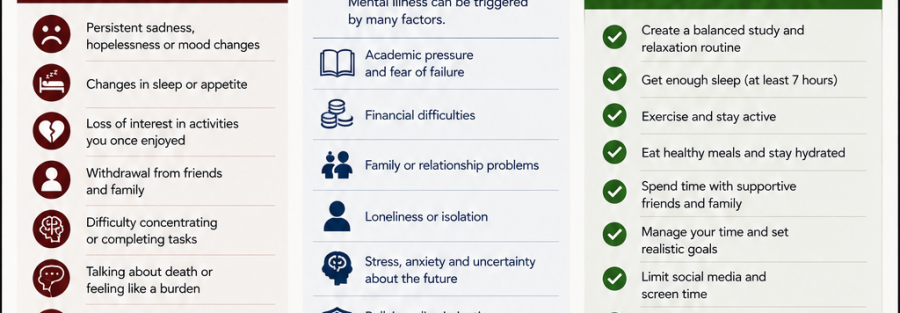
One important step in protecting yourself is understanding that experiencing stress, sadness, disappointment or anxiety from time to time does not automatically mean that you have a mental illness. Mental health exists on a spectrum, and a person can experience difficult emotions while still being able to function effectively in everyday life. Problems become more concerning when symptoms persist, become severe, interfere with studying or relationships, or make it increasingly difficult to perform normal daily activities. The National Institute of Mental Health’s guide on knowing when you may need help provides useful guidance on recognizing when professional assistance may be appropriate.
An IAT student should therefore avoid attempting to diagnose themselves or a classmate simply because they are experiencing stress. A self-check can help you recognize changes in your emotional well-being, but it cannot replace assessment by a qualified mental-health professional. Ask yourself whether your mood, sleep, concentration, appetite, motivation, relationships or academic functioning have changed significantly and whether those changes are continuing rather than disappearing after a short period. If something feels seriously wrong or you are struggling to cope, seeking professional assistance is a sign of responsibility rather than weakness.
What Can Contribute to Mental-Health Problems Among Students?
There is rarely one single cause of mental-health difficulties because emotional well-being can be influenced by biological, psychological, social, environmental and economic factors. Students may experience academic pressure, examination anxiety, financial difficulties, family conflict, relationship problems, loneliness, bullying, discrimination, grief, uncertainty about the future or pressure to meet other people’s expectations. WHO notes that mental health is influenced by multiple factors and that supportive environments, healthy sleep, physical activity, coping skills and interpersonal skills can contribute to well-being.
Technology can also create challenges when students remain connected to social media, entertainment and online conversations for much of the day. Constant comparison with other people’s achievements can create the false impression that everyone else is succeeding while you are falling behind. Excessive screen time can also compete with sleep, exercise, face-to-face relationships and focused study. The solution is not to reject technology but to develop healthy boundaries around how and when you use it.
Academic overload is another potential contributor because students sometimes believe that studying continuously demonstrates commitment. However, spending many hours with books or a computer does not automatically mean that learning is taking place effectively. Fatigue can reduce concentration, motivation and the ability to remember information, while chronic stress can affect both physical and mental well-being. The CDC’s guidance on managing stress recommends practical approaches such as taking breaks, making time to unwind, connecting with trusted people, sleeping adequately and remaining physically active.
The Importance of Balancing Study and Relaxation
A healthy student timetable should contain both productive academic time and genuine recovery time. Studying is important because it helps you understand concepts, complete assignments, prepare for examinations and build professional competence, but relaxation gives your mind an opportunity to recover from sustained concentration. A balanced routine might include scheduled study sessions followed by short breaks, exercise, social interaction, hobbies, meals and adequate sleep. The objective is not to study as little as possible but to make your study time more focused while protecting the rest of your life.
An IAT student can begin by creating a realistic weekly schedule that identifies classes, assignments, revision periods, personal responsibilities and relaxation. You can use a notebook, calendar, phone application or digital task-management system to divide large assignments into smaller tasks. The IAT Student Life page specifically highlights effective study methods, time-management guidance and life-skills development as part of the student experience. Planning your time therefore does not mean filling every minute with work; it means deliberately making space for the things that help you remain healthy and productive.
Sleep Should Not Be Treated as Wasted Time
One of the most common mistakes students make is sacrificing sleep to complete assignments or revise for examinations. A student may feel productive when studying late into the night, but repeatedly sleeping too little can leave the person exhausted and less capable of concentrating the following day. The CDC recommends that adults get at least seven hours of sleep and emphasizes maintaining consistent sleep and wake times as part of healthy stress management. Sleep should therefore be considered part of academic preparation rather than an obstacle to academic preparation.
If you have an examination tomorrow, staying awake throughout the night may appear attractive, but it may not be the most effective long-term strategy. A better approach is to plan your revision earlier, identify the most important topics and allow yourself sufficient time to rest. You can also avoid turning your bed into a permanent study location because separating study and sleep environments can help create healthier routines. If persistent sleep problems are accompanied by significant emotional or functional difficulties, consider discussing them with a qualified health professional rather than simply accepting exhaustion as normal student life.
Exercise, Hobbies and Recreation Are Part of Student Success
Physical activity is another important part of maintaining balance because movement can support both physical and emotional well-being. You do not necessarily need expensive gym membership or intensive athletic training because walking, jogging, stretching, dancing, playing football, cycling or participating in another enjoyable activity can help you become more active. Research and public-health guidance recognize links between physical activity, mental well-being, sleep and overall health. The important principle is consistency rather than perfection.
Hobbies can also give students an opportunity to step away from academic pressure and reconnect with activities that provide enjoyment. An IAT student might enjoy music, photography, coding projects outside class, gaming in moderation, reading, sports, art, volunteering, church or community activities, depending on personal interests. Relaxation should not automatically be viewed as laziness because recovery is necessary for sustainable performance. A student who takes a reasonable break may return to their studies with greater concentration than a student who forces themselves to continue while completely exhausted.
Maintain Healthy Relationships and Do Not Isolate Yourself
Social connection can be an important protective factor when students experience difficult periods. Having a trusted friend, relative, lecturer, mentor, counselor or other supportive person can provide an opportunity to talk about problems before they become overwhelming. IAT’s student-support information indicates that its student services include professional counseling and mental-health support for personal, academic and emotional challenges. Students should therefore not assume that they have to solve every problem alone.
Friendship also requires responsibility because students should learn to notice when someone close to them appears to be struggling. A friend who suddenly withdraws, expresses hopelessness, talks about being a burden or shows major changes in sleeping or eating patterns may need support. The NIMH suicide-warning-signs guide explains that warning signs can include talking about wanting to die, feeling hopeless or trapped, withdrawing from others, giving away important possessions, extreme mood changes and increased substance use. Such signs should be taken seriously rather than dismissed as attention-seeking.
Learn to Recognize Your Own Warning Signs
Every student should develop a personal mental-health self-check that can be completed regularly. Ask yourself whether you are sleeping normally, eating reasonably, attending classes, completing responsibilities, enjoying activities you previously enjoyed and maintaining contact with people who matter to you. Also ask whether you have become unusually irritable, hopeless, anxious, isolated or unable to concentrate. If several areas have changed significantly and the problem is continuing, consider seeking professional support rather than waiting for the situation to become unbearable.
The purpose of a self-check is early recognition rather than self-diagnosis. You might keep a simple weekly journal in which you record your energy, mood, sleep, workload and major sources of stress. This can help you identify patterns such as becoming overwhelmed every time examinations approach or regularly sacrificing sleep because of poor planning. Once you recognize a pattern, you can respond earlier by adjusting your schedule, talking to someone, seeking academic assistance or obtaining professional mental-health support.
How to Counter Common Causes of Student Stress
Academic pressure can be countered through planning, prioritization and asking for assistance early. Financial pressure may require a conversation with family, student-support personnel or another trusted person rather than silently carrying the burden until it becomes overwhelming. Relationship problems may require boundaries, honest communication or professional counseling rather than allowing conflict to consume all your attention. Uncertainty about employment can be addressed by developing practical skills, using career resources and focusing on achievable steps instead of constantly comparing yourself with other people.
IAT students can also make use of the institution’s wider academic and career resources while developing their professional skills. The IAT Courses section provides information about available programmes, while the ICT programme demonstrates how students can build technology-related knowledge through structured training. Students interested in future opportunities can also explore IAT’s Career Center and its career-development resources. Having a clear academic and career plan can help transform vague worry about the future into practical actions that can be managed one step at a time.
Do Not Use Alcohol or Drugs as Your Main Coping Strategy
When students are overwhelmed, they may be tempted to use alcohol or other substances as a way of escaping emotional pain. Although some people may temporarily feel relaxed, substance use can create additional problems and may interfere with sleep, relationships, academic performance, finances and emotional stability. The CDC identifies increased use of alcohol or drugs as something that can occur during significant stress and recommends healthier coping approaches. If substance use is becoming difficult to control or is being used to cope with distress, professional assistance should be considered.
A healthier coping strategy is to identify several options that can be used before a situation becomes a crisis. These might include taking a walk, talking with a trusted person, writing down your concerns, praying or reflecting if that is meaningful to you, exercising, resting, engaging in a hobby or seeking professional support. Different strategies work for different people, and there is no requirement to pretend that everything is fine. The important thing is to develop responses that reduce harm and help you move toward practical support.
When Should an IAT Student Seek Professional Help?
Professional help should be considered when emotional or behavioral changes persist, become severe or interfere with everyday functioning. Examples can include persistent sadness or hopelessness, significant anxiety, major changes in sleep or appetite, difficulty concentrating, withdrawal from normal activities or an inability to manage school and personal responsibilities. NIMH advises people to seek professional help when symptoms are interfering with tasks and activities, and especially when there are thoughts of suicide or urges to self-harm. You do not need to wait until you reach an extreme point before asking for assistance.
Students should also understand that counseling is not a punishment and does not mean that someone is “crazy.” Counseling can provide a structured opportunity to discuss academic, personal, emotional or relationship difficulties with someone trained to help. IAT states that its professional counselors provide confidential support for students dealing with personal, academic and emotional challenges. If you need to know how to access available student support, you can use the IAT Contact Us page to reach the institution directly.
Never Ignore Thoughts of Suicide or Self-Harm
The most important rule during a mental-health crisis is to take thoughts of suicide or self-harm seriously. If you are thinking about killing yourself, feel unable to stay safe or believe that you may act on suicidal thoughts, do not remain alone with the crisis. Move toward another person you trust, tell them clearly that you need help and seek immediate professional or emergency assistance. WHO emphasizes that suicide can be prevented and that timely emotional support and effective interventions can save lives.
In Kenya, students can contact Befrienders Kenya on +254 722 178 177 for emotional support, while its resources page also advises people in immediate danger to contact emergency services on 999 or 112. The Befrienders Kenya website provides information and support relating to emotional distress and suicide prevention, while the Kenya Red Cross provides humanitarian and support services in Kenya. The Kenya Red Cross Chat Care service also provides an AI-powered mental-health support channel, although an AI tool should never replace emergency services or qualified professional care when someone is in immediate danger.
How to Help an IAT Friend Who May Be Struggling
If you are concerned about another student, begin with a calm and private conversation. You can say that you have noticed they seem to be struggling and ask how they are doing without judging, criticizing or immediately trying to solve everything. Listen carefully and encourage them to connect with a counselor, mental-health professional, trusted family member or another appropriate support person. If the person expresses suicidal thoughts or appears to be in immediate danger, treat the situation as an emergency rather than promising to keep it secret.
You do not have to become someone’s therapist in order to be supportive. Your role can be to listen, stay with the person when appropriate, encourage professional help and assist them in reaching a safer environment. WHO’s suicide-prevention guidance emphasizes the importance of creating supportive environments and improving access to appropriate care. Being a good friend therefore means knowing both how to provide compassion and when to involve people who have the professional skills to manage a crisis.
Create Your Own IAT Student Wellness Routine
A practical student wellness routine can be built around several simple principles. Begin each week by identifying your most important academic tasks and distributing them across realistic study periods rather than waiting until deadlines are almost due. Protect time for sleep, meals, physical activity, friends, hobbies and relaxation in the same way that you protect time for classes. Review your routine at the end of each week and identify what caused unnecessary pressure so that you can make improvements during the following week.
For example, an IAT student might study intensively for several focused hours, take short breaks between sessions, exercise later in the day, spend time with friends or family and maintain a consistent bedtime. Another student may prefer morning study, afternoon classes and evening relaxation, while someone attending evening classes may require a completely different schedule. The goal is not to copy somebody else’s routine but to create one that allows you to meet your academic responsibilities without destroying your physical and emotional energy. A balanced lifestyle should be flexible because examination periods may require additional study while other periods should allow greater recovery.
Mental Health and Academic Excellence Can Work Together
Looking after your mental health does not mean lowering your academic ambitions. In fact, healthy routines can make it easier to concentrate, retain information, solve problems and maintain motivation over time. The same discipline that helps an IAT student complete an assignment can also be used to schedule sleep, exercise, relaxation and social connection. Academic excellence becomes more sustainable when the student recognizes that the person doing the studying also needs care.
The IAT student experience is designed around more than academic instruction, with the institution highlighting personal development, student support, career preparation, life skills and professional readiness. Students can therefore think of their education as a broader journey that includes technical competence, communication, resilience, relationships, decision-making and personal well-being. The goal should be to graduate not only with qualifications but also with the capacity to manage pressure responsibly and continue learning throughout life.
Do Not Suffer in Silence
September’s focus on suicide prevention provides an important reminder that conversations about mental health should not happen only after someone reaches a crisis. An IAT student can take meaningful preventive steps by creating a realistic study timetable, protecting sleep, exercising, maintaining relationships, enjoying hobbies, limiting unhealthy coping mechanisms and asking for assistance when problems become difficult to manage. Recognizing warning signs early can create an opportunity for intervention before distress becomes overwhelming. Most importantly, no academic grade, examination, relationship problem, financial challenge or career setback should convince a student that their life has lost its value.
The message of suicide prevention is ultimately a message about connection, hope and action. WHO’s 2026 campaign calls on society to “Change the Narrative on Suicide” and start conversations that reduce stigma and make it easier for people to seek help. For an IAT student, changing the narrative can begin in the classroom, the library, the computer laboratory, the student community or a simple conversation with a friend. Study hard, but rest wisely; pursue your goals, but protect your well-being; and if you or someone you know is struggling, speak up and seek help.
Useful IAT and Mental-Health Resources
For students who want to explore IAT’s academic and student-support resources, visit the IAT Home Page, IAT Student Life, IAT Courses, IAT ICT Programme, IAT Career Center, IAT Online Registration and IAT Contact Us. These internal resources can help students connect their academic journey with broader personal and professional development.
For external information, students can also consult the WHO Suicide Prevention resources, WHO World Suicide Prevention Day 2026, WHO adolescent mental-health guidance, NIMH Suicide Warning Signs, NIMH mental-health self-help guidance, CDC Managing Stress, Befrienders Kenya and Kenya Red Cross Chat Care.
Important: This article is intended for education and awareness, not to diagnose or treat a mental illness. If a student is experiencing suicidal thoughts, has made an attempt, is in immediate danger, or cannot keep themselves safe, seek emergency assistance immediately, stay with them where possible, and contact emergency services or a qualified mental-health professional. In Kenya, emergency numbers include 999 and 112, and Befrienders Kenya lists +254 722 178 177 as a support contact.
About the Author
Dennis Njeru is a versatile and results-driven professional with broad experience across finance, human resource management, ICT, operations management, general management digital marketing and multimedia production. His professional journey has given him exposure to diverse organizational environments, enabling him to develop a practical understanding of business operations, people management, technology, financial processes and organizational development.
He has extensive experience in financial management, accounting, data analysis, human resource management, administration, compliance, operations, project coordination and customer service. His technical capabilities extend to IT support, networking, IT service management, CCTV systems, digital marketing, UI/UX design, graphic design, camera operations, video editing and content creation, giving him a multidisciplinary perspective on the evolving demands of today’s workplace.
Dennis is also experienced in resource mobilization, proposal writing, monitoring and evaluation, programme coordination, and organizational performance. His exposure to different professional functions has strengthened his ability to analyze challenges from multiple perspectives, develop practical solutions, coordinate teams and resources, and communicate effectively with diverse audiences.
A strong advocate of continuous learning and professional development, Dennis has continually expanded his knowledge across business, technology, management, digital transformation, and creative fields. This multidisciplinary approach reflects his belief that today’s professionals need to go beyond academic knowledge by developing practical, adaptable, and technology-enabled skills that remain relevant in a rapidly changing employment environment.
Through his professional work and writing, Dennis is particularly interested in career development, employability, workplace skills, technology, professional growth, and the transition from education to employment. His perspective is informed by extensive exposure to organizational environments and an understanding of the challenges faced by students, graduates, professionals, and organizations in an increasingly competitive and technology-driven world.
His work and insights encourage students and emerging professionals to develop practical skills, present themselves professionally, embrace continuous learning, leverage technology, and take a strategic approach to building their careers.