
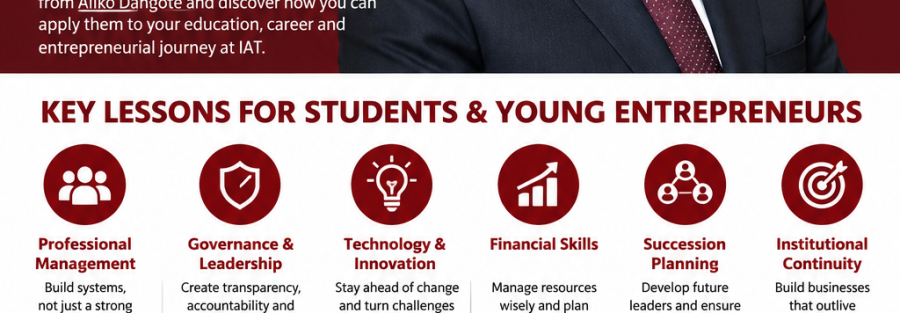
Article Description:From a Great Entrepreneur to the Next Generation of African Leaders explores the powerful lessons young people can draw from Aliko Dangote’s vision of building professionally managed businesses that can thrive beyond their founders. Inspired by his reflections on companies such as Microsoft, Apple and JPMorgan, the article examines the importance of professional management, leadership, succession planning, governance, technology, financial skills and institutional continuity. It connects these lessons directly to students and aspiring entrepreneurs, showing why acquiring practical and industry-relevant skills can help young people prepare for the opportunities and challenges of tomorrow’s economy.
The article also highlights how students at the Institute of Advanced Technology (IAT) can apply these principles to their own education, careers and entrepreneurial ambitions. IAT offers training across areas including ICT, programming, cybersecurity, data analysis, artificial intelligence, project management, business management, accounting and other professional disciplines. The article encourages current students to look beyond simply earning certificates and instead develop the practical skills, innovative thinking, discipline and problem-solving abilities required to create value. For prospective students, it presents education as a starting point for building a meaningful career, becoming an entrepreneur and potentially creating organizations that can make a lasting contribution to Africa’s future.
Estimated Read Time
Fast reader: 12–15 minutes
Average reader: 18–22 minutes
Careful reader: 25–30 minutes
The Greatest Business You Can Build May Be One That Outlives You
What if the real measure of an entrepreneur’s success is not how much money they make, but whether the organization they build can continue creating value long after they are gone? That question sits at the heart of a recent interview in which Aliko Dangote explained his desire for his companies to be professionally managed and built to last beyond one individual. In the interview, Dangote specifically referred to global corporations such as Microsoft, Apple and JPMorgan as examples of institutions whose operations and leadership structures have developed beyond dependence on their founders. His message offers a powerful lesson not only to established entrepreneurs, but also to young Kenyans preparing to enter technology, finance, management and business careers.
For a student sitting in a classroom today, this lesson may initially appear far removed from everyday academic life, but it is actually extremely relevant. The organization that eventually becomes a major technology company, financial institution, consulting firm or manufacturing business often begins with a person who has an idea, acquires skills and learns how to solve problems. Dangote’s journey therefore provides students with an opportunity to think beyond simply getting a certificate and instead consider what kind of professional, entrepreneur or business leader they want to become. The Institute of Advanced Technology (IAT) provides a practical environment where students can begin developing some of the technical and professional capabilities required in this changing business environment. The bigger lesson is simple: learn today, build tomorrow and create something capable of making a difference long after you have moved on.
Dangote’s Message Is Bigger Than Dangote
The central message from Dangote’s interview is not simply about one company or one entrepreneur. It is about the transition from a founder-dependent business to an institution supported by professional management, governance, systems and capable people. In his interview with ARISE News, Dangote said he wanted his companies to be professionally run and to have governance strong enough to ensure that they survive beyond him. This is an important distinction because entrepreneurship may begin with an individual, but sustainable organizations eventually require teams, processes, technology, leadership structures and institutional knowledge.
That distinction should matter enormously to young people preparing for the world of work. A student who learns only how to perform a particular task may become useful in one position, but a student who understands how technology, data, finance, management and people work together can develop a much broader professional perspective. Modern organizations need people who can solve problems, manage projects, analyze information, protect digital systems, communicate effectively and understand how their work contributes to organizational objectives. The World Economic Forum’s Future of Jobs Report 2025 identifies technological skills, AI and big data, networks and cybersecurity and technological literacy among areas expected to grow in importance, alongside analytical thinking, leadership and lifelong learning. For an IAT student, this is a reminder that education should not be viewed as preparation for one job title but as preparation for continuous professional growth.
The Founder Cannot Be the Entire Business
Every successful entrepreneur starts with an idea, a problem to solve or an opportunity to pursue. However, an organization becomes more resilient when knowledge, responsibility and decision-making are distributed across competent teams rather than concentrated entirely in one individual. Dangote’s comments highlight precisely this challenge: how can a founder create systems that allow the organization to continue functioning effectively as leadership changes? That question applies equally to a multinational conglomerate, a Kenyan SME, a technology startup or even a student’s future business venture.
This is where professional education becomes particularly important. Students need to learn not only what to do but also how organizations work, how decisions are made, how projects are implemented, how risks are managed and how technology supports operations. IAT’s Project Management programme covers project planning, execution, monitoring, stakeholder communication, risk management, team leadership and methodologies such as Agile, Waterfall and Scrum. These capabilities are relevant because an entrepreneur who wants to build an organization that lasts must eventually learn how to convert ideas into structured projects and projects into repeatable organizational processes. In other words, the future business leader needs both the entrepreneurial vision to identify opportunities and the professional discipline to execute them.
Microsoft and the Power of Leadership Transition
One reason Dangote referred to Microsoft is that its history demonstrates that a major company can move from founder leadership to subsequent generations of executives. Microsoft’s own history records that Steve Ballmer became the company’s second CEO in January 2000, succeeding Bill Gates. Microsoft had also been developing its leadership structure before that transition, with Gates appointing Ballmer as president in 1998 as part of a broader effort to expand the company’s management capacity. This provides an important lesson for students: leadership continuity is not something that should be considered only when a leader is leaving.
The Microsoft example also demonstrates that technical brilliance alone does not create institutional continuity. Organizations need people who understand strategy, operations, customers, technology, finance, human resources and organizational culture. A young person studying technology today could eventually become a software developer, cybersecurity professional, data analyst, project manager, technology entrepreneur or executive. Someone studying accounting or business could become a financial manager, auditor, consultant, entrepreneur or corporate leader. At IAT, the courses catalogue brings together technology, business, professional and specialized training areas that can help learners build different combinations of these capabilities.
Apple Shows Why Succession Cannot Be an Afterthought
Apple provides another useful example because Steve Jobs’ departure from the CEO position involved an identified successor. In August 2011, Apple announced that Jobs had resigned as CEO and that Tim Cook, previously the company’s Chief Operating Officer, would become CEO. Apple’s announcement on Steve Jobs and Tim Cook Jobs’ own communication to the Apple Board recommended that the company’s succession plan be implemented and that Cook be named CEO. Steve Jobs’ succession letter The example illustrates why organizations that expect to survive leadership changes need people, structures and processes capable of supporting continuity.
For students, the lesson is about preparing before the opportunity arrives. A student should not wait until becoming a manager to start learning leadership, communication, problem-solving and strategic thinking. These abilities can be developed through academic work, practical projects, teamwork, presentations, internships, entrepreneurship activities and professional training. IAT’s Data Analysis programme combines tools such as Advanced Excel, STATA, SPSS, Power BI and R with practical applications in data analysis, reporting and decision-making. When combined with leadership and business knowledge, technical competence can become part of a much broader professional toolkit.
JPMorgan and the Importance of Institutional Continuity
Dangote also referenced JPMorgan, another organization with a long institutional history. JPMorganChase’s 2025 annual report notes that the organization traces its history back to 1799 and describes 2026 as its 227th anniversary. Whatever the particular history of its predecessor institutions and mergers, the broader point is that an organization can develop an identity and operating structure that extends far beyond any single executive. This is precisely the type of institutional thinking that Dangote says he wants to strengthen within his own business empire.
For an aspiring entrepreneur, this raises a powerful question: If you started a business tomorrow, would the business depend entirely on you? If the answer is yes, the next question should be what systems, people, technology and knowledge would be needed to make it stronger. A business that cannot function without its founder may have entrepreneurial energy but still need greater institutionalization. A business supported by documented processes, competent employees, financial controls, technology systems, governance structures and leadership development has a stronger foundation for continuity.
Professional Management Is a Skill, Not a Title
Professional management should not be confused with simply hiring people with impressive job titles. It involves establishing clear responsibilities, measurable objectives, accountability mechanisms, communication channels, decision-making processes and systems for monitoring performance. It also involves creating a culture where people understand both what they are expected to accomplish and why their work matters. This is why education in project management, finance, data, information technology, cybersecurity and business administration can be highly relevant to future entrepreneurs and managers.
IAT’s professional Project Management courses include pathways covering areas such as CAPM, PMP, PMI-PBA, PgMP, PfMP, PMI-RMP and PMI-SP. Project management is particularly relevant because organizations turn strategies into results through projects, programmes and operational activities. The Project Management Institute(PMI) also identifies communication, problem-solving, collaborative leadership and strategic thinking as important power skills for project professionals. For a young person who dreams of becoming an entrepreneur or executive, learning how to plan, coordinate, communicate and deliver results can therefore be as important as having a great idea.
Technology Is Becoming Part of Institutional Memory
Another major lesson from Dangote’s vision is that organizations need systems that preserve knowledge. In a traditional environment, important information may exist primarily in the memories of a few experienced employees, but digital transformation makes it possible to document, organize, analyze and share information systematically. Databases, enterprise systems, cybersecurity controls, digital records, analytics platforms, cloud services and collaboration tools can help organizations operate with greater consistency. This means that tomorrow’s entrepreneur needs to understand technology not merely as something used by the IT department but as part of organizational strategy.
IAT’s Data Management and Analysis programmes include areas such as Advanced Excel, Power BI, financial modelling, research methodology, statistical analysis, records management, Tableau and data management. The World Bank similarly identifies digital skills as increasingly important for individuals, businesses and governments and highlights the importance of connecting skills development with industry needs. For an IAT student, the message is therefore clear: learning technology is not simply about getting a technology job; it can also prepare you to build, manage and transform organizations.
Cybersecurity Is Part of Responsible Leadership
A company that wants to survive for generations must also protect its information, systems, customers and digital assets. As businesses become more dependent on technology, cybersecurity becomes part of organizational resilience rather than a narrow technical responsibility. Entrepreneurs therefore need to understand the risks associated with data breaches, weak access controls, insecure systems and poor information management. Professionals working in technology need to develop the technical capabilities required to help organizations identify and manage those risks.
IAT’s CompTIA courses cover areas including A+, Network+, Security+, Cloud+, Linux+, CySA+, PenTest+, Data+ and Project+. These areas demonstrate how a learner can progressively build technical capabilities that complement business and management knowledge. A future entrepreneur may not personally become a cybersecurity specialist, but understanding the importance of cybersecurity can help that entrepreneur make better organizational decisions. The broader lesson from Dangote’s vision is that sustainable businesses require competent professionals across many different disciplines.
Finance and Governance Must Grow with the Business
A company can have a brilliant product and still struggle if its financial systems, controls and governance structures are weak. Professional organizations require people who understand accounting, financial reporting, taxation, audit, risk, compliance and decision-making. These disciplines help leaders understand whether resources are being used responsibly and whether business decisions are supported by reliable information. This is why finance remains an important component of building an organization capable of lasting for generations.
For students interested in this area, IAT’s ACCA programme covers accounting, financial management, taxation, audit, corporate law and other areas of professional finance. The programme also offers physical, online and blended learning options according to the information currently published by IAT. ACCA’s current research on future finance careers also highlights the growing importance of technical capabilities alongside data-driven insights and adaptability as career structures evolve. For a young person who wants to understand how businesses make and manage money, finance education can therefore become part of a much larger entrepreneurial toolkit.
Business Leaders Need More Than One Skill
One of the strongest lessons young people can take from Dangote is that major business leadership requires the ability to connect different areas of knowledge. An entrepreneur may need to understand finance while also appreciating technology, marketing, people management, operations, data and strategy. This does not mean that one individual must become an expert in every discipline, but it does mean that leaders need enough understanding to ask good questions and work effectively with specialists. The strongest organizations are often built by teams whose different skills complement one another.
IAT’s IIBA courses provide another example of how professional skills can bridge technology and business. The programme catalogue includes business analysis, business data analytics, agile analysis, product ownership analysis and cybersecurity analysis. Business analysis is particularly relevant to institutional development because it focuses on understanding needs, analyzing problems and connecting business requirements with solutions. For a student who wants to become an entrepreneur, manager, consultant or technology professional, learning how to understand a problem before proposing a solution is an extremely valuable habit.
The African Entrepreneur Needs to Think Beyond the First Generation
Africa’s business environment is changing rapidly, and technology is creating new opportunities for young entrepreneurs to develop businesses, services and careers. The World Bank’s work on digital transformation in Africa highlights the connection between digital technologies, skills, jobs and economic opportunity. World Bank’s Digital Africa report This creates an important opportunity for a new generation of African professionals who can combine technical competence with entrepreneurial thinking. Instead of viewing themselves only as job seekers, young people can also develop the capabilities needed to become problem-solvers, innovators and future employers.
That is where Dangote’s story becomes particularly inspiring for Kenyan students. His example shows what can happen when entrepreneurship is combined with ambition, long-term thinking, organizational development and investment in large-scale business systems. Students should not interpret his success as evidence that everyone must build a conglomerate of the same size, because every entrepreneur’s circumstances, industry and resources are different. Instead, they can take the underlying lesson that a serious business begins with solving problems and grows through people, systems, knowledge and disciplined execution. The IAT DataComms courses illustrate another route through which learners can acquire specialized technical knowledge in areas including structured cabling, data centres, enterprise security, IP surveillance and wireless technologies.
IAT Students: Do Not Study Only for the Examination
For current IAT students, Dangote’s interview can serve as a reminder to look beyond the immediate examination, assignment or certificate. The knowledge being acquired today can become part of a professional foundation that may be used years later in a company, project, consultancy, startup or leadership role. A student studying programming can eventually build software that solves a real business problem, while a student studying data analysis can help an organization make better decisions. A cybersecurity student can help protect an organization’s digital assets, while a project management student can help turn strategy into measurable results.
Students should therefore approach their training with the mindset of future professionals rather than temporary learners. Ask questions, practice what is taught, build portfolios, work with classmates, research industries and seek opportunities to apply knowledge to real-world problems. At IAT, the goal should be not merely to complete a course but to emerge with knowledge and capabilities that can be demonstrated in the workplace or applied in an entrepreneurial venture.
Prospective Students: Choose Skills That Help You Build
For someone considering joining IAT, Dangote’s message provides a useful way to think about education. Instead of asking only, “Which course can I complete quickly?” consider asking, “Which skills can help me solve meaningful problems and build a sustainable career?” That question can lead you toward areas such as project management, data analysis, cybersecurity, programming, business analysis, finance, accounting, digital technologies and other professional disciplines. IAT currently provides a range of technology and business programmes and states that its training approach emphasizes practical, industry-relevant skills.
IAT also publishes programme-specific entry information, including admission requirements for its different training pathways. Its current information describes programmes spanning End-User Training, authorized technology training, professional courses and TVET-CDACC certificate and diploma programmes. For learners who want flexibility, individual programmes may offer different study modes, including physical and online options, depending on the course. This makes it possible for students and working professionals to explore training that aligns with their circumstances and career direction.
Building the Next Microsoft, Apple, JPMorgan or Dangote-Level Institution Starts with Skills
It would be unrealistic to suggest that attending a college automatically guarantees that someone will build a multinational corporation. Entrepreneurship is affected by many factors, including opportunity, capital, market conditions, leadership, timing, networks, execution and persistence. What education can do is provide knowledge, skills, exposure and professional foundations that increase a person’s capacity to recognize problems and develop solutions. IAT’s role can therefore be understood as helping learners acquire practical capabilities that they can later apply in employment, entrepreneurship, consulting and organizational leadership.
Kenya’s wider TVET environment also emphasizes the importance of quality and relevance in technical and vocational training. The TVET Authority states that it regulates and coordinates training through licensing, registration and accreditation of programmes, institutions and trainers, while its accreditation framework addresses quality assurance and governance requirements. For students, this reinforces the importance of taking their training seriously and selecting programmes that match their aspirations and professional development needs. The future belongs to people who are prepared to learn continuously, apply their skills and adapt as industries change.
Your Career Should Become Bigger Than Your First Job
A student may begin as a junior employee, but there is no reason for that first position to define the entire professional journey. Someone can begin in IT support and later move into cybersecurity, cloud computing, systems administration, project management or technology leadership. Another person may begin in accounting and progress toward financial management, audit, consulting, entrepreneurship or corporate leadership. The important principle is to keep building capabilities instead of assuming that one qualification marks the end of learning.
This approach is increasingly relevant because technology is changing the nature of work itself. The World Bank’s recent work on digital jobs and skills points to the importance of advanced IT and technical skills as economies adapt to changing labour markets. The World Economic Forum likewise identifies technological literacy, AI and big data, networks and cybersecurity, analytical thinking and lifelong learning among important areas for the changing workplace. IAT students therefore have an opportunity to think of their education as the beginning of a professional journey rather than the conclusion of one.
The Entrepreneurial Mindset IAT Students Can Take from Dangote
The most valuable lesson from Dangote’s interview may be the idea of thinking beyond immediate success. A young entrepreneur may initially focus on making the first sale, winning the first client or completing the first project, but sustainable entrepreneurship requires thinking about what happens next. How will the business maintain quality when it grows? How will employees understand their responsibilities? How will customers be served consistently? How will leadership continue when the founder is no longer involved in every decision?
These are not merely questions for billionaires or multinational corporations. They are questions that can be applied to a student starting a small online business, a technology startup, a consultancy, a retail operation or a professional services firm. Learning data and technology skills can help entrepreneurs understand information, while project management can help them organize execution and professional accounting training can strengthen their understanding of finance. When such skills are combined with curiosity, integrity, discipline and a willingness to keep learning, a young entrepreneur can begin building something that has the potential to become more than a personal income source.
A Call to Current and Future IAT Students
If you are already an IAT student, do not underestimate the significance of what you are learning. The computer in front of you, the data you analyze, the project you plan, the financial statement you interpret or the network you configure may look like an ordinary classroom exercise today, but these activities can develop capabilities that organizations need tomorrow. Take your assignments seriously because they are opportunities to practice professional thinking. Take your practical sessions seriously because employers and clients need people who can apply knowledge rather than simply describe it. Most importantly, develop the habit of asking how what you are learning could solve a real problem.
If you are considering joining IAT, this is an opportunity to start thinking about your future in a more ambitious way. IAT’s programmes span technology, data, business, finance, project management, cybersecurity, business analysis and other professional areas, giving learners different pathways depending on their interests and career goals. The IAT course catalogue provides an overview of available programmes, while the institution’s current information highlights practical training, industry relevance and flexible learning approaches. Your first step does not need to be the creation of a giant corporation; it can simply be the decision to acquire one useful skill, then another, then another, until those skills become the foundation of a career, enterprise or institution.
From Dangote’s Vision to Your Own Future
Aliko Dangote’s comments about professional management, governance and institutional continuity provide a valuable case study in long-term entrepreneurship. Microsoft demonstrates how leadership can transition beyond a founder, Apple provides a documented example of succession planning and JPMorgan illustrates how an institution can maintain a long historical identity across generations of leadership and organizational change. These examples do not mean that every business should copy the same structure, because companies operate in different industries, markets and regulatory environments. They do, however, demonstrate why entrepreneurs need to think about people, systems, governance, technology and continuity as their organizations grow.
For IAT students, the message is especially relevant because today’s digital economy requires professionals who can combine technical knowledge with business understanding and leadership capabilities. The next major African entrepreneur may not look exactly like today’s business leaders, and the next transformative company may emerge from an industry that has not yet reached its full potential. What matters is whether young people are prepared to recognize opportunities, develop useful skills, solve problems and build organizations responsibly. The next great African business story could begin with a student who is currently sitting in a classroom, learning a skill and wondering what to do with it.
Conclusion: Do Not Just Prepare to Get a Job-Prepare to Build Value
Dangote’s vision offers students a powerful challenge: do not think only about getting into an organization; think about becoming the kind of professional who can help an organization grow, transform and endure. Learn technology because technology creates possibilities, learn business because ideas need sustainable models, learn finance because resources must be managed responsibly and learn leadership because people ultimately turn strategies into results. At IAT, students have access to programmes designed around many of these capabilities, including technology, data, project management, business analysis, accounting and specialized professional training. The institution’s current programme information also reflects a practical orientation toward skills that can be applied in professional environments.
The most important lesson is therefore not that every student should try to become another Dangote. It is that every student should aim to become exceptionally useful at solving problems, creating value and continuously developing their capabilities. Dangote built businesses from opportunities he identified and now speaks about building institutions that can continue beyond the founder; today’s students can begin their own journeys by building knowledge, discipline, technical competence and entrepreneurial thinking. Whether your ambition is to become a technology specialist, accountant, data analyst, project manager, cybersecurity professional, business analyst, entrepreneur or corporate leader, the journey begins with learning and purposeful action.
At IAT, your education can be more than preparation for employment-it can be preparation for the responsibility of building the businesses, technologies and institutions that will shape Africa’s future.
About the Blog Writer
Dennis Njeru is a business, technology and education professional with more than 10 years of experience spanning management, finance, human resources, information technology, digital marketing and business operations. His multidisciplinary background allows him to examine technology not only from a technical perspective but also through the lens of education, career development, entrepreneurship and business transformation.
Dennis is passionate about ICT education, digital skills development and inspiring young people to pursue careers in technology, be God-fearing, morally upright, be wholesome and quality global citizen. His writing focuses on making complex technology topics relatable while connecting them to practical opportunities for students and aspiring professionals.
He encourages young aspiring technology professionals to explore areas such as software engineering, programming, artificial intelligence, data science, networking, databases and cybersecurity.
Dennis believes that the next great technology solution could come from Kenya, Africa and from a young person who chooses to learn today. His goal is to use practical and inspirational storytelling to help students move from simply consuming technology to understanding, creating and using it to solve real-world problems.