Article Description: Discover the technologies powering Elon Musk’s companies and learn how AI, programming, data science, networking, cybersecurity, software engineering and robotics can shape your ICT career. Explore ICT courses at IAT and identify the technology skills you need to prepare for the future.
The Technology You Learn Today Could Build Tomorrow
What if the ICT course you choose today could eventually help you build an AI system, secure a satellite network, develop intelligent robots or create software for autonomous vehicles? Technologies that once sounded like science fiction are already being developed and deployed in real businesses around the world. Elon Musk’s companies provide one of the most visible examples of how software, artificial intelligence, data, networking, robotics and computing can come together to solve complex problems. If you’re a student trying to decide which ICT course to study, looking at these technologies can help you understand where different ICT skills can take your career.
You don’t have to become another Elon Musk to benefit from this story. What you need to understand is that the technologies behind his companies depend on thousands of professionals with specialised skills in programming, software engineering, artificial intelligence, data science, networking, cybersecurity, cloud computing and other areas. This means that your ICT career doesn’t have to be limited to working for a traditional IT company. You could eventually apply your technology skills in transport, healthcare, energy, finance, telecommunications, manufacturing, education or even space technology.
Why Elon Musk’s Technology Matters to You
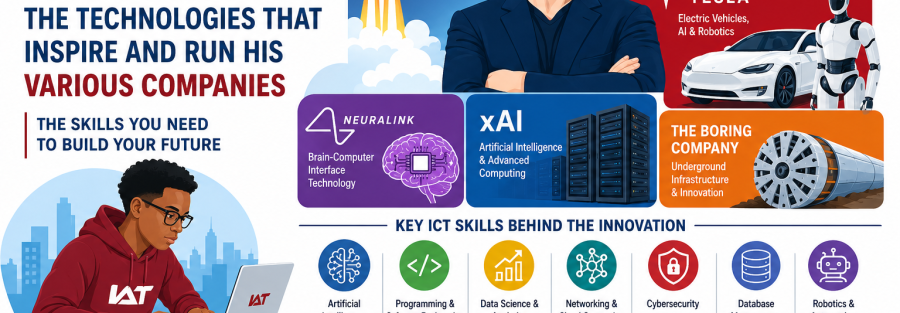
Elon Musk is associated with several technology-driven companies operating across different industries. Tesla is known for electric vehicles, energy storage, artificial intelligence and robotics, while SpaceX focuses on space transportation and satellite communications through Starlink. xAI is developing artificial intelligence systems and large-scale computing infrastructure, while Neuralink is developing brain-computer interface technology. The Boring Company is applying technology and automation to underground transportation infrastructure, showing how digital skills can influence industries that may not initially appear to be part of the ICT sector.
The important question for you isn’t simply, “What technology does Elon Musk use?” A better question is, “What skills do people need to build and operate these technologies?” Once you ask that question, you begin to see why choosing the right ICT course can be an important career decision. The technologies powering these companies require people who can write software, analyse data, build networks, protect systems, manage databases, develop AI models and maintain complex computing infrastructure.
Artificial Intelligence: One of the Most Important Technologies of the Future
Artificial intelligence is one of the strongest technology themes across Musk’s businesses. Tesla uses AI in its work on vehicle autonomy and robotics, with technologies involving neural networks, computer vision, planning and AI inference. Tesla also develops Optimus, a humanoid robot that requires advanced software, perception, control and machine-learning technologies. You can explore Tesla’s approach to Artificial Intelligence and Robotics to understand how AI is being applied beyond conventional computer applications.
For you as a student, AI represents an opportunity to learn how computers can analyse information, identify patterns and support intelligent decision-making. AI is already being applied in healthcare, banking, agriculture, manufacturing, education, marketing, cybersecurity and transportation. You don’t have to know exactly which industry you’ll work in ten years from now because AI skills can be transferred across many sectors. If you enjoy problem-solving, mathematics, programming and experimenting with technology, studying Artificial Intelligence and related ICT programmes at IAT could be an excellent starting point.
Programming: The Foundation Behind Digital Innovation
Artificial intelligence may attract attention, but programming remains one of the foundations that make advanced technology possible. Software is required to operate applications, websites, autonomous systems, databases, robots, cloud platforms and many other digital technologies. Tesla’s technology ecosystem demonstrates how software and AI have to work together to process information and control complex systems. This is why learning programming can give you a foundation that remains useful even as individual technologies change.
If you enjoy creating things with computers, programming can give you the ability to move from being a technology user to becoming a technology creator. You can start by learning programming concepts and then progress into software development, web development, data science, artificial intelligence or cybersecurity. Python is particularly useful because it is widely applied in areas such as AI, data analysis and automation. IAT provides Computer Programming and Python-related training for students and professionals who want to build practical programming skills.
Software Engineering: Turning Ideas into Working Systems
A great technology idea is only useful when someone can turn it into a reliable product. Software engineering provides the structured approach needed to design, develop, test, deploy and maintain software applications. Large technology companies need software engineers who can think about architecture, performance, security, reliability and scalability. Whether you’re building a mobile application or software that interacts with an autonomous machine, software engineering principles help turn an idea into a system that users can depend on.
You might begin your ICT journey with programming and later progress into software engineering. From there, you could specialise in web applications, mobile applications, enterprise systems, cloud platforms, artificial intelligence or other areas of technology. This gives you flexibility because your fundamental software skills can be applied across industries. IAT’s Software Engineering programmes can help you explore this pathway and develop skills for building digital solutions.
Data Science: Turning Information into Intelligence
Modern technology produces enormous quantities of data. Autonomous vehicles collect information from sensors, digital platforms generate information about user interactions and businesses produce operational and financial data every day. Artificial intelligence systems also require large amounts of data for training, testing and improvement. This makes data science one of the important ICT fields supporting the technologies of the future.
If you enjoy numbers, statistics, patterns and problem-solving, data science could be a strong ICT career option. A data professional can help organisations understand what is happening, identify trends and make evidence-based decisions. You could work in finance, healthcare, marketing, telecommunications, manufacturing, government or technology. IAT provides Data Analysis and Data Science training that can help you explore this increasingly important field.
Networking: Connecting the Modern Digital World
SpaceX’s Starlink provides a powerful example of why networking and communication technologies remain important. Starlink uses a constellation of satellites to provide broadband internet connectivity, bringing together satellite technology, communication systems, computing and networking. You can learn more about Starlink’s technology and appreciate the scale at which modern communication systems operate. Although you may think of networking as simply connecting computers in an office, today’s networking technologies operate across organisations, data centres, cloud platforms and communication infrastructure.
Learning networking can therefore open doors to several ICT careers. You could work in network administration, telecommunications, infrastructure support, cloud networking or network security. Networking knowledge can also become the foundation for moving into cybersecurity because you need to understand how systems communicate before you can effectively protect them. IAT offers Cisco networking programmes such as CCNA and CCNP for learners interested in developing professional networking skills.
Cybersecurity: Protecting the Technologies We Depend On
Every new technology creates new security responsibilities. Companies that operate connected vehicles, satellite networks, AI infrastructure and digital platforms need professionals who can identify vulnerabilities and protect information systems. Cybersecurity is therefore becoming a core requirement rather than an optional technical speciality. As businesses continue moving their operations online, the demand for people who understand digital security is likely to remain significant.
If you enjoy investigating problems and understanding how systems can be protected, cybersecurity could be an excellent ICT pathway. You can develop skills in network security, ethical hacking, security operations, penetration testing, risk management and incident response. Cybersecurity also connects naturally with programming, networking, operating systems, databases and cloud computing. IAT offers Cybersecurity programmes and professional certification pathways including CompTIA Security+, giving learners opportunities to build skills in this important field.
Databases: The Memory Behind Digital Systems
You may not hear databases mentioned as frequently as artificial intelligence or robotics, but almost every large digital system depends on them. Applications need databases to store information, businesses need databases to manage records and websites need databases to organise content. AI and data science projects also depend on accessing large quantities of well-structured information. Without reliable data management, many modern digital systems wouldn’t function effectively.
Database technology can therefore be a valuable ICT career pathway if you enjoy organising information and understanding how systems store and retrieve data. You can learn relational database technologies such as Oracle and PostgreSQL as well as modern database technologies such as MongoDB. These skills can support careers in database administration, software development, data engineering and enterprise systems. IAT offers Oracle Database, PostgreSQL and MongoDB training for learners interested in building database expertise.
Robotics: Where Software Meets the Physical World
Robotics provides one of the clearest examples of how ICT skills are moving beyond traditional computers. Tesla’s Optimus project combines artificial intelligence, computer vision, software engineering, motion planning and control systems to create a humanoid robot capable of interacting with the physical environment. This type of technology requires professionals from several technical disciplines working together. You can explore Tesla’s AI and Robotics work to see how software and intelligent machines are increasingly connected.
For you as a student, robotics demonstrates why learning foundational ICT skills is important. A robot needs software to control its actions, sensors to collect information and AI to interpret its surroundings. Depending on its design, it may also need networking, databases, cloud services and cybersecurity. Even if you don’t eventually become a robotics engineer, studying programming, AI, data science or networking can prepare you to participate in technology projects involving intelligent machines.
xAI and the Rise of Large-Scale Computing
xAI demonstrates another important part of the modern technology ecosystem: computing infrastructure. Advanced artificial intelligence systems require enormous computing resources, specialised processors, high-speed networking, storage and software infrastructure. xAI’s Colossus computing infrastructure demonstrates the enormous scale of computing resources being deployed to support AI development. This shows that AI isn’t only about creating algorithms because the infrastructure supporting those algorithms is equally important.
This creates several ICT career opportunities for students with different interests. You could specialise in AI development, but you could also work in cloud computing, Linux administration, networking, systems administration or data centre technology. Large computing environments require professionals who can configure systems, manage networks, troubleshoot infrastructure and maintain security. IAT’s CompTIA and infrastructure-related training can help you explore some of these technology pathways.
Neuralink: When ICT Meets Healthcare and Neuroscience
Neuralink demonstrates how ICT can combine with disciplines that may initially appear unrelated to technology. The company is developing brain-computer interface technology involving neural signals, electronics, software and data processing. Its work illustrates how computing can increasingly interact with healthcare, biomedical technology and human-machine interfaces. You can learn more about Neuralink’s technology to appreciate how multidisciplinary modern technology has become.
The lesson for you is that your ICT career doesn’t have to remain inside a traditional IT department. Programming, data science, AI and software skills can be applied in healthcare technology, assistive technology, research and biomedical systems. As technology continues to develop, new careers will emerge at the intersection of computing and other industries. Building strong ICT foundations now can therefore give you the flexibility to participate in opportunities that may not yet exist in their current form.
Energy Technology is Becoming Digital
Tesla’s energy business provides another example of how ICT is transforming traditional industries. Modern energy storage systems increasingly depend on software, sensors, data and digital monitoring to operate efficiently. Tesla’s Megapack technology demonstrates how large-scale energy storage can be supported by software that monitors and manages system performance. This means that ICT professionals can contribute to energy and infrastructure projects even when the final product isn’t a traditional computer application.
This trend is important because digital transformation is spreading across almost every industry. A data analyst can help an energy company understand consumption patterns, while a cybersecurity professional can help protect connected infrastructure. A network specialist can support communication between connected devices, while a software engineer can develop applications that monitor and control digital systems. By learning ICT, you aren’t choosing only an IT career because you’re developing skills that can be transferred into many different sectors.
What Does This Mean When Choosing Your ICT Course?
The technologies behind Elon Musk’s companies shouldn’t make you feel that you need to study every ICT discipline. Instead, use them to understand the range of opportunities available and then identify the problems you enjoy solving. If you enjoy creating applications, programming and software engineering could be a strong choice, while students interested in mathematics, patterns and intelligent systems could explore AI and data science. If you enjoy connecting systems, networking could be appropriate, while students interested in protecting technology could consider cybersecurity.
You can also combine your skills as your career develops. You might begin with programming and later add artificial intelligence, databases and cloud computing to your skill set. Another student could start with networking and progress into cybersecurity, while someone interested in data could combine data analysis with Python, databases and machine learning. IAT’s ICT course portfolio provides different technology pathways that can help you build skills according to your interests and career goals.
The most important thing is to choose a course that matches your interests and gives you opportunities to practise what you learn. Don’t choose AI simply because it is popular, and don’t choose cybersecurity only because you’ve heard that it has good career prospects. Technology requires continuous learning, curiosity and problem-solving, so your interest in the subject will matter throughout your career. Your first ICT course also doesn’t have to be your final destination because it can become the foundation for the next skill you develop.
The Bigger Lesson from Elon Musk’s Companies
The biggest lesson from Musk’s technology companies isn’t simply that rockets, robots, AI and electric vehicles are exciting. The deeper lesson is that major technology projects require different technical disciplines to work together. An autonomous vehicle can require AI, programming, computer vision, sensors, networking, data and cybersecurity, while an AI company can require software engineering, databases, networking, computing infrastructure and data science. This shows you why developing complementary ICT skills can make your career more adaptable.
You should therefore think beyond the job title you want immediately after completing your course. Instead of asking only whether you want to become a programmer, network administrator or cybersecurity specialist, consider the problems you want your technology skills to solve. You could eventually apply ICT skills in finance, healthcare, education, manufacturing, telecommunications, agriculture, energy, transportation or government. Technology will continue to change, but professionals who can learn, adapt and solve problems will continue to have opportunities.
Your ICT Career Can Start with One Skill
You don’t need to know everything before beginning your ICT journey. Start by identifying what interests you and choose an entry point that gives you practical skills you can build on. IAT provides a broad range of ICT and technology courses covering areas such as programming, software engineering, AI, data science, networking, databases and cybersecurity. This gives you the opportunity to explore a pathway that matches your interests and career ambitions.
You can then build your skills progressively as your understanding grows. A student interested in AI could begin with Python programming before progressing into data science and machine learning, while someone interested in cybersecurity could start with IT and networking before moving into security certifications. Someone interested in software could begin with programming and progress into web development or software engineering. The important thing isn’t to learn everything immediately but to develop one strong foundation and then keep expanding your capabilities.
Build Your Future With ICT
Elon Musk’s companies show that ICT skills power innovation.
Artificial intelligence, programming, data science, networking, cybersecurity, databases, software engineering and robotics are all contributing to technologies that are changing the world. Your ICT course can therefore become more than a qualification because it can provide the foundation for solving real problems across different industries. The future is being built by people who understand technology, and your journey can begin with the skills you choose to learn today.
Start Your ICT Journey at IAT
Are you a student, graduate or professional wondering which ICT course to choose? Visit the IAT website and explore the available ICT and technology courses to identify a programme that matches your interests and career goals. Whether you’re interested in artificial intelligence, programming, software engineering, data science, networking, cybersecurity or databases, the right skills can help you prepare for the opportunities created by tomorrow’s technologies.
Don’t just use technology. Learn how to build it, manage it and secure it. Start your ICT journey at IAT today.
About the Blog Writer
Dennis Njeru is an experienced business and technology professional with over 10 years of experience spanning ICT, business management, finance, HR, digital marketing and operations. His interests include artificial intelligence, data analytics, cybersecurity, digital transformation and emerging technologies. Through his writing, Dennis simplifies complex technology and business concepts while helping students and professionals understand emerging trends, develop relevant skills and make informed education and career decisions.