
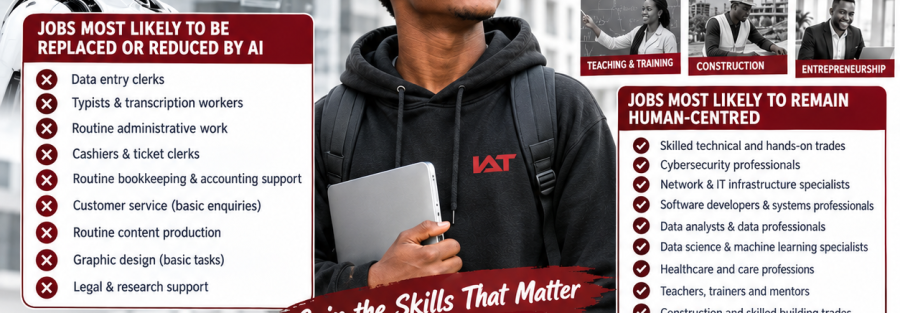
Article Description: The article explores one of the most important questions facing students, graduates, professionals, parents and employers today: what will happen to jobs as artificial intelligence becomes more powerful? The article explains why AI is more likely to automate many repetitive and predictable tasks than eliminate entire professions, while highlighting the types of work that continue to depend heavily on human judgement, creativity, practical skills, empathy, communication, problem-solving and physical interaction. It also examines the growing importance of technical and digital skills such as ICT, cybersecurity, networking, software engineering, Python programming, data analysis, data science, machine learning and artificial intelligence. Most importantly, the article connects these developments to the opportunities available at the Institute of Advanced Technology (IAT) and encourages students, particularly those considering TVET-CDACC certificate and diploma programmes, to acquire practical, industry-relevant and future-ready skills. The central message is simple: do not prepare for yesterday’s jobs-prepare to create value in tomorrow’s workplace.
Estimated reading time:
- KCSE students and prospective TVET students: 12-15 minutes
- TVET-CDACC certificate and diploma students: 10-12 minutes
- Parents and guardians: 8-10 minutes
- Working professionals: 10-12 minutes
- Employers, entrepreneurs and career advisers: 12-15 minutes
The Question Every Student Should Be Asking
Imagine spending two, four or even six years preparing for a career, only to discover that many of the tasks you were trained to perform can now be completed in seconds by an artificial intelligence system. Imagine a young person entering the job market with a certificate, a diploma or even a degree, only to compete against software that can analyze documents, generate reports, answer customer questions, write computer code, process invoices, create images and perform calculations continuously without taking a lunch break. This is no longer simply a science-fiction scenario because artificial intelligence is already changing how organizations perform everyday work. The important question, therefore, is not whether AI will affect employment, but which tasks and occupations are most exposed, which human capabilities remain difficult to automate, and what students should learn today to remain useful tomorrow.
The discussion, however, needs to be more balanced than the frightening headline that “AI will take all our jobs.” Research from the International Labour Organization indicates that roughly one in four workers globally are in occupations with some exposure to generative AI, but its 2025 analysis also concludes that job transformation is generally more likely than complete replacement because most occupations still contain tasks requiring human involvement. The World Economic Forum’s Future of Jobs Report 2025 similarly projects substantial labour-market disruption by 2030, but also projects the creation of many new jobs alongside declining occupations.
For a young Kenyan deciding what to study, this distinction is extremely important. The goal should not be to find a career that AI can supposedly “never” touch, because no responsible institution can guarantee that any occupation will remain unchanged forever. Instead, students should acquire technical competence, practical hands-on skills, digital literacy, problem-solving ability, communication skills, adaptability and the ability to work alongside AI. This is where institutions such as the Institute of Advanced Technology (IAT) become particularly relevant for students who want practical, industry-oriented skills.
AI Is More Likely to Replace Tasks Before It Replaces Entire Jobs
One of the biggest mistakes people make when discussing AI and employment is treating a job as though it consists of one single activity. A job is normally a collection of many different tasks, and AI may be very good at some of those tasks while being poor or inappropriate for others. For example, an accountant may use AI to categorize transactions and prepare preliminary reports, but still need to interpret financial information, communicate with management, investigate unusual transactions and exercise professional judgement. Similarly, a software developer may use AI to generate sections of code but still need to understand the business problem, design the system, test the result, secure the application and take responsibility for what is deployed.
The ILO‘s 2025 research examined thousands of occupational tasks rather than simply declaring entire professions “safe” or “unsafe.” Its findings show particularly high exposure in clerical occupations, while also identifying increasing exposure in some professional and technical occupations as generative AI becomes more capable. The OECD‘s more recent work likewise emphasizes that AI exposure is multidimensional and that current AI capabilities are closest to occupations involving routine information processing and codifiable tasks, while they remain further from work requiring contextual judgement, interpersonal understanding, complex decision-making and responsibility.
That means students should stop asking only, “What job will AI not take?” A much more useful question is, “What skills will make me valuable when AI becomes part of my workplace?” That question changes everything because it encourages students to combine a recognized qualification with practical technical skills and AI literacy. Instead of trying to hide from technological change, the future-ready worker learns how to use technology to become more productive while retaining the human capabilities machines struggle to reproduce.
Jobs and Tasks Most Likely to Face AI Replacement or Major Reduction
1.Data Entry Clerks
Data entry is one of the clearest examples of work vulnerable to automation because much of the activity involves transferring structured information from one system to another. Optical character recognition, automated forms, document processing, databases and AI-powered extraction systems can increasingly capture and organize information without requiring a person to manually type every field. The ILO specifically identifies data-entry work among the occupations with high exposure to generative AI.
This does not mean that every person currently working with records will suddenly become unemployed. Instead, the traditional role can evolve into information management, data quality control, records governance, database administration or analytical work. A student who learns only repetitive data entry may therefore face greater vulnerability than one who progresses into data analysis and information systems. Students can explore IAT’s Data Analysis programme as an example of how a basic administrative skill set can be developed into a more analytical and technology-oriented capability.
2.Typists and Routine Transcription Workers
Traditional typing and transcription are also increasingly exposed because AI systems can convert speech into text, summarize meetings and generate documents. A person who previously spent hours typing information from recordings can now potentially complete the initial transcription much faster using automated tools. The ILO identifies typists among the occupations with significant generative-AI exposure.
However, the need for humans does not disappear completely because accuracy, context, confidentiality, specialized terminology and final verification remain important. The opportunity therefore shifts toward editing, quality assurance, specialized transcription, document management and information governance. Students should understand that typing speed alone is becoming less valuable than the ability to understand, verify, manage and use information intelligently.
3.Routine Administrative and Clerical Work
Administrative assistants and other clerical roles are among the occupations repeatedly identified as vulnerable to technological change. AI can draft emails, organize calendars, summarize documents, prepare meeting notes, search information and automate repetitive workflows. The World Economic Forum lists clerical and secretarial occupations among the job categories expected to experience significant decline between 2025 and 2030.
But administrative professionals who develop stronger organizational, communication, customer-service, project-management and digital skills can move into higher-value responsibilities. This is why students should not think of office administration as simply “doing paperwork.” Modern administration increasingly involves digital systems, customer relationship management, data interpretation, workflow automation, communication and coordination.
4.Cashiers and Ticket Clerks
Cashiers and ticket clerks are also exposed to automation through self-service systems, mobile payments, online ticketing, digital identification and automated customer-service platforms. The World Economic Forum identifies cashiers and ticket clerks among the fastest-declining job roles in its 2025-2030 employer survey.
The lesson for students is not that retail and service industries will disappear. Rather, businesses will increasingly require workers who can operate and troubleshoot digital systems, manage customers, analyze sales information, coordinate operations and solve problems when technology fails. A person who understands technology can therefore become more valuable than someone whose role is limited to manually processing transactions.
5.Routine Bookkeeping and Accounting Support
AI and accounting software can already automate many repetitive financial processes, including transaction classification, reconciliation assistance, invoice processing and preliminary reporting. The ILO identifies accounting and bookkeeping clerks among occupations with substantial exposure to generative AI.
This does not mean that finance professionals will become unnecessary. Organizations will continue to need people who understand taxation, financial controls, auditing, risk, compliance, business strategy and financial decision-making. The future accountant is therefore increasingly likely to be a technology-enabled financial professional, rather than someone whose primary value is manually entering transactions.6
6.Routine Customer-Service Work
AI-powered chatbots and voice systems can handle many predictable customer enquiries, particularly questions involving opening hours, order status, basic product information and standard procedures. Businesses have strong incentives to automate these repetitive interactions because customers increasingly expect rapid responses at any time of day. Microsoft’s workplace research has also documented widespread interest in using AI for administrative, analytical and information-related tasks.
Yet customer service involving angry customers, sensitive situations, negotiation, empathy and complex problem-solving remains considerably more human. This means customer-service professionals should develop communication, conflict resolution, sales, relationship management and digital CRM skills rather than relying solely on scripted responses.7
7.Routine Content Production
AI can now generate drafts of articles, product descriptions, social-media posts, marketing ideas, summaries and other forms of basic written content. It can also produce images, video concepts and other creative materials. The ILO has noted that increasing AI capabilities in voice, image and video generation have increased automation scores for several media and web-related occupations.
The implication is not that creativity is dead. Instead, basic content production is becoming easier, while original thinking, brand strategy, storytelling, research, editorial judgement, audience understanding and creative direction become more important. Someone who combines digital marketing knowledge with analytics, communication and AI tools may therefore be better positioned than someone whose skill is simply producing generic text.
8.Routine Graphic Design
Graphic design is an interesting case because generative AI can create logos, illustrations, layouts and marketing concepts extremely quickly. The World Economic Forum noted that graphic designers appeared just outside its top ten fastest-declining roles for 2025-2030, a development it associated partly with AI and information-processing technologies.
Nevertheless, businesses still need designers who understand brands, audiences, visual communication, user experience and commercial objectives. The designer of the future may spend less time manually producing every visual element and more time directing creative systems, refining concepts and ensuring consistency across an organization’s communications.
9.Routine Legal and Research Support
Legal research and document review involve large amounts of text, making some activities increasingly suitable for AI assistance. AI can search documents, summarize clauses, identify patterns and organize information much faster than a human performing the same repetitive task. This does not eliminate the need for lawyers because legal responsibility, interpretation, negotiation, advocacy, ethics and client relationships require human judgement.
The broader lesson is applicable across professional careers. If your main value comes from processing information that follows predictable rules, expect AI to affect your work. If your value comes from applying knowledge to ambiguous real-world situations and accepting responsibility for decisions, your human contribution remains much more important.
Jobs Most Likely to Remain Strongly Human-Centred
1.Skilled Technical and Hands-On Trades
Jobs involving physical environments, installation, maintenance, troubleshooting and practical problem-solving can be more difficult to automate completely. An electrician, network technician, CCTV installer, refrigeration technician, equipment technician or field service professional often works in environments that are unpredictable and different from one installation to another. Such work requires physical dexterity, situational awareness, customer interaction and the ability to diagnose problems in the real world.
This is particularly important for Kenyan students because practical technical training can create pathways into employment, self-employment and entrepreneurship. A student who combines technical competence with digital tools can potentially install systems, troubleshoot them, manage customers and operate a small technical business. This is one reason TVET-CDACC certificate and diploma training deserves serious consideration by students looking for practical career pathways.
2.Cybersecurity Professionals
The more organizations digitize their operations; the more important cybersecurity becomes. AI can assist cybersecurity professionals by detecting unusual behaviour, analyzing logs and identifying potential threats, but organizations still need people who understand networks, systems, vulnerabilities, security policies, incident response and risk. Cybersecurity is also an adversarial field in which attackers continually change their methods.
Students interested in this area can explore IAT’s TVET-CDACC Cyber Security programme. The programme covers areas including network security, penetration testing, cyber laws and secure software development, providing a foundation for learners interested in cybersecurity careers. The combination of recognized training and continuously updated technical skills is particularly relevant because the cybersecurity environment itself changes rapidly.
3.Network and IT Infrastructure Professionals
AI applications still require networks, computers, servers, databases, cloud infrastructure and secure connectivity. Someone has to configure systems, troubleshoot connectivity, manage infrastructure and respond when technology fails. AI may make network monitoring and diagnostics more efficient, but organizations still require professionals who understand the underlying systems.
For students interested in this pathway, IAT’s TVET-CDACC programmes and wider technical training portfolio provide opportunities to develop practical technology competencies. The important point is that students should not simply learn one technology and stop. They should develop a foundation that allows them to keep learning as networking, cloud computing, cybersecurity and AI evolve.
4.Software Developers and Systems Professionals
At first glance, software development might appear highly vulnerable because AI can generate code. In reality, the profession is changing rather than simply disappearing. Developers still need to understand requirements, architecture, security, testing, databases, APIs, deployment, integration and the business purpose of an application.
Students who want to build this kind of capability can explore IAT’s Software Engineering programme and IAT’s Python Programming programme. The objective should not be to compete with AI at writing every line of code manually. Instead, the objective should be to become the person who can tell AI what needs to be built, evaluate what AI produces, integrate different technologies and take responsibility for the final system.
5.Data Analysts and Data Professionals
Data is becoming more important, not less, because organizations need reliable information to make decisions. AI can process enormous quantities of information, but businesses still need people who understand what questions to ask, whether data is reliable, what a result means and what action should follow.
IAT’s Data Analysis programme provides training involving tools such as Advanced Excel, SPSS, STATA, Power BI and R Programming. Students who combine data analysis with AI literacy can potentially become more valuable because they can use AI to accelerate analysis while applying human judgement to interpretation and decision-making.
6.Data Science and Machine Learning Specialists
AI is not merely a threat to employment; it is also an industry that needs skilled people. Organizations require professionals who understand data, algorithms, models, evaluation, visualization and machine learning applications. The World Economic Forum lists AI and machine learning specialists among the fastest-growing roles in its 2025-2030 outlook.
Students who want to explore this pathway can consider IAT’s Data Science and Machine Learning programme. Its curriculum includes Python for data science, data analysis and visualization, statistics, machine learning fundamentals and model evaluation. This is a powerful illustration of why the right response to AI disruption is often learning how the technology works rather than simply fearing it.
7.Healthcare and Care Professions
Human care involves empathy, physical interaction, ethical judgement and trust. A machine can assist a healthcare worker with information and analysis, but caring for a person involves much more than producing information. The World Economic Forum expects care-related occupations, including nursing and social-care roles, to experience significant growth over the 2025-2030 period, driven partly by demographic trends.
This does not mean technology will not enter healthcare. AI will increasingly support diagnosis, documentation, research, scheduling and monitoring. But the human professional remains central because patients require communication, reassurance, ethical judgement and physical care.
8.Teachers, Trainers and Mentors
Education is another field where AI will transform work without necessarily eliminating the need for educators. AI can generate lesson materials, explain concepts, create exercises and provide personalized practice, but effective education involves understanding individual learners, motivating them, identifying difficulties and building confidence.
The World Economic Forum identifies education-related occupations among significant sources of projected job creation through 2030. Teachers who learn to use AI effectively may therefore become more capable rather than obsolete. The same principle applies to vocational trainers who combine practical demonstration with digital learning tools.
9.Construction and Skilled Building Trades
Construction involves unpredictable physical environments, teamwork, safety requirements, measurement, adaptation and practical decision-making. Although robotics and automation will increasingly enter construction, many tasks remain difficult to perform economically with fully autonomous machines.
The World Economic Forum expects building construction workers and related trades to be among major sources of job growth in absolute terms through 2030. For students, this reinforces an important principle: a future-proof career does not have to mean sitting behind a computer. It can mean becoming highly skilled at solving real-world physical problems while using digital tools to work more efficiently.
10.Entrepreneurs and Business Leaders
AI can write a business plan, analyze a market, produce advertisements and assist with forecasting, but entrepreneurship involves decisions under uncertainty. Entrepreneurs have to identify opportunities, build relationships, understand customers, negotiate, manage people, raise resources and take responsibility for outcomes.
This is why business education remains valuable even in an AI-driven economy. IAT’s Business Management programme focuses on areas including strategic planning, financial management, marketing, human resources, operations and leadership. These capabilities become even more useful when combined with AI because the entrepreneur can use technology as a productivity tool while retaining responsibility for business decisions.
The Most Important Skills in an AI-Driven Job Market
The World Economic Forum’s 2025 report identifies AI and big data, networks and cybersecurity, technological literacy, creative thinking, resilience, flexibility, lifelong learning, leadership, analytical thinking and other human capabilities among skills rising in importance. World Economic Forum Reports The OECD similarly reports that AI is changing not only employment but also the skills required within occupations.
This means that the future worker should ideally have a T-shaped skill profile. The vertical part is deep technical competence in one field, such as ICT, cybersecurity, software engineering, data analysis, business management or another practical discipline. The horizontal part consists of communication, teamwork, creativity, critical thinking, problem-solving, adaptability and AI literacy.
This is precisely why a student should not think of a certificate or diploma as the final destination. A qualification provides a foundation, but the modern professional needs continuous learning. A TVET-CDACC certificate or diploma can be combined with industry certifications, specialized software skills, AI training, entrepreneurship and practical experience to create a much stronger professional profile.
Why TVET-CDACC Training Matters in the Age of AI
There is a dangerous misconception that university education is automatically safer from AI while TVET is somehow less relevant. The opposite way of thinking deserves serious consideration because AI is particularly capable of automating many forms of routine digital information processing, while practical technical work often requires people to interact with the physical world. This does not make TVET “immune” to AI, but it can provide an important foundation of practical competence.
For a student considering IAT, the IAT TVET-CDACC Certificate and Diploma programme category provides a starting point for exploring technical and business pathways. IAT’s ICT programme, for example, covers areas including computer networks, software applications, hardware, cybersecurity, databases and emerging technologies. Institute of Advanced Technology This breadth is important because future employment is likely to reward people who can connect several capabilities rather than perform one narrow repetitive task.
A student who completes training in ICT and then adds cybersecurity, networking, Python, data analysis or AI skills is developing a much broader technology profile. Similarly, a business student who learns digital marketing, data analysis, AI tools and customer relationship management is better equipped for an environment in which business processes increasingly depend on technology. The objective should therefore be skill stacking – combining complementary competencies so that your professional value is greater than the value of any one skill alone.
Do Not Run Away from AI-Learn How to Use It
One of the biggest mistakes a student can make is choosing a career simply because it appears untouched by AI. Technology is spreading across nearly every sector, meaning almost every professional will eventually interact with AI in some form. The more useful strategy is to become the professional who understands both the occupation and the technology.
IAT’s Artificial Intelligence training programme reflects this emerging need by focusing on ways professionals can use AI to improve productivity, automate tasks, support decisions and drive innovation. AI literacy is increasingly becoming a general workplace skill rather than something reserved for computer scientists. The student who knows how to use AI responsibly can potentially accomplish more than the student who refuses to engage with it.
The future may therefore belong increasingly to the human-plus-AI worker. The human identifies the problem, establishes objectives, evaluates information, exercises judgement and takes responsibility, while AI assists with research, analysis, drafting, automation or pattern recognition. Microsoft’s 2026 Work Trend Index describes a similar shift toward organizations combining AI agents with human direction, judgement and accountability.
A Practical Career Strategy for Today’s Student
The first step is to obtain a solid technical or professional foundation. For a student interested in ICT, that might mean a TVET-CDACC certificate or diploma followed by specialized areas such as networking, cybersecurity, software development, data analysis or AI. For a business student, it might mean business management combined with digital marketing, analytics, financial technology and AI productivity tools. The important thing is to avoid becoming dependent on one narrow, repetitive task.
The second step is to develop practical experience. Employers do not only need people who can explain what a technology is; they need people who can use it to solve problems. Build projects, complete attachments, participate in practical assignments, create portfolios, solve real business problems and develop evidence of what you can actually do.
The third step is continuous learning. The OECD’s 2026 research on AI and skills emphasizes the growing importance of being able to use, analyze and interpret data while also highlighting the continuing role of high-level skills. The technology you learn today may change considerably within several years, so your ability to learn new technology may become as important as the particular software you currently know.
What Should Parents Tell Their Children About AI?
Parents should not tell young people that AI will destroy their future. They should also not tell them that technology will have no effect on employment. Both extremes can be harmful because one creates unnecessary fear while the other creates dangerous complacency.
Instead, parents can encourage young people to acquire recognized qualifications while deliberately building practical and digital skills. They can ask their children not only, “What job do you want?” but also, “What problems will you be able to solve?” and “What can you do that will remain valuable even when technology changes?”
The role of education is therefore changing. Students need knowledge, but they also need the ability to apply knowledge. They need certificates and diplomas, but they also need practical competence. They need technical skills, but they also need communication, creativity, integrity, teamwork and the confidence to keep learning.
Why IAT Is Relevant to Students Preparing for the AI Era
For students who want to position themselves for the changing employment landscape, IAT provides several pathways that connect directly with emerging technology and business needs. Its ICT training offers a foundation across technology areas, while its specialized programmes extend into cybersecurity, software engineering, Python, data analysis, data science, machine learning and AI.
The institution’s course portfolio also illustrates the importance of combining formal qualifications with specialized skills. A student can begin with a TVET-CDACC certificate or diploma and subsequently add industry-relevant competencies rather than assuming that one qualification will carry them through an entire career. IAT currently offers physical and online learning options across different programmes, with its published course information listing January, May and September intakes for several TVET-CDACC programmes.
For prospective students, this is an important moment to make a deliberate education decision. The question is no longer simply, “Which course can get me a job?” It is increasingly, “Which course can give me a foundation from which I can continue creating value as technology changes?”
The Future Belongs to Adaptable People
There is no honest list of occupations that can be labelled permanently “AI-proof.” Technology evolves, robotics is improving, AI systems are becoming more capable, and organizations continually redesign their processes. The ILO explicitly warns that AI exposure should not be interpreted as automatic occupational replacement, while the OECD’s research similarly emphasizes that actual effects depend on adoption, organizational change, regulation and other factors.
However, there are clear patterns. Jobs dominated by repetitive information processing, predictable clerical activities and highly codifiable tasks face greater automation pressure. Jobs involving physical environments, interpersonal relationships, responsibility, complex judgement, leadership, creativity and unpredictable problem-solving are generally harder to automate completely.
The safest career strategy, therefore, is not to search for a job that AI can never touch. It is to become a professional who can work effectively in an environment where AI is everywhere.
Key Learning Point: Do Not Prepare for Yesterday’s Jobs
Artificial intelligence is changing the employment landscape, but the future is not simply a story about humans versus machines. The World Economic Forum projects major job creation alongside job displacement through 2030, while the ILO’s research suggests that transformation will be more common than complete replacement across most occupations. The real challenge for today’s student is therefore to avoid being trapped in a narrow skill set that technology can easily reproduce.
For a young Kenyan, this makes practical and relevant education more important, not less important. A TVET-CDACC certificate or diploma can provide a foundation, while additional skills in ICT, cybersecurity, networking, software development, data analysis, Python, data science, AI, digital marketing and business management can broaden the student’s capabilities. At IAT, these pathways can be explored through a combination of technical training, specialized programmes and continuing professional development.
The future worker will not necessarily be the person who knows the most facts. It will increasingly be the person who can learn, adapt, solve problems, use technology intelligently, communicate effectively, work with people and take responsibility for results. AI may write the first draft, analyze the first dataset, generate the first design or suggest the first solution, but organizations will still need people who know what question to ask, whether the answer makes sense and what should happen next.
So, if you are a student wondering whether it is still worthwhile to pursue a technical certificate or diploma in the age of AI, the more important question is what you will do with the skills you acquire. Do not choose education merely because you hope it will protect you from technology. Choose education that teaches you how to understand technology, apply technology, manage technology and combine technology with uniquely human capabilities.
That is why investing in relevant technical and professional training today can be a powerful step toward building a career for tomorrow. Explore the opportunities available at IAT, speak to the admissions team, identify the pathway that matches your interests and begin building a skill set that can evolve with the workplace rather than becoming obsolete when the workplace evolves.
Institute of Advanced Technology (IAT)
Website: www.iat.ac.ke
Email: registrar@iat.ac.ke
Phone: 0725040588
Branches: Nairobi CBD, Buruburu and Mombasa
About the Author
Dennis Njeru is a versatile and results-driven professional with broad experience across finance, human resource management, ICT, operations management, general management, digital marketing and multimedia production. His professional journey has given him exposure to diverse organizational environments, enabling him to develop a practical understanding of business operations, people management, technology, financial processes and organizational development. This multidisciplinary experience informs his interest in the relationship between technology, business and professional development.
He has extensive experience in financial management, accounting, data analysis, human resource management, administration, compliance, operations, project coordination and customer service. His technical capabilities extend to IT support, networking, IT service management, CCTV systems, digital marketing, UI/UX design, graphic design, camera operations, video editing and content creation. This combination of technical and business exposure provides a practical perspective on how technology continues to change the modern workplace.
Dennis is also experienced in resource mobilization, proposal writing, monitoring and evaluation, programme coordination and organizational performance. His exposure to different professional functions has strengthened his ability to analyze challenges from multiple perspectives, develop practical solutions, coordinate teams and resources, and communicate effectively with diverse audiences. These experiences have reinforced his belief that professionals increasingly need combinations of technical, business and interpersonal skills.
A strong advocate of continuous learning and professional development, Dennis has continually expanded his knowledge across business, technology, management, digital transformation and creative fields. His multidisciplinary approach reflects the belief that today’s professionals need to go beyond academic knowledge by developing practical, adaptable and technology-enabled capabilities. Through his professional work and writing, he is particularly interested in career development, employability, workplace skills, technology, professional growth and the transition from education to employment.
His work and insights encourage students and emerging professionals to develop practical skills, present themselves professionally, embrace continuous learning, leverage technology and take a strategic approach to building their careers.