
Article Description: Discover how Isaya Yunge founded SomaApp to help African students find scholarship opportunities, the technology behind its matching platform and the ICT lessons it offers students at IAT.
What If Technology Could Find an Opportunity You Didn’t Know Existed?
Imagine being a talented student with the ambition to study at a leading university but not knowing that a fully funded scholarship exists for someone with your qualifications. Imagine spending hours searching through websites, reading complicated eligibility requirements and still not knowing which opportunities are relevant to you. This was the kind of challenge that inspired Tanzanian technology entrepreneur Isaya Yunge to create SomaApp, a mobile and web application designed to make scholarship opportunities easier for African students to discover and pursue. For an ICT student, the story is particularly inspiring because it demonstrates how technology can transform an everyday problem into a digital solution with the potential to affect people’s lives.
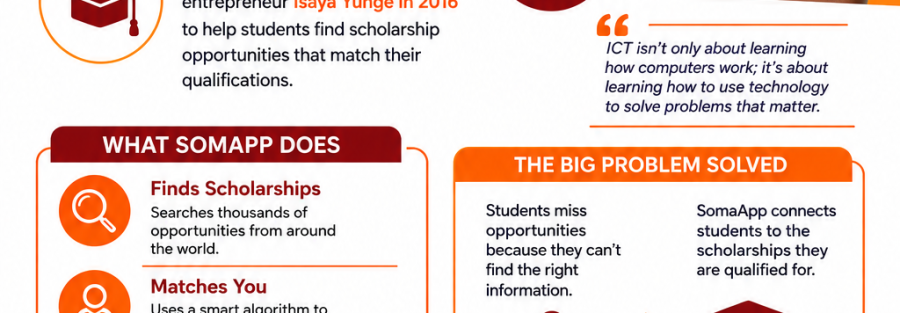
According to Ashoka, Isaya created SomaApp in 2016 after observing the difficulties students experienced while searching for scholarship opportunities. The platform used an automated algorithm to search and tailor scholarship results to individual students, while also providing tools such as sample essays and application guidance. The story provides an important lesson for students at the Institute of Advanced Technology (IAT): ICT isn’t only about learning how computers work; it’s about learning how to use technology to solve problems that matter.
Who Is Isaya Yunge?
Isaya Yunge is a Tanzanian social entrepreneur whose work has focused on increasing access to higher education for students from lower-income backgrounds. His work with SomaApp earned him recognition as an Ashoka Fellow in 2019, with Ashoka describing his innovation as an effort to open education-funding resources to African students who might otherwise struggle to access advanced education.
Isaya’s personal journey makes the story even more compelling. Ashoka’s profile explains that he grew up in Mwanza and experienced significant challenges during childhood, including periods without access to education and time living on the streets. Despite these circumstances, he viewed education as a pathway toward a better future and eventually became involved in initiatives supporting other young people. His experience demonstrates something important for an ICT student: your starting point doesn’t determine the size of the problem you can eventually solve.
How The Idea for SomaApp Started
The idea for SomaApp developed from Isaya’s own experience at university. He became interested in international scholarships and began collecting information about opportunities before sharing them with other students through WhatsApp groups. Through that experience, he discovered that many students were frustrated by the difficulty of finding appropriate scholarships and navigating the application process.
This is where an ordinary observation became a technology opportunity. Instead of simply continuing to send scholarship information manually, Isaya considered whether technology could automate the process. Could an application collect scholarship information, understand a student’s qualifications and identify opportunities that appeared relevant? That question eventually became the foundation for SomaApp.
For an ICT student, this is a powerful example of the problem-solving process in technology. You observe a problem, investigate why it exists, think about possible solutions, determine whether technology can help and then develop a system around the solution.
What Problem Does SomaApp Solve?
The central challenge SomaApp sought to address was the information gap surrounding scholarships. Students could have the academic ability to pursue higher education but still miss opportunities because they didn’t know where to find relevant scholarships or didn’t understand which ones suited their circumstances. Meanwhile, scholarship providers could have funding available but struggle to attract suitable applicants.
SomaApp attempted to bring these two sides closer together. Students could provide information about their academic qualifications and receive scholarship opportunities that matched their profiles. Contemporary reporting by The Citizen described the application as allowing students to enter their academic qualifications before the SomaApp search engine generated scholarships for which they qualified.
This is an excellent example of information technology as a bridge. The technology doesn’t necessarily create the scholarship itself; instead, it makes information about the opportunity easier to discover and connects the right people with the right information.
How The SomaApp Matching Algorithm Works
One of the most interesting aspects of SomaApp is its matching algorithm. Ashoka describes the platform as having an algorithm that automated scholarship searches and produced results tailored to individual students, particularly opportunities where they had a strong chance of winning.
Think about what has to happen behind such a system. A scholarship might have requirements concerning academic qualifications, nationality, field of study, education level or other eligibility criteria. A student also has a set of characteristics and qualifications. The software can then compare the two sets of information and identify potential matches.
This is where algorithms and programming become practical. When you learn programming, you’re not merely learning how to write lines of code. You’re learning how to give a computer logical instruction for solving problems. An application such as SomaApp demonstrates how those concepts can eventually become useful features that affect thousands of users.
Databases: The Information Behind the Application
A scholarship-matching platform needs data. Scholarship opportunities need to be recorded, updated and retrieved, while student profiles need to be stored and processed. The system also needs information about eligibility criteria, deadlines, fields of study and other characteristics that can help determine whether an opportunity is relevant.
This is where database management becomes essential. A developer might need to design structures for students, scholarships, eligibility criteria and applications. The matching system can then retrieve information from the database and apply its logic to identify relevant opportunities.
This is one reason database skills are valuable for ICT students at IAT. Technologies such as PostgreSQL, Oracle Database and MongoDB teach different approaches to managing digital information. Once you understand databases, you begin to see that almost every modern application depends on well-organised data.
Mobile Application Development
SomaApp was designed as a mobile phone and web application, making it accessible through technologies that students were increasingly using to access information. Ashoka describes the platform as a mobile and web application that gathers scholarship information, presents it in an accessible format and matches students with appropriate opportunities.
For an ICT student, this demonstrates the importance of mobile application development. You can learn how to design user interfaces, write application logic, connect an application to backend services and work with databases and APIs. These skills can eventually be used to develop applications for education, healthcare, banking, agriculture, transportation, retail and many other sectors.
The key lesson isn’t that every ICT student should build a scholarship application. Instead, it is that mobile technology gives you a platform through which your ideas can reach real users.
Web Technology and Accessibility
The web component of SomaApp also illustrates the importance of web technologies. A web application can allow users to access information through a browser without necessarily installing a dedicated application.
Developers working on such systems need to understand concepts such as HTML, CSS, JavaScript, backend programming, databases, APIs, authentication and responsive design. At IAT, students can explore technology pathways covering ICT and related areas that provide foundations for developing digital solutions.
When you learn web development, don’t limit your thinking to creating attractive pages. Think about the systems behind those pages. A website can become a platform for searching information, submitting applications, processing payments, analyzing data or connecting people.
Automation Makes Technology More Powerful
SomaApp’s automated scholarship-search process is another important lesson. Instead of requiring students to manually search through numerous websites, the system was designed to automate parts of the process. Ashoka specifically describes the search and matching process as automated.
Automation is one of the fundamental strengths of computing. Computers can process large amounts of information and perform repetitive tasks much faster than people can when the rules and data are properly structured.
As an ICT student, start looking for repetitive processes around you. Could a school automate student registration? Could a business automate inventory management? Could an organization automate reporting? Could a college automate appointment scheduling? These questions can lead to software projects that demonstrate your ability to apply technology rather than simply describe it.
Application Support Was Part of the Solution
SomaApp wasn’t focused only on helping students discover scholarships. According to Ashoka, Isaya also incorporated tools that helped students prepare stronger applications, including sample essays from successful applicants and guidelines for writing scholarship applications.
This is an important lesson in user-centred technology design. A student doesn’t necessarily solve their problem simply by discovering a scholarship. They may also need help understanding eligibility requirements, preparing an application and presenting their qualifications effectively.
When you’re designing software, therefore, think about the entire user journey. Ask yourself what happens before the user opens the application, what they need while using it and what they need after completing the primary task. The best digital products often solve a complete problem, not just one small part of it.
Data Analytics And Personalization
SomaApp’s matching process also demonstrates why data analytics is becoming increasingly important. When an application collects information about students and scholarship opportunities, that information can potentially be analyzed to improve matching and understand user behaviour.
For example, developers could potentially examine which types of scholarships attract the most interest, which categories have few applicants or where students abandon the application process. Such insights can help improve a digital platform.
This is where data analytics and ICT intersect. At IAT, students can explore Data Analysis and other technology programmes that provide skills for working with data. Data isn’t valuable simply because it exists; its value comes from the ability to transform it into useful information and decisions.
Artificial Intelligence and the Current SOMAPP Ecosystem
The current SOMAPP Foundation has expanded its digital-access mission beyond the original scholarship-matching concept. Its website describes programmes covering digital skills, women’s empowerment, agriculture, digital access, online safety and scholarships.
Its current scholarship programme describes an AI-powered SOMAPP EduTech app that provides scholarship matching, CV and essay assistance, mentorship and career support. The organization’s programme page describes a process in which students create profiles, receive scholarship matches, shortlist opportunities and receive AI-assisted support for CVs and essays.
This is an important development for ICT students because it shows how technology products can evolve. A system that initially focused on automated scholarship discovery can develop into a broader digital ecosystem as artificial intelligence and other technologies become more accessible.
Don’t Assume the Technology Stack
There is an important lesson here for anyone writing about technology. Public sources explain what SomaApp does, but they don’t provide a complete technical specification showing every programming language, framework, database or AI model used to build it.
Therefore, you shouldn’t automatically claim that SomaApp uses a particular framework simply because that framework is popular. What we can establish from credible sources is that the platform used an automated matching algorithm and mobile/web technology, while the current SOMAPP Foundation describes AI-powered scholarship services.
For an ICT student, this distinction matters. Good technology professionals separate verified information from assumptions. Learning to research, test and verify information is just as important as learning to code.
SomaApp’s Reported Impact
The historical impact reported for SomaApp is significant. Ashoka says that during the first twelve months after launch, 1,000 Tanzanian students connected to short-course, full-study and conference scholarships through the platform. It further reports that by the end of 2018, 15,000 students in Tanzania, Zambia, Rwanda, Nigeria and South Africa had used the application to win a total of $850,000 in scholarships.
The Citizen independently reported in early 2019 that SomaApp had been used by students in several African countries and described Isaya Yunge as its founder and chief executive. The report said the application enabled students to enter their academic qualifications and receive matched scholarship opportunities.
These historical figures should be understood as reported figures from the respective periods, rather than assuming they represent the platform’s current user or impact numbers.
SomaApp And the Wider African Technology Ecosystem
SomaApp’s story also demonstrates the potential of Africa’s technology ecosystem. Isaya’s work was not isolated from other technology communities. For example, a team involving Somaapps won first place at the 2017 GSMA Mobile Money Hackathon in Dar es Salaam with a solution called RuPesa. GSMA said the winning team demonstrated effective use of a mobile money API and strong teamwork.
This provides another lesson for ICT students: don’t learn in isolation. Hackathons, technology communities, innovation challenges and collaborative projects can expose you to new ideas and people who possess different technical skills.
A programmer may work with a designer. A data analyst may work with a business student. A cybersecurity student may work with a software developer. Technology innovation frequently happens when different skills come together.
What SomaApp Can Teach an IAT ICT Student
The first lesson is identify problems before choosing technologies. Don’t begin by asking, “Which programming language should I learn?” Begin by asking, “Which problem do I want to solve?” Once you understand the problem, you can determine which technologies are appropriate.
The second lesson is to learn multiple layers of technology. A product such as SomaApp involves more than a user interface. Behind the interface are algorithms, databases, application logic, networking, data and potentially AI. You don’t need to master everything at once, but understanding how these areas connect will make you a stronger ICT professional.
The third lesson is to build projects while you’re studying. Don’t wait until you’ve completed your course before creating something. Build a small application that solves a problem for fellow students, a local business, a community organization or even yourself.
The fourth lesson is to listen to users. A technology solution is only useful when people can actually use it. Ask potential users what frustrates them, what they currently do to solve the problem and what they would consider a better experience.
From Classroom Knowledge to Real Products
At IAT, an ICT student can develop skills across several technology areas that connect with the lessons demonstrated by SomaApp. The institution’s ICT programme provides a foundation across areas including software applications, hardware, networking, databases, cybersecurity and emerging technologies.
You can then specialize according to your interests. If you’re interested in building applications, explore programming and software development. If you’re interested in how information is stored and processed, explore databases and data analytics. If you’re fascinated by intelligent systems, explore Artificial Intelligence. If you’re interested in protecting digital platforms, explore cybersecurity.
The important thing is to connect every skill to a practical problem.
Your First App Could Start Small
You don’t have to build the next SomaApp immediately. Start with a small project that demonstrates your understanding of a problem.
For example, you could build a simple scholarship deadline tracker that allows students to enter opportunities and receive reminders. You could later add a database, user accounts, search functionality and eventually a matching algorithm. As your ICT skills improve, you could add analytics, APIs and AI-powered features.
That progression is important because it teaches you how complex systems are constructed from smaller components. A sophisticated application isn’t necessarily one giant piece of technology; it is usually a collection of smaller systems working together.
Technology Entrepreneurship Starts with Curiosity
Isaya Yunge’s story also demonstrates the importance of curiosity. He didn’t simply accept the difficulty students faced while searching for scholarships. He investigated the problem; shared information manually and eventually saw an opportunity to use technology to make the process easier.
You can develop the same mindset. When you encounter an inefficient process, don’t immediately accept it as normal. Ask why it works that way and whether technology could improve it.
That doesn’t mean every problem requires an app. Sometimes the best solution might be a database, website, dashboard, automation workflow or improved digital process. The role of an ICT professional is to understand the problem and select the appropriate technology.
Build For Kenya and Africa
One of the most inspiring aspects of SomaApp is that it addressed a problem within the African education environment. It wasn’t simply a technology demonstration; it was designed around the realities faced by African students.
This should encourage Kenyan ICT students to look around their own communities. Kenya has challenges in education, healthcare, agriculture, financial services, transportation, logistics, retail, public services and many other areas. Each challenge can potentially inspire a technology solution.
You don’t need to copy an application created somewhere else. You can ask what is unique about your community and build something specifically for it.
What Should You Learn At IAT?
If SomaApp’s story interests you, start developing a strong foundation in programming, databases, web and mobile development, networking and data. From there, you can explore AI, cloud computing, cybersecurity and other emerging technologies.
IAT provides opportunities to explore different technology pathways, including ICT, AI, Data Analysis, PostgreSQL, Oracle Database and MongoDB. These areas can help you develop the technical foundation needed to understand and eventually build modern digital platforms.
The goal isn’t to collect as many technologies as possible. The goal is to become capable of using technology to create value.
Learning Point: SomaApp Shows What ICT Can Achieve
SomaApp is a powerful example of how an African technology idea can emerge from a real social problem. Isaya Yunge identified the difficulty students faced in finding scholarship opportunities and developed a mobile and web application that used automated matching to connect students with relevant funding opportunities. The platform also provided application-support resources, while the current SOMAPP ecosystem has expanded into AI-powered scholarship and digital-opportunity initiatives.
For an ICT student at IAT, the most important lesson isn’t simply to learn how SomaApp works. It is to develop the mindset behind it. Observe problems. Learn technology. Build solutions. Test them. Improve them.
Your programming assignment could become a prototype. Your database project could become a useful information system. Your AI experiment could become a real product. Your final-year project could eventually become a business.
Your Idea Could Be the Next African Technology Story
The journey of SomaApp shows that technology can make information more accessible and connect people with opportunities that might otherwise remain hidden. It also demonstrates that African innovators can build technology around African problems and create solutions with relevance beyond their immediate communities.
As an ICT student at IAT, don’t limit your ambition to earning a certificate, diploma or degree. Those qualifications are important, but they should be a foundation for what you can do with technology.Start asking yourself: What problem around me needs solving? What technology could help solve it? What do I need to learn to build the solution?The next great African application doesn’t have to come from a multinational technology company. It could begin with an ICT student sitting in a classroom at IAT today.
Start Your ICT Journey With IAT
Explore IAT’s ICT programmes and discover opportunities to develop skills in programming, databases, networking, cybersecurity, data and emerging technologies. Visit www.iat.ac.ke to explore the programmes available and start turning your interest in technology into practical skills.
Learn. Build. Innovate. Solve.
About the Blog Writer
Dennis Njeru is an experienced business and technology professional with over 10 years of experience spanning ICT, business management, finance, HR, digital marketing and operations. His interests include artificial intelligence, programming, data analytics, cybersecurity, digital transformation and emerging technologies. Through his writing, Dennis simplifies complex technology and business concepts while helping students and professionals understand emerging trends, develop relevant skills and make informed education and career decisions.