
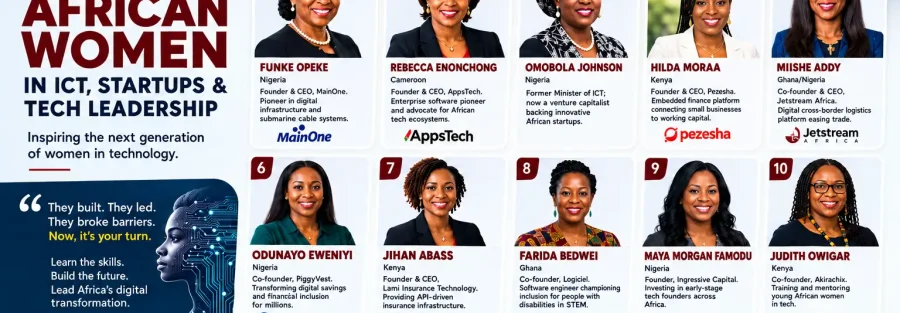
Article Description: Discover 10 inspiring African women who are transforming ICT, fintech, software, digital infrastructure and startups, and learn how their journeys can inspire more Kenyan women to study ICT courses at IAT.
Imagine a young Kenyan girl sitting in a classroom wondering whether technology is really a career for her, while somewhere else in Africa a woman is building a company that connects businesses to finance, another is transforming internet infrastructure and another is helping thousands of young women discover the power of technology. The important question isn’t whether African women can succeed in ICT because history has already answered that question with a resounding yes! The more important question is whether the next generation of African girls will see themselves as programmers, software engineers, cybersecurity specialists, data analysts, artificial intelligence professionals, technology entrepreneurs and technology executives. If you’re a young woman in Kenya considering an ICT course, the stories of these remarkable African women should remind you that technology isn’t a man’s field because there is already an African generation of women proving that women can build, lead, invest in and transform the digital economy.
Why African Women in ICT Matter
Africa’s technology story is no longer being written only by multinational companies or governments because African entrepreneurs are increasingly creating solutions designed around African problems. From financial inclusion and logistics to software development, broadband infrastructure and digital education, technology is being used to solve challenges that affect millions of people across the continent. This creates an enormous opportunity for young women who are willing to acquire practical digital skills and turn those skills into careers, businesses and innovations.
The above considerations are particularly important when telling stories about women in technology because the objective isn’t simply to list successful names but to help you see the possibilities that exist beyond the examples. When you read about an African woman who started with an idea, encountered difficult circumstances and eventually built something significant, you should begin asking yourself what technology problem you could solve with the right skills.
The African technology ecosystem is also becoming increasingly diverse because women are participating as founders, engineers, investors, policymakers, educators, executives and ecosystem builders. Their contributions demonstrate that studying ICT doesn’t mean you must spend your entire career writing computer code because technology opens doors into business, finance, management, entrepreneurship, consulting, data, cybersecurity, artificial intelligence, digital marketing and many other fields. The Institute of Advanced Technology (IAT) reflects this broad understanding of technology through training in areas including software engineering, programming, web development, data science, machine learning, Python, networking, databases, cybersecurity, artificial intelligence and data analysis.
1.Funke Opeke: Building Africa’s Digital Infrastructure
If you’ve ever wondered whether a woman can build the infrastructure that supports an entire digital economy, the story of Nigerian technology entrepreneur Funke Opeke provides a powerful answer. Opeke founded MainOne and became one of the most recognizable women in Africa’s digital infrastructure industry by helping expand connectivity through submarine cable and data-centre infrastructure. Her journey is especially inspiring because infrastructure isn’t always the most visible part of technology, yet reliable connectivity is essential for businesses, cloud services, digital platforms, remote work and online education.
MainOne’s story became even more significant when Equinix announced its intention to acquire MainOne and its assets in a transaction valued at US$320 million. Equinix stated that Opeke and the management team would continue serving in their respective roles under the transaction, highlighting the scale of the company she had helped build. For a young Kenyan woman, Opeke’s journey offers an important lesson because ICT careers can take you far beyond ordinary office computer work into telecommunications, networking, cloud infrastructure, data centres and large-scale digital transformation.
If you’re fascinated by how the internet works, you don’t have to stop at using websites and mobile applications because you can learn how networks are designed, secured and maintained. Training in areas such as networking, cybersecurity, cloud computing and databases can provide a foundation for participating in the infrastructure behind Africa’s digital transformation. At IAT, programmes such as CCNA, CCNP, cybersecurity, database technologies, cloud-related certifications and other technology courses provide pathways for learners who want to develop practical ICT capabilities.
2.Rebecca Enonchong: Turning Software into a Global Business
Cameroonian technology entrepreneur Rebecca Enonchong is another powerful example of what African women can accomplish through software and enterprise technology. She founded AppsTech in 1999, building a company focused on enterprise applications and technology solutions, and her journey demonstrates that an African woman doesn’t need to wait for permission from the global technology industry before creating a technology company. Her career also illustrates how technical knowledge can be combined with entrepreneurship, leadership and international business.
Enonchong’s journey wasn’t simply a smooth path to success because expanding a technology business across different markets brought its own difficulties. Available biographical accounts note that some AppsTech subsidiaries eventually closed, demonstrating an important reality about entrepreneurship that is sometimes hidden behind successful headlines. For a young woman considering ICT, that lesson is extremely important because failure, experimentation and changing direction can be part of building a successful technology career rather than evidence that you don’t belong in the industry.
Software development can therefore become much more than a technical skill because it can become the foundation for entrepreneurship. Once you understand programming, databases, web development and software engineering, you can build applications that address problems in education, healthcare, finance, agriculture, transportation and commerce. IAT offers training pathways including software engineering, computer programming, web design and development, Python programming, Java, C++, C#, databases and other technology areas that can help learners develop foundations for this type of digital career.
3.Hilda Moraa: Using Fintech to Expand Financial Inclusion
Kenya’s own Hilda Moraa provides another powerful example of how technology can be combined with entrepreneurship to solve real economic problems. Moraa is the founder and CEO of Pezesha, a digital financial infrastructure company focused on supporting access to working capital and credit scoring for small and medium-sized enterprises across Africa. Her story is particularly relevant to Kenyan women because it shows how technology can emerge from understanding a problem affecting ordinary businesses and then developing a scalable digital solution around it.
Before Pezesha, Moraa had already built experience in technology and entrepreneurship, including founding Weza Tele, a startup focused on innovations for last-mile businesses. Her first technology startup achieved what CGAP describes as Kenya’s first multi-million-dollar technology exit in 2015, providing an important example of how an entrepreneur can build, learn and then use that experience to create something bigger. Google has also highlighted Moraa’s discipline and entrepreneurial journey through Pezesha, noting the company’s participation in Google startup programmes and its growth journey.
Moraa’s story should make you think differently about what an ICT career can look like because you don’t necessarily have to choose between technology and business. You can study technology and later use those skills to build fintech platforms, digital banking solutions, payment systems, data products or financial applications. At IAT, programmes in ICT, data analysis, artificial intelligence, programming, databases and other technology areas can help you develop the technical foundation needed to understand and participate in such industries.
4.Miishe Addy: Digitising Africa’s Logistics
Ghanaian entrepreneur Miishe Addy demonstrates another important dimension of technology entrepreneurship because she has applied digital technology to one of Africa’s major economic challenges, moving goods across borders. Addy is the co-founder and CEO of Jetstream Africa, a technology company focused on simplifying cross-border logistics and trade. Her journey shows that technology isn’t limited to social media, mobile applications or websites because it can transform traditional industries such as shipping, customs, logistics and international commerce.
Before Jetstream, Addy had already experimented with entrepreneurship through Skilltapp, a startup that connected people needing assistance with independent contractors. One of the lessons from that earlier experience was that she initially didn’t think about venture capital while building the company, but by the time she started Jetstream she had a better understanding of fundraising and entrepreneurship. Jetstream later raised US$13 million in pre-Series A equity and debt funding, showing how the combination of technology, market knowledge and entrepreneurial execution can attract significant investment.
For a Kenyan woman interested in ICT, Addy’s story offers a valuable lesson about the importance of looking beyond traditional technology jobs. You could use software development, data analytics, artificial intelligence or digital systems to transform agriculture, transport, logistics, manufacturing or retail. The skills you gain from an ICT course can therefore become tools for solving problems in almost any sector rather than restricting you to a single profession.
5.Odunayo Eweniyi: Making Financial Technology Accessible
Nigeria’s Odunayo Eweniyi demonstrates how a simple everyday problem can become the foundation for a powerful technology platform. Eweniyi is the co-founder and COO of PiggyVest, a digital savings and investment platform that has helped transform how many Nigerians think about saving and managing money. Her personal website identifies her as a founder, investor and operator while also highlighting her role as PiggyVest co-founder and COO and her involvement in FirstCheck Africa.
The origins of PiggyVest are particularly interesting because the idea was connected to the traditional practice of saving money in a physical kolo, or savings box. WIRED reported that Eweniyi joined Joshua Chibueze and Somto Ifezue in developing the concept into a digital platform that allowed users to automate savings using their phones. This is an excellent example of African innovation because the technology didn’t necessarily require abandoning African practices but instead used technology to redesign a familiar idea for a digital generation.
Eweniyi’s journey is important for women studying ICT because it demonstrates that technical innovation can emerge from understanding people’s behaviour. You don’t have to invent a completely new human need before you can build a technology business because sometimes the biggest opportunities come from improving something people already do. If you learn programming, data analysis, digital product development, user experience or other ICT skills, you can begin identifying everyday problems that technology could solve.
6.Jihan Abass: Transforming Insurance Through Technology
Kenyan entrepreneur Jihan Abass has also demonstrated how technology can transform traditional financial services. She founded Lami Technologies, a company built around digital insurance infrastructure and technology-enabled insurance distribution. Her journey is significant because insurance has historically been viewed as a complicated and highly traditional industry, yet technology can make insurance products easier to access, distribute and integrate into other digital platforms.
The significance of this type of innovation goes beyond creating an application because modern fintech increasingly depends on APIs, data, automation and digital infrastructure. This means that someone interested in insurance doesn’t necessarily have to follow a traditional insurance career path because ICT skills can position you at the intersection of technology and financial services. A young Kenyan woman could therefore study programming, data science, cybersecurity or software engineering and later work in fintech, insurtech or digital banking.
The lesson from Abass is that technology creates opportunities in industries that may initially appear unrelated to ICT. When you combine sector knowledge with technical skills, you can become the person who understands both the problem and the technology needed to solve it. This is one reason choosing an ICT course can give you flexibility because the skills can be transferred into finance, healthcare, education, agriculture, government, retail and entrepreneurship.
7.Farida Bedwei: Software Engineering And Inclusive Innovation
Ghanaian software engineer Farida Bedwei is another inspiring figure because her career demonstrates the power of technical expertise. Bedwei is a software engineer and co-founder of Logiciel, a Ghanaian fintech company, and she has worked extensively with mobile and enterprise applications as well as software architecture and banking technology. Her story also stands as an important reminder that personal circumstances don’t have to determine the limits of your ambitions.
For young women entering technology, Bedwei’s career demonstrates why technical competence matters. Understanding software architecture, programming and digital systems can enable you to participate in building the infrastructure behind financial services and other industries. Instead of seeing coding as something reserved for a particular type of person, you can see it as a language that allows you to turn ideas into functioning digital products.
Her example should also encourage African technology institutions to make ICT education accessible to diverse learners. When more women gain access to technology training, the industry benefits from a wider range of experiences, ideas and problem-solving approaches. IAT’s emphasis on practical, industry-relevant ICT training can provide a starting point for Kenyan learners who want to develop technical skills and explore the possibilities of technology careers.
8.Judith Owigar: Creating Pathways For More African Women In Technology
Some technology leaders don’t only build companies because they build communities that help other people enter the technology industry. Kenyan technology entrepreneur Judith Owigar is a strong example because she is a co-founder and president of AkiraChix, an organisation created to promote technology among African women through training, mentorship and networking. Kenya Yearbook describes Owigar as a technology entrepreneur and notes her background in Computer Science and Applied Computing.
Her work is particularly inspiring because she has focused on increasing the number of women who participate in technology rather than simply pursuing her own career. Her journey demonstrates that leadership can involve creating opportunities for others to discover their abilities. When one woman learns technology and then mentors another woman, the impact can multiply across families, workplaces, communities and eventually entire economies.
For a Kenyan girl thinking about ICT, this is an important message because your career doesn’t have to end with getting a job. You could eventually become a trainer, mentor, founder, investor or community leader who helps other women enter technology. Studying ICT at an institution such as IAT can therefore be the first step in a much larger journey where your technical knowledge eventually becomes a tool for empowering other people.
9.Maya Horgan Famodu: Investing In Africa’s Technology Founders
Not every technology leader has to build software directly because some create impact by investing in people who build technology companies. Nigerian-American investor Maya Horgan Famodu founded Ingressive Capital, a venture capital firm focused on early-stage startups in Sub-Saharan Africa. Forbes reported that Ingressive Capital was created as a US$10 million venture capital firm targeting early-stage startups across key African technology markets and that it invested in companies including Paystack.
Famodu’s journey highlights an important career possibility that many young women may overlook. Technology can lead not only to engineering and programming but also to venture capital, investment analysis, startup acceleration, entrepreneurship and technology strategy. If you combine ICT knowledge with finance, business and analytical skills, you can eventually become someone who evaluates technology businesses and helps promising founders access resources.
Her philosophy also reinforces the importance of execution because having an idea isn’t enough to build a successful company. Ingressive Capital has highlighted Famodu’s view that ideas and execution are different things and that building a strong company requires learning, experience and implementation. For a student, that means you shouldn’t wait for the perfect idea before starting to develop your skills because learning to build, test, improve and solve problems is itself part of becoming an entrepreneur.
10.Omobola Johnson: Technology Leadership Beyond Entrepreneurship
Dr Omobola Johnson represents another pathway into technology because her career combines engineering, management, public policy, leadership and venture capital. She served as Nigeria’s Minister of Communication Technology from 2011 to 2015, where she focused on the country’s National Broadband Plan and initiatives designed to support the technology ecosystem. She later became a Senior Partner at TLcom Capital, where she participates in investing in technology companies across Sub-Saharan Africa.
Johnson’s education and professional journey also demonstrate the value of combining technical and leadership capabilities. She holds a bachelor’s degree in Electrical and Electronic Engineering, a master’s degree in Digital Electronics and a doctorate in Business Administration, while her professional career included more than two decades of consulting experience. Her career therefore demonstrates that studying technology doesn’t mean you have to remain in a technical role forever because technology knowledge can become a foundation for management, policy, investment and executive leadership.
For Kenyan women, Johnson’s journey offers a powerful reminder that the technology industry needs leaders who understand both technology and institutions. Africa needs people who can design digital strategies, manage technology companies, develop public policy, invest in startups and create systems that make technology accessible. An ICT qualification can provide the technical foundation while additional experience in business, management and leadership can help you progress into influential decision-making roles.
What These Women Teach the Next Generation
When you put these stories together, an important pattern becomes visible because these women didn’t all follow the same career path. Funke Opeke built digital infrastructure, Rebecca Enonchong built enterprise software, Hilda Moraa developed fintech solutions and Miishe Addy transformed logistics through technology. Odunayo Eweniyi worked in digital finance, Judith Owigar built a community for women in technology, Maya Horgan Famodu invested in African startups and Omobola Johnson combined engineering, government leadership and venture capital.
Their differences are actually what make their stories so powerful. There isn’t one correct way to become a technology leader because ICT is a broad ecosystem containing hundreds of different careers and specialisations. One woman might become a software engineer while another becomes a data analyst, cybersecurity specialist, cloud administrator, AI professional, product manager, technology entrepreneur or technology investor.
This is why young women should stop asking whether ICT is suitable for them and instead ask which part of ICT matches their interests. If you love numbers, data analysis and problem-solving could be an exciting direction, while someone who enjoys building things might prefer programming or software engineering. If you enjoy protecting systems, cybersecurity could be attractive, while someone interested in creativity could explore UI/UX design, digital media or web development.
Why Kenya Needs More Women In ICT
Kenya has already developed a strong technology ecosystem, but the country’s digital future will require participation from people with different experiences and perspectives. Women represent an enormous pool of talent that can contribute to software development, cybersecurity, artificial intelligence, data science, digital finance, networking and technology entrepreneurship. The question isn’t whether women have a place in technology because women are already contributing, but whether enough young women are receiving the training and encouragement needed to participate at scale.
One of the biggest advantages of ICT is that the skills can travel across industries. A programmer can work in finance, a data analyst can work in healthcare, a cybersecurity specialist can work in government and a cloud professional can support businesses across different sectors. This flexibility means that learning technology can give you multiple opportunities rather than forcing you into a single career path.
IAT provides a broad range of technology training options that reflect this diversity, including ICT, software engineering, computer programming, web design and development, data science and machine learning, Python programming, networking, databases, cybersecurity and artificial intelligence. Its Certificate and Diploma in ICT under TVET-CDACC are designed around foundational technology competencies including networks, software applications, hardware, cybersecurity, databases and emerging technologies.
Your ICT Journey Can Start with One Decision
You don’t need to know today whether you will become the next Funke Opeke, Rebecca Enonchong or Hilda Moraa because successful careers are built step by step. You first need curiosity, then training, then practice, then experience and eventually the confidence to solve bigger problems. The woman who becomes a technology founder tomorrow may currently be a student who is simply deciding whether to enrol for her first ICT course.
The technology industry also rewards people who keep learning because technologies change rapidly. Artificial intelligence, cloud computing, cybersecurity, data science, software development and digital platforms continue to evolve, meaning your first course should be viewed as the beginning of your learning journey rather than the end. Institutions such as IAT provide multiple technology learning pathways, allowing learners to explore different areas and progressively develop their skills.
You should also remember that successful technology founders don’t start with everything they eventually need. They learn from mentors, work with teams, experiment with ideas, listen to customers, understand markets and continue improving their skills. The journey of Miishe Addy, for example, shows how experience from one startup can contribute to a later venture, while the stories of Hilda Moraa and Odunayo Eweniyi show how technology can be combined with a deep understanding of everyday financial challenges.
The Future of African Technology Needs You
Africa’s technology future will not be built only in Silicon Valley or by large multinational companies because African entrepreneurs are already creating solutions for African markets. From Nairobi and Lagos to Accra and other growing technology hubs, founders are demonstrating that local problems can become opportunities for globally relevant innovation. The next chapter of this story should include even more African women building companies, developing software, analysing data, securing networks, creating AI solutions and leading technology institutions.
If you’re a young woman in Kenya, you shouldn’t see the success of these women as something distant or impossible. Instead, see their stories as evidence that African women can build technology companies, lead teams, attract investment, influence policy and create solutions that affect millions of people. Your starting point may simply be choosing an ICT course, learning one programming language, completing your first project or discovering an area of technology that you genuinely enjoy.
At IAT, you can explore technology training options ranging from ICT and software engineering to programming, data science, machine learning, networking, databases, cybersecurity and artificial intelligence. The institution describes its approach as practical and focused on real-world applications while offering training centres in Nairobi, Buruburu and Mombasa, creating opportunities for learners who want to build relevant skills for the digital economy.
African Women Are Building The Future
The future of African technology needs more women.If these women have inspired you, don’t stop at reading their stories because your own technology journey could begin with a decision to learn. Explore the ICT courses at IAT and discover a pathway that can help you turn your curiosity about technology into practical skills, professional opportunities and perhaps one day your own technology venture. The next great African woman in ICT could be you, and the first step may simply be deciding to start.
About the Blog Writer
Dennis Njeru is a technology, ICT and digital transformation enthusiast with a strong interest in helping learners, professionals and aspiring entrepreneurs understand the opportunities created by technology. His work focuses on making complex technology and career topics accessible, practical and relevant to the African context, particularly for young people exploring careers in ICT and emerging technologies.
Through his writing and digital content, Dennis explores subjects including information and communication technology, software development, programming, artificial intelligence, data science, cybersecurity, networking, digital transformation, technology entrepreneurship and the future of work. He is particularly passionate about highlighting real-world technology stories and showcasing how digital skills can be transformed into meaningful careers, businesses and innovations.
Dennis is also interested in the role of technology education in empowering the next generation of African professionals. His approach is centred on connecting ICT education with practical career opportunities, encouraging learners to look beyond traditional perceptions of technology and discover the wide range of pathways available across software engineering, data, cybersecurity, artificial intelligence, cloud computing, digital business and technology leadership.
His interest in stories about African technology leaders reflects a broader belief that representation matters. By highlighting the achievements of African innovators, entrepreneurs and technology professionals, Dennis seeks to encourage more young people-particularly women and girls-to see themselves as future programmers, engineers, technology entrepreneurs, data professionals, cybersecurity specialists and digital leaders.
Through his work, Dennis aims to contribute to a more informed and digitally empowered generation that can use technology not only to build successful careers but also to solve African problems, create businesses and contribute to the continent’s digital transformation.