
Article Description: Considering a project management course in Kenya? Discover why Kenya’s demand for certified project professionals is growing at up to 63% by 2035 — and why employers are already treating this as one of the most expensive hires in the market.
Most organizations in Kenya already have someone doing project management. They just don’t call it that. An office manager coordinating a branch expansion, a marketing lead chasing approvals across five departments, an IT supervisor keeping a system migration from collapsing into chaos. All of them are managing projects. Few of them have the framework, the vocabulary, or the certification that would make an employer pay significantly more for the same work they’re already doing for free.
What Certification Actually Changes
The gap between managing projects informally and managing them as a certified professional isn’t about effort. It’s about proof. Corporate Staffing Services, one of Kenya’s largest recruitment firms, published a direct finding in November 2025: hiring managers are now choosing certified candidates first, because certification shows proof of competence rather than guesswork. Employers across construction, tech, NGOs, and finance are not just preferring certified project managers, they’re writing certification into job descriptions as a requirement rather than a preference.
Wanja Murekio, PMP, a senior programme manager at Safaricom in Nairobi, made this plain in an interview with The Exchange Africa. Recruitment firms had told her directly that project professionals have become “one of the more expensive hires because demand is so high.” That observation came from inside one of Kenya’s most significant employers, not from a training provider’s marketing material.
What Kenya’s Infrastructure Is Actually Demanding
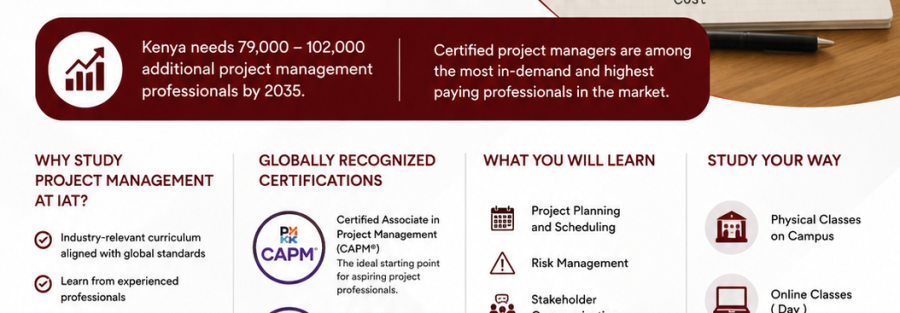
The numbers behind that demand are specific and sourced. According to a November 2025 report by the Standard, citing the Project Management Institute’s global workforce analysis, Kenya’s need for project management professionals is projected to grow between 48 and 63% by 2035, from around 150,000 professionals today to between 223,000 and 247,000. That’s an additional 79,000 to 102,000 roles the country needs to fill within a decade.
Capital Fm reported in March 2026, citing the same PMI research, that Sub-Saharan Africa faces a 57% talent gap in construction project professionals specifically, with demand rising from 260,000 in 2025 to over 410,000 by 2035. The Programme for Infrastructure Development in Africa, which includes over 400 priority projects in energy, transport, ICT, and water systems, has committed over $360 billion in funding to make that happen. PMI’s Sub-Saharan Africa Managing Director, George Asamani, was direct about the consequence of getting this wrong. “Without the right project management capabilities, we risk delays, cost overruns and lost value,” he told Capital Business. PMI’s own data shows approximately 10% of global project investment is lost every year due to poor performance, which in a region deploying hundreds of billions translates directly into infrastructure that stalls, budgets that collapse, and projects that consume resources without delivering outcomes.
What the Certification Itself Covers
Project management training isn’t one credential. It sits across a recognized framework. The entry point is the Certified Associate in Project Management, CAPM, which covers planning, execution, monitoring, and closing a project according to globally standardized methodologies including both traditional Waterfall and Agile approaches. The more advanced Project Management Professional, PMP, requires documented experience in addition to training, and carries salary premiums of 16% globally according to PMI’s own salary survey across 40 countries. Both credentials are the same ones employers in Kenya’s infrastructure, tech, and NGO sectors are now specifying in job advertisements.
The skills themselves, scheduling, stakeholder communication, risk management, resource allocation, and budget tracking, are not sector-specific. A certified project manager working in construction today is applying the same planning discipline as one managing a software rollout or coordinating a donor-funded health programme. That portability is exactly why Kenya’s employers across industries are all looking for the same qualification.
What This Looks Like in Practice
At the Institute for Advanced Technology, the Project Management programme is available with ongoing intake, and can be studied physically, online during the day, in the evening, or through private arrangement. Before enrolling, review the admission requirements directly. If project management is where you’re headed but you’re working in a tech environment specifically, pairing this with Software Engineering or ITIL, which covers IT service management frameworks, gives you the combination that technology employers in Kenya increasingly look for in a single candidate.
Project Management: Kenya’s Most Expensive Hire
The argument this blog started with is worth restating plainly at the close. Kenya already has people doing project management work. The 79,000 to 102,000 additional professionals the country needs by 2035 aren’t going to appear from nowhere. They’re going to come from people already inside organizations, already coordinating the work, who made the decision to formalize what they were doing informally. Certification is that formalization. It’s the difference between being the person who manages projects and the person employers compete to hire for that exact reason.
Call +254 725 040 588, email registrar@iat.ac.ke, or go directly to the Project Management programme page and start your online registration when you’re ready.
Blog Writer: James Gitonga