
Article Description: Considering a digital marketing course in Kenya? Discover what employers in Nairobi are actually hiring for — and why the gap between managing social media pages and understanding campaign strategy is the difference between KES 38,198 and KES 212,267 a year.
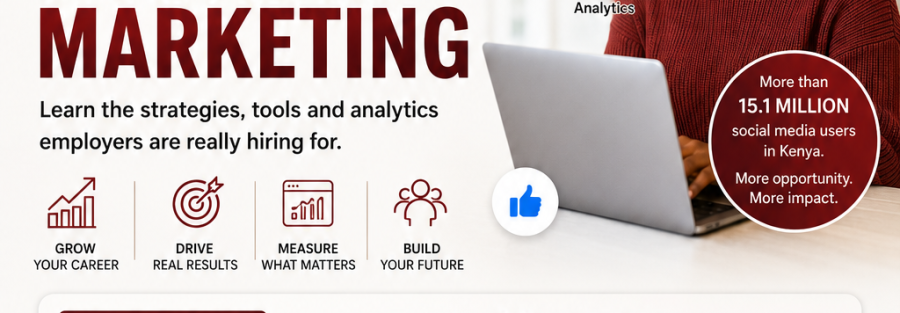
There are 15.1 million social media user identities in Kenya as of January 2025, according to DataReportal’s Digital 2025 Kenya report, growing at 15.9% year-on-year. That same audience spends an average of 3 hours and 43 minutes daily on social platforms — more than any other country in the world, according to GlobalWebIndex data from November 2024. Every one of those minutes is a business opportunity. The professionals who know how to convert that attention into revenue are not the same people who know how to post content. That distinction is exactly what employers are now paying to make.
What Employers Are Actually Hiring For
Corporate Staffing Services, one of Kenya’s largest recruitment firms, currently lists over 17 digital marketing vacancies in Nairobi spanning entry-level content roles through to senior campaign strategy positions. The spread across those listings reflects how differently the market values different levels of capability. OPPO Kenya’s recent Digital Marketing Manager advertisement specifically listed social media strategy and lead generation as core responsibilities. Simba Corp’s listing named content production, community engagement, and digital customer engagement performance metrics. BBC Africa’s Nairobi desk listed a senior role requiring the ability to shape how millions of people across the continent consume digital news.
None of those job descriptions are looking for someone who knows how to post. They’re looking for someone who knows what to measure, what to change, and why.
The Specific Skills Driving the Gap
Glassdoor’s July 2025 salary data, drawn from 41 salary submissions by Digital Marketing Specialists in Kenya, places the 25th percentile at KES 38,198 annually and the 90th percentile at KES 212,267 annually — both figures from the same dataset, the same country, the same job title. The jump between those two numbers corresponds almost exactly to the gap between someone who can run campaigns and someone who can prove they worked.
That proof requires specific tools. Google Analytics tells a client which pages convert and which ones lose people. Meta Ads Manager controls who sees paid content and at what cost per click. SEO tools determine whether a company’s website appears on the first page of Google when a potential customer searches for what they sell. Email marketing platforms like Mailchimp measure open rates, click rates, and which subject lines actually get read. These are not intuitive skills. They’re learnable ones, and they’re the specific competencies that separate a KES 38,198 hire from a KES 212,267 one.
What the Course Covers and Where It Leads
At the Institute for Advanced Technology, the Digital Marketing course runs for three months, with ongoing intake and the option to study physically or online, during the day, in the evening, or privately. The programme covers the specific tools and disciplines employers name in their job postings — SEO, paid advertising, content strategy, analytics, and campaign management. For those building toward a complete digital business skill set, this pairs naturally with Web Design and Development, since understanding how a site is built changes how effectively a marketer can optimize it, and with Data Science and Machine Learning for those who want to move into the analytics-heavy, higher-paid end of the field.
A note on fees: course pricing isn’t published in this article. Call or email the contacts below and ask directly — the team will give you an accurate figure for your specific study format and intake.
Before enrolling, review the admission requirements and check our campuses page for physical class locations.
Just Running Someone’s Instagram Is Not Full Digital Marketing
Kenya’s 15.1 million social media users represent an audience that took years to build. The businesses trying to reach that audience are not running short of content. They’re running short of people who can prove their content is working, adjust what isn’t, and allocate budget toward what converts. That skill doesn’t develop from posting daily. It develops from structured training in measurement, strategy, and the specific platforms employers are already paying to master. The gap between the two is not closing on its own — and the businesses that figure out which side of it their hire is on will always pay accordingly.
Call +254 725 040 588, email registrar@iat.ac.ke, or go directly to the Digital Marketing course page and begin your online registration.
Blog Writer: James Gitonga