
Article Description: Discover how to master accounting software in 5 simple steps. Learn to automate payroll, track invoices and generate financial reports. Enroll now in our hands-on course designed for SMEs.
Have you ever stayed up late at night worrying about whether your business books are accurate? Maybe you are still relying on manual ledgers, or perhaps your Excel sheets have become so messy that you no longer trust the numbers staring back at you. The truth is that many small and medium-sized business owners find themselves in this exact situation. They know they need to get their finances in order, but the thought of learning complex accounting software can feel overwhelming. It does not have to be that way. You can take full control of your business finances, and you do not even need an accounting degree to do it.
The modern business environment demands efficiency, accuracy and real-time visibility into your financial health. If you are still doing things the old-fashioned way, you are not just making life harder for yourself; you are putting your business at a serious disadvantage. Your competitors are using technology to streamline their operations, reduce errors and make faster, smarter decisions. The good news is that you can do the same. With a structured, hands-on approach, you can master accounting software in five major steps, transforming the way you manage your SME.
This article will walk you through the five essential steps to mastering accounting software, from setting up your general ledger to generating powerful financial reports. By the end of this read, you will understand exactly what it takes to computerize your business finances, and you will be ready to take the next step toward financial mastery. Are you ready to stop chasing payments and start making data-driven decisions? Let us begin this journey together.
Step One: Setting Up Your General Ledger and Chart of Accounts
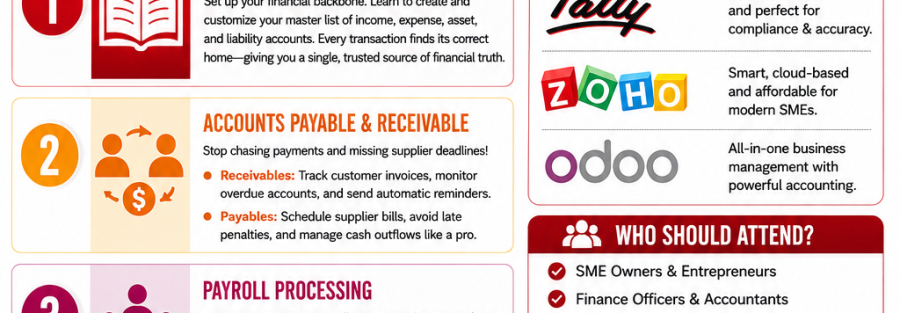
The very first step in mastering any accounting software is establishing the financial backbone of your business. This is known as the general ledger and chart of accounts. Think of it as the master list that categorizes every single transaction your business will ever make. Without a properly set up chart of accounts, your financial data will be chaotic and unreliable, making it impossible to generate meaningful reports.
In this foundational step, you will learn to create and customize your master list of income, expense, asset and liability accounts. This might sound technical, but it is simply about organizing your finances into clear, logical categories. For example, you will have separate accounts for sales revenue, office supplies, rent, bank accounts and loans. When you record a transaction, it is assigned to the correct account, ensuring that every dollar finds its proper home.
The beauty of a well-structured general ledger is that it provides you with a single, trusted source of financial truth. You will no longer have to dig through piles of receipts or guess where your money went. The software will automatically organize everything for you, giving you a clear and accurate picture of your financial position at any given moment. This is the foundation upon which all your other accounting activities will be built, so getting it right is crucial.
Once your chart of accounts is set up, you have created a system that will grow with your business. You can easily add new accounts as you expand into new product lines or services. This initial setup might take a little time, but it is an investment that will save you countless hours of frustration in the long run. A solid general ledger is the first step toward financial clarity and control. To learn more about the fundamentals, you can explore this comprehensive guide on what is a chart of accounts.
Step Two: Mastering Accounts Payable and Receivable
Once your general ledger is in place, it is time to tackle the lifeblood of your business: cash flow. This is where mastering your accounts payable and receivable becomes absolutely critical. Many businesses fail not because they are unprofitable, but because they run out of cash. They are unable to collect payments from customers on time, or they fail to manage their own payment schedules effectively.
The second major step in mastering accounting software is automating your accounts receivable processes. This means taking control of your customer invoices. You will learn how to track customer invoices, monitor overdue accounts and send automatic reminders to clients who have not yet paid. Instead of spending your valuable time chasing late payments, the software does the heavy lifting for you. It sends out professional reminders, helping you get paid faster and improving your cash flow. For more insights on managing receivables, check out this guide to accounts receivable management.
On the other side of the coin, you have accounts payable. This involves managing the bills you owe to your suppliers. By scheduling supplier bills in your accounting software, you can avoid late payment penalties and negotiate better terms with your vendors. You will know exactly when each bill is due and how much cash you need to set aside. This level of visibility allows you to manage your cash outflows like a true professional. You can read more about accounts payable best practices to deepen your understanding.
By mastering both accounts receivable and payable, you gain complete control over your cash flow. You stop chasing payments and missing supplier deadlines. Instead, you operate from a position of strength, knowing exactly when money is coming in and when it needs to go out. This is a game-changer for any SME owner.
Step Three: Automating Payroll Processing
For many business owners, payroll is one of the most dreaded tasks. It is time-consuming, complex and riddled with potential for costly errors. Calculating gross pay, deducting statutory contributions like PAYE, NSSF and NHIF, generating payslips and filing returns is a headache that no one enjoys. However, with the right accounting software, you can automate your entire payroll process in just minutes.
The third step on your journey to mastering accounting software is setting up and automating your payroll. You will learn how to set up employee profiles, define their compensation structures and let the software handle all the calculations. The software will automatically compute gross pay, deduct the correct statutory contributions and generate compliant payslips for all your employees. You no longer have to worry about making arithmetic mistakes or falling out of compliance with government regulations. For a deeper dive into payroll automation, visit this resource on payroll processing.
Beyond just calculating pay, the software can also help you file your statutory returns with a single click. This ensures that you stay compliant and avoid penalties. Imagine eliminating spreadsheet nightmares and the stress that comes with payroll processing. You will be able to run payroll accurately and efficiently, freeing up your time to focus on growing your business instead of wrestling with numbers.
This automation is not just about convenience; it is about accuracy and compliance. Your employees will appreciate receiving accurate payslips on time, and you will have the peace of mind that comes with knowing your payroll is always in order. Automating payroll is a powerful way to professionalize your operations and build trust with your team.
Step Four: Effortless Bank Reconciliation
Even with a great accounting system, there is always the risk of errors, omissions or even fraud. That is why bank reconciliation is such a vital process. It is the act of matching your accounting records with your bank statement to ensure they agree. If your books say you have ten thousand dollars but your bank says you have eight, you have a problem that needs to be investigated.
Step four in mastering accounting software is learning to perform effortless bank reconciliations. Modern accounting software makes this process incredibly simple. You can import live bank feeds directly into the system, which means your transactions automatically appear in the software. You can then reconcile these transactions in real time, ensuring that your accounting records always reflect exactly what is in your bank account. Learn more about bank reconciliation best practices to see how technology simplifies this task.
This process instantly catches errors and helps you identify potential fraud. Perhaps a payment was recorded twice, or maybe a check you issued has not yet cleared. The reconciliation process will highlight these discrepancies, allowing you to investigate and correct them before they become major problems. By staying on top of your bank reconciliation, you always have a clean and accurate picture of your cash position.
Gone are the days of waiting for your bank statement to arrive in the mail and spending hours manually ticking off transactions. With live bank feeds and real-time reconciliation, your accounting is always up to date. This gives you the confidence to make financial decisions based on the most current information available.
Step Five: Generating Financial Reports and Analytics
The final and most rewarding step in mastering accounting software is turning all your data into actionable insights. The ultimate goal of bookkeeping is not just to record transactions, but to understand what those transactions mean for your business. This is where financial reporting and analytics come into play.
Step five is all about generating powerful financial reports that help you make better business decisions. With a few clicks, you can generate Profit and Loss Statements, Balance Sheets and Cash Flow Reports. These reports provide a comprehensive overview of your financial performance, showing you exactly where your money is coming from and where it is going. For a detailed explanation of these reports, refer to this guide to financial statements.
Beyond the standard reports, modern accounting software offers powerful analytics features. You can track your business KPIs, spot spending trends and identify areas where you can cut costs or increase revenue. For example, you might notice that a particular product line is not as profitable as you thought, or that a certain marketing campaign is generating a strong return on investment. This kind of insight allows you to make confident, data-driven decisions instead of relying on guesses or gut feelings. Explore more about financial analytics for SMEs to unlock the full potential of your data.
By mastering financial reporting and analytics, you transform your role as a business owner. You move from being a reactive manager who is constantly putting out fires to a proactive leader who is steering the business toward strategic goals. Data becomes your most powerful tool for growth, innovation and long-term success.
Choosing the Right Software for Your SME
One of the most important decisions you will make is choosing the right software for your specific business needs. The good news is that you have excellent options. You can choose from powerful, easy-to-use software that is ideal for growing businesses. These platforms are designed to scale with you, offering robust features without being overly complex.
Alternatively, you might prefer reliable and robust software that is perfect for compliance and accuracy. These solutions are often favored by businesses in highly regulated industries where precision is paramount. For those who prefer cloud-based solutions, there are smart and affordable options that are ideal for modern SMEs. These platforms allow you to access your financial data from anywhere, collaborate with your team and integrate with other business apps.
You might also consider an all-in-one business management solution that combines powerful accounting with other functions like inventory management, customer relationship management and project management. The key is to choose software that matches your business size, industry and growth plans. With the right tool in hand, the five steps we have discussed become incredibly simple to execute. These are not just theoretical concepts; they are practical, actionable steps that you can take to revolutionize the way you run your business.
Who Should Attend This Course?
This course is designed for a wide range of professionals. If you are an SME owner or an entrepreneur, you will find immense value in taking control of your finances. You will no longer have to rely on guesswork or external accountants for basic financial insights. For finance officers and accountants, this course offers an opportunity to modernize your skill set and learn the latest software techniques that your employer will value.
Office administrators and bookkeepers will benefit from automating routine tasks and improving the accuracy of their work. You will learn to perform your duties faster and with less stress. Finally, if you are an aspiring finance professional, this course provides the practical, hands-on experience that employers are looking for. It is a fantastic way to build your resume and gain a competitive edge in the job market.
A Bonus You Cannot Ignore
What truly sets this course apart is the practical project you get to complete. You will not just be listening to lectures. You will be building and implementing a system for your own business. By the end of the training, you will walk away with a fully computerized bookkeeping system that is already set up and ready to use. You will have applied everything you learned to your own business, and you will leave with confidence and a real solution that solves your daily financial challenges.
This hands-on approach is the best way to learn because it ensures that you understand not just the theory, but also how to apply it in a real-world context. You will have the chance to ask questions about your specific business, and you will get the support you need to overcome any hurdles. The result is not just a certificate, but a working system that will transform your business operations from day one.
Take the Next Step
The journey to mastering accounting software is clearer and more achievable than you might have thought. By following these five major steps, you can set up your general ledger, manage your payables and receivables, automate payroll, reconcile your bank accounts and generate insightful financial reports. The technology is available, and the know-how is within reach.
Now is the time to stop struggling with manual ledgers and Excel sheets. It is time to embrace the digital tools that will empower you to take control of your business finances. The course I have outlined here is designed to give you the practical skills you need to succeed, with hands-on training in some of the industry’s leading software solutions.
You will have the opportunity to choose and master the platform that best suits your business, whether it is QuickBooks for its ease of use, Tally and Sage for their robustness and compliance features, Pastel for its tailored African market capabilities, Zoho for its smart cloud-based flexibility, or Odoo for its comprehensive all-in-one business management.
This is a hands-on, no-nonsense program that will equip you to handle your bookkeeping with confidence and professionalism, regardless of which software you choose. This is an investment in your business and in yourself. Are you ready to stop making guesses and start making data-driven decisions? Are you ready to free up your time from tedious bookkeeping and focus on what you do best: growing your business? Then it is time to take action. The knowledge and skills you gain will pay dividends for years to come. This is your opportunity to transform your financial management and build a stronger, more profitable business.
What Next?
Do not let this opportunity pass you by. Slots are limited, and demand is high. If you are ready to master accounting software and take full control of your SME finances, now is the time to enroll. Take the first step toward financial clarity, efficiency and peace of mind.
Contact the registrar today to secure your seat. For more information or to register, reach out via Phone or WhatsApp at 0723 819 257. You can also send an email to registrar@iat.ac.ke. Visit the website at www.iat.ac.ke for more details. The training takes place at Hazina Towers, 1st Floor, Nairobi.
Learn today, apply tomorrow and grow forever. Your journey to financial mastery starts now. Do not wait. Enroll today and take control of your business finances!
Course details: Accounting Software Course | Duration: Contact for details | Location: Hazina Towers, 1st Floor, Nairobi | Cost: Contact for details
Blog Writer: Dennis Njeru